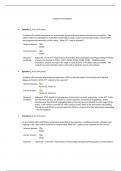
Chapter 2 2.1-1 Let us denote the signal in question by gjt) and its energy by E,. For parts (a) and (b) 4r 4r 4r (e) ~~-~~sin~rdr=f~~dt-~/~~s~~dt=n+O=~ 2 n (d) E. = 1 (lsin t12 dt = 4 [i 12" dt - ; 1. cos 2 dt] = Iln + 01 = 4n Sign change and time shift do not affect the signal energy. Doubling the signal quadr~iples its energy. In the same way we can sllow that the energy of kp(t) is k2&. Sirnilally. we can show that Ex-, = 4n Therefore Ex*, = E:, + E,. Mre are tempted to conclude thar C,*, = E, - t', in general. Let us see. Therefore. in general Eli, # El $ E, 2.1-4 This prob!em is identical to Example 2.2b. except that ;u.i f a. Jn this case. the third integral in Po (see p. 19 is not zero. This integral is given by Cl Cz T/? = T-,r. lim T [~T,2coli~l - O2)0t + cos(2~lt + (9, + 82) rlt I Therefore 2.1-5 2 (~')~dt = 64/7 (a) p-y 5 f 12(-t3)2dt = 64/7 1' 2 ? 2 (b) Pz. = J2(2t ) dt = 4(64/i) = 256/7 (e) Peg = $ /_2(ct')2dt = 64r?/l Sign change of a signal does not affect its power. hfultiplication of a signal by a constant r. increases the power by a factor 2. w2 (t) rlt = - dt = 0.5 T;2 T/2 r~ Py = !kn= ; J ,q(t)g4 it) dt I z D~D*,~J(-A--~)~ dt Ti2 -7/2 k=m rrm The integrals of the cross-product terms (when k # r) are finite because the integrands are periodic signals Onnde up of sinusoids!. These terms. when dh~ided by T - oo. yield zero. The remaining terms (k = r.) yield ken: 2.1-8 (a) Power of a sinusoid of amplitude C is c2/2 [Eq. (2.6a)l regardless of its frequency (4, # Oj and phase. Tllerrfore. in this case P = (10)'/2 = 50. (b) Power of a sum of sinusoids is equal to the sum of the powers of the sinusoids IEq. (2.6b)j. Therefore. in this case P = + = 178. (c) (10 + 2 sin 3t) cos 10t = locos lint 0 sin 131 - sin 3,. Hence from Eq. (2.6b) P = + 4 + 4 = 51. (d) locos St cos lot = 5(cos St + cos 13. Hence from Eq. (2.6b) P = a f + e& = 25. (E) IOsin itcos 101 = 5(sin 151 - sin St. Hence from Eq. (2.6b) P = % + = 23. (f) rtat C0S40i = 4 [ p-~(a+-ro)t + cJ("-"o)']. Using the result in Prob. 2.1-7. we obtain P = (1/4) + (1/4) = lj2. 2.2-1 Foi a real n T/2 P, = li~n - (c-")~ rlt = lim - FOI irnegina~ y o. let n = jr. Then (pJf')(r-'ft)dt = lim - tlt = 1 Fig. S2.3-2 CIlearly. if o is veal. r-"' is neither energy not power signal. However. if a is imaginary, it is a power signal with POH'CI. 1. The signal gs(tl can be obtained by (i) delaying g(t) by 1 second (replace t with t - 1). (ii) then time-expanding by n factor 2 (replace t with 1,.'2). (iiij then ri~ultiply with 1.5. Thus ps(t) = 1.5g(i - 1). 2.3-2 All the signals are showri in Fig. 52.3-2 2.3-3 All the signals are shown in Fig. S2.3-3 Fig. 52.99 3.4-1 Using the fact that g(r)h(.t) = g(O)O(r). we haw (a) 0 (b) $A(&) (c) ih(t) (d) - At - I) is) hh(; + 3) (f) kd(u) (UX L' Hirpital's ride) 1.4-2 In these problems ternember that impulse h(n:) is located at 3. = 0. Thus. an impulse 6(t - :) is located at 7 = t and so on. (a) The impulse is located at : = t and g17) at s = t is g(t). 'Therefore (b) The impulse b(r) is at T = 0 and g(t - s) at r = 0 is g(t). Therefore Using similar arguments. we obtain (c) I (d) 0 (e) rvf) 5 (g) g(-1) (h) -c2 2.4-3 Letting nt = 2.. we obtain (for n > 0) Similarly for n < 0. we show that this integral is -3@(0). Therefore 2.5-1 Trl\.lal Take the derivative of lei2 with respect to c and equate it to zero. 2.5-2 (a) In this case El = $ dt = 1. and (b) f111rs. qtt) e 0.5.7(!). and the error r(tj = t - 0.5 over (0 5 t 5 1). and zero outside this intc~.vai -Also E, and E. (the energy of the el rorj are Eg = 1' g2(tjdt = 1' t2d+ = lj3 and E. - (I - 0.5)'df = 1/12 1' 'I'hc error (1 - O..5) is orthogonal to .r(t) hecause Sote that E, = r2~, + E,. To explain these results in terms of vector cotacepts we observe from Fig. 2.15 that the er~or \-ector e is orthogonal to the component 12. Because of this orthogonality, the length-square of g jo)e:gy of g(t)l is equal to I he sum of the square of the lengths of EX and e isurn of the energies of r,r(t) and : r(t)l. 2.5-3 In this case E, = g2(t)dt = ,/: t2rlt = 1/3. and Thus. r(t) 2' 1.5g(t), and the error ~(t) = ~(t) - 1.5g(t) = 1 -- 1.5t over (0 5 t 5 1). and zero outside this inte~v:rl. Also Ec (the cnerglv of the error) is E, = S,'(l - 1.5t)'dt = 1/4. 2.5-4 (a) In this case E, = J, sin2 2st $t = 0.5. and (h) Thus. p(t) zz -(l/n)r(t). and the error ~(t) = t + (I/t)sin 2ni over (0 _< t 5 1). and zero outside this itlterval. Also E, and Ee (the cnergy of the error) we
Exam (elaborations)
ECE MISC[Solutions Manual] Modern Digital and Analog Communications Systems - B P Lathi.
Rating
Sold
-
Pages
155
Grade
A+
Uploaded on
08-09-2021
Written in
2021/2022
4 r 4 r 4 r (e) ~ ~ - ~ ~ s i n ~ r d r = f ~ ~ d t - ~ / ~ ~ s ~ ~ d t = n + O = ~ 2n (d) E. =1 (lsin t12 dt = 4 [i12" dt -; 2 dt] = Iln + 01 = 4n Sign change and time shift do not affect the signal energy. Doubling the signal quadr~iplesits energy. In the same way we can sllow that the energy of kp(t) is k2&. Sirnilally. we can show that E x - , = 4n Therefore Ex*, = E:, + E,. Mre are tempted to conclude thar C,*, = E, - t', in general. Let us see. Therefore. in general Eli,# El $ E, 2.1-4 This prob!em is identical to Example 2.2b. except that ;u.i f a.J n this case. the third integral in Po (see p. 19 is not zero. This integral is given by ClCz T/? = T-,r. lim T[ ~ T , 2 c o l i ~ l - O 2 ) 0 t + c o s ( 2 ~ l t + (9, + 8 2 ) rltITherefore 2.1-5 2 ( ~ ' ) ~ d t = 64/7 (a)p-y5 f 12(-t3)2dt = 64/7 1 ' ? 2 2 (b)Pz. = J 2 ( 2 t ) dt = 4(64/i) = 256/7 (e)Peg= $ /_2(ct')2dt = 64r?/l Sign change of a signal does not affect its power. hfultiplication of a signal by a constant r . increases the power by a factor 2. w2(t) rlt =- dt = 0.5 T;2 T/2 r~ Py= !kn= ;J ,q(t)g4i t ) dt I zD ~ D * , ~ J ( - A - - ~ ) ~ dt T i 2 - 7 / 2 k=m rrm The integrals of the cross-product terms (when k # r ) are finite because the integrands are periodic signals Onnde up of sinusoids!. These terms. when dh~idedby T- oo. yield zero. The remaining terms ( k= r . ) yield k e n : 2.1-8 (a)Power of a sinusoid of amplitude C is c 2 / 2 [Eq.(2.6a)l regardless of its frequency (4, # O j and phase. Tllerrfore. in this case P = (10)'/2 = 50. (b) Power of a sum of sinusoids is equal to the sum of the powers of the sinusoids IEq. (2.6b)j. Therefore. in this case P = + = 178. (c) (10 + 2 sin 3t) cos 10t = locos lint 0 sin 131 - sin 3,. Hence from Eq. (2.6b) P = + 4 + 4 = 51. (d) locos St cos lot = 5(cos St +cos 1 3 . Hence from Eq. (2.6b) P =af + e& = 25. (E) IOsin itcos 101= 5(sin 151- sin S t . Hence from Eq.(2.6b) P = %+ = 23. ( f ) rtatC0S40i = 4 [p-~(a+-ro)t+ cJ("-"o)']. Using the result in Prob. 2.1-7. we obtain P = (1/4) + (1/4) = l j 2 . 2.2-1 Foi a real n
Show more
Read less
Institution
Michigan State University
Course
ECE MISC
Whoops! We can’t load your doc right now. Try again or contact support.
Written for
- Institution
-
Michigan State University
- Course
-
ECE MISC
Document information
- Uploaded on
- September 8, 2021
- Number of pages
- 155
- Written in
- 2021/2022
- Type
- Exam (elaborations)
- Contains
- Questions & answers
Subjects
-
ece miscsolutions manual modern digital and analog communications systems b p lathi
-
4 r 4 r 4 r e s i n r d r f d t s d t n o 2n d e 1 lsin t12 dt
Content preview
$18.49
Get access to the full document:
100% satisfaction guarantee
Immediately available after payment
Both online and in PDF
No strings attached