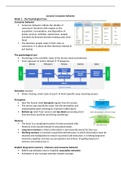
Lectures Consumer behavior
Week 1 – the Psychological Core
Consumer behavior
Consumer behavior reflects the totality of
consumers’ decisions with respect to the
acquisition, consumption, and disposition of
goods, services, activities, experiences, people,
and ideas by (human) decision-making units [over
time].
The decisions people make in their roles as
consumers. It is about all their decisions instead of
just buying
The psychological core
Psychology is the scientific study of the human mind and behavior
From exposure to action: Stimuli Response
Sensation (senses)
Vision, hearing, smell, taste & touch brain (specific areas receiving senses)
Perception
How the human mind interprets signals from the senses
The senses stay exactly the same, but the perception and
interpretation gives meaning to it (picture rabbit/duck)
Bottom-up (start from senses) and top-down processing (start
from the brain and then perceiving something)
Memory
The brain is a complicated system of interconnected cells.
Memory is the neural network of associated nodes
Long-term memory is where information is permanently stored for later use
Working memory is involved in goal-directed behaviors in which information must be
retained and manipulated to ensure successful task execution. It is linking long-term
memories together and also our perceptions and actions getting long-term
memory into actions/use it
Implicit (long-term) memory - Memory and consumer behavior
Beliefs and attitudes exist in (implicit) associative networks
Activation of one concept activates related concepts
, Associate networks for brands can be influenced by marketing actions
Celebrity endorsements build associations between the endorser and the brand
Priming is the act of introducing a stimulus to influence how individuals respond to a
subsequent stimulus (example of filling in the missing word). Activating a certain
node in an associative network determines how you respond to a certain stimulus.
o Music with strong national associations activated related knowledge and led
to customers buying wine from the respective country
Procedural implicit: about introducing schemes (lunch, breaks – 16:00 cup-a-soup)
Attention
Attention reflects how much mental activity is devoted to a stimulus
o Attention is limited (cannot be infinite, so it is selective)
o Attention is selective
o Attention can be divided (among several things)
“Marketing is a contest for people’s attention” you want to claim people’s
attention
Marketing application (example)
- Coca cola ad
- Sensation: It’s a visual sensation with colors
- Perception/Interpretation: it’s a bottle, its coca cola, happiness (associations)
- Memories: I like the taste, I like the brand, happy thoughts, always coca cola
- Response selection: I like this/do not like
- Response: do nothing, tune in, tune out, grab a coke
Sensory marketing (Krishna, 2012)
Marketing that engages the consumers’ senses and affects their perception,
judgement and behavior… in a subconscious way (it has an impact, but the consumer
is not always aware of it)
Olfaction is smell
Haptics: (interpersonal) touch
o Touch is the first sense you develop in the womb and the last sense you lose
with age
o Interpersonal touch is related to oxytocin, which promotes feelings of love,
social bonding and well-being
o People who receive interpersonal touch leave higher tips, are more
satisfied, comply with requests to sample or buy, take their medications, help
others, let others cut in line
, o Touch creates a sense of interpersonal connection
o Touching products:
Touching an object increases perceived ownership of that object
Touchscreens increase psychological ownership, and this in turn
magnifies the endowment effect (assign higher value because you
want to hold on to it)
Smell/Olfaction
o Memory for scents persists (much longer than other sensations)
o Memories triggered by scent are emotional
o Many distinct scent receptors
o Direct connection between olfactory nerve and amygdala and hippocampus
o Scent increases memory for associated information triggers associated
thoughts
o Scent can trigger emotions (physically close to each other)
o Scents can enhance product and store evaluations
o Scents can enhance shopping time and variety seeking
o Scent marketing:
Smell of fresh bread in the supermarket, smell of popcorn in cinema,
new car scent (spray)
Air Conditioner Scent Diffuser
Hearing
o We attach meaning to sounds (chips, Netflix) crispy products are
associated with fresh
o Music with strong national associations activated related knowledge and led
to customers buying wine from the respective country
Taste
o We are bad at distinguishing taste, because it is influenced by other senses
o Blind: sample beers indicate preference
o Before: Information sample beers indicate preference (top-down
process)
Vision
o We attach meaning to colors through learned associations and biological
predispositions
o Colors are important in marketing
Construal Level Theory (Trope, Liberman & Wakslak, 2007)
CLT is about how we perceive the world around us
People use concrete, low-level construal to mentally represent near objects and
events
People use abstract, high-level construal to mentally represent distant objects and
events
, Example: Low – exam next week, need to read 5 articles, wash socks. High – good
investment in my future
Psychological distance is a subjective experience that something is close or far away
from the self, here and now
1. Temporal distance: tonight vs. next year
2. Social distance: close relative vs. unknown person
3. Spatial distance: across the street vs. another country (e.g. refugees: what about
the value of my house vs. we should help these people) thoughts are different
when it is closer to us
4. Hypothetical distance: unsafe vs. safe neighborhood (how likely it is to happen to
you) put an extra lock on the door vs. how to prevent crime in society?
Primary vs. secondary features
o Purchases in the distant future focus perception on primary features (what
your TV offers in 6 months, what kind of travel do you desire)
o Purchases in the near future also focus on secondary features (next week is
your TV on discount, buying tickets)
Feasibility vs. desirability
o Desirability-related information affects purchase intentions for distant events
(trip in 6 months)
o Feasibility-related information affect purchase intentions for close events (air
ticket next week)
Bi-directionality
o Psychological distance not only affects mental construal, manipulations of
construal level also affect distance perceptions
o Psychological distance Construal level
o By framing an event or object as high or low construal level, psychological
distance can be manipulated
Pictures vs. words
o Words are abstract, pictures are concrete. Adding picture will make it more
concrete than just using words. Perceived social distance will increase
when it is abstract and it will decrease by making it more concrete
Memories of yesterday’s emotions (Shatz, Stone & Kahneman, 2009) – Memory
Long-term memory is where information is permanently stored for later use
Experiences vs. memories
o Which matters more: how much you actually enjoy something in the moment
or how much you remember enjoying something?
Memory-Experience Gap
Week 1 – the Psychological Core
Consumer behavior
Consumer behavior reflects the totality of
consumers’ decisions with respect to the
acquisition, consumption, and disposition of
goods, services, activities, experiences, people,
and ideas by (human) decision-making units [over
time].
The decisions people make in their roles as
consumers. It is about all their decisions instead of
just buying
The psychological core
Psychology is the scientific study of the human mind and behavior
From exposure to action: Stimuli Response
Sensation (senses)
Vision, hearing, smell, taste & touch brain (specific areas receiving senses)
Perception
How the human mind interprets signals from the senses
The senses stay exactly the same, but the perception and
interpretation gives meaning to it (picture rabbit/duck)
Bottom-up (start from senses) and top-down processing (start
from the brain and then perceiving something)
Memory
The brain is a complicated system of interconnected cells.
Memory is the neural network of associated nodes
Long-term memory is where information is permanently stored for later use
Working memory is involved in goal-directed behaviors in which information must be
retained and manipulated to ensure successful task execution. It is linking long-term
memories together and also our perceptions and actions getting long-term
memory into actions/use it
Implicit (long-term) memory - Memory and consumer behavior
Beliefs and attitudes exist in (implicit) associative networks
Activation of one concept activates related concepts
, Associate networks for brands can be influenced by marketing actions
Celebrity endorsements build associations between the endorser and the brand
Priming is the act of introducing a stimulus to influence how individuals respond to a
subsequent stimulus (example of filling in the missing word). Activating a certain
node in an associative network determines how you respond to a certain stimulus.
o Music with strong national associations activated related knowledge and led
to customers buying wine from the respective country
Procedural implicit: about introducing schemes (lunch, breaks – 16:00 cup-a-soup)
Attention
Attention reflects how much mental activity is devoted to a stimulus
o Attention is limited (cannot be infinite, so it is selective)
o Attention is selective
o Attention can be divided (among several things)
“Marketing is a contest for people’s attention” you want to claim people’s
attention
Marketing application (example)
- Coca cola ad
- Sensation: It’s a visual sensation with colors
- Perception/Interpretation: it’s a bottle, its coca cola, happiness (associations)
- Memories: I like the taste, I like the brand, happy thoughts, always coca cola
- Response selection: I like this/do not like
- Response: do nothing, tune in, tune out, grab a coke
Sensory marketing (Krishna, 2012)
Marketing that engages the consumers’ senses and affects their perception,
judgement and behavior… in a subconscious way (it has an impact, but the consumer
is not always aware of it)
Olfaction is smell
Haptics: (interpersonal) touch
o Touch is the first sense you develop in the womb and the last sense you lose
with age
o Interpersonal touch is related to oxytocin, which promotes feelings of love,
social bonding and well-being
o People who receive interpersonal touch leave higher tips, are more
satisfied, comply with requests to sample or buy, take their medications, help
others, let others cut in line
, o Touch creates a sense of interpersonal connection
o Touching products:
Touching an object increases perceived ownership of that object
Touchscreens increase psychological ownership, and this in turn
magnifies the endowment effect (assign higher value because you
want to hold on to it)
Smell/Olfaction
o Memory for scents persists (much longer than other sensations)
o Memories triggered by scent are emotional
o Many distinct scent receptors
o Direct connection between olfactory nerve and amygdala and hippocampus
o Scent increases memory for associated information triggers associated
thoughts
o Scent can trigger emotions (physically close to each other)
o Scents can enhance product and store evaluations
o Scents can enhance shopping time and variety seeking
o Scent marketing:
Smell of fresh bread in the supermarket, smell of popcorn in cinema,
new car scent (spray)
Air Conditioner Scent Diffuser
Hearing
o We attach meaning to sounds (chips, Netflix) crispy products are
associated with fresh
o Music with strong national associations activated related knowledge and led
to customers buying wine from the respective country
Taste
o We are bad at distinguishing taste, because it is influenced by other senses
o Blind: sample beers indicate preference
o Before: Information sample beers indicate preference (top-down
process)
Vision
o We attach meaning to colors through learned associations and biological
predispositions
o Colors are important in marketing
Construal Level Theory (Trope, Liberman & Wakslak, 2007)
CLT is about how we perceive the world around us
People use concrete, low-level construal to mentally represent near objects and
events
People use abstract, high-level construal to mentally represent distant objects and
events
, Example: Low – exam next week, need to read 5 articles, wash socks. High – good
investment in my future
Psychological distance is a subjective experience that something is close or far away
from the self, here and now
1. Temporal distance: tonight vs. next year
2. Social distance: close relative vs. unknown person
3. Spatial distance: across the street vs. another country (e.g. refugees: what about
the value of my house vs. we should help these people) thoughts are different
when it is closer to us
4. Hypothetical distance: unsafe vs. safe neighborhood (how likely it is to happen to
you) put an extra lock on the door vs. how to prevent crime in society?
Primary vs. secondary features
o Purchases in the distant future focus perception on primary features (what
your TV offers in 6 months, what kind of travel do you desire)
o Purchases in the near future also focus on secondary features (next week is
your TV on discount, buying tickets)
Feasibility vs. desirability
o Desirability-related information affects purchase intentions for distant events
(trip in 6 months)
o Feasibility-related information affect purchase intentions for close events (air
ticket next week)
Bi-directionality
o Psychological distance not only affects mental construal, manipulations of
construal level also affect distance perceptions
o Psychological distance Construal level
o By framing an event or object as high or low construal level, psychological
distance can be manipulated
Pictures vs. words
o Words are abstract, pictures are concrete. Adding picture will make it more
concrete than just using words. Perceived social distance will increase
when it is abstract and it will decrease by making it more concrete
Memories of yesterday’s emotions (Shatz, Stone & Kahneman, 2009) – Memory
Long-term memory is where information is permanently stored for later use
Experiences vs. memories
o Which matters more: how much you actually enjoy something in the moment
or how much you remember enjoying something?
Memory-Experience Gap