OPMT 1197
Business Statistics
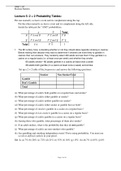
Lecture 5: 2 × 2 Probability Tables:
Put one mutually exclusive event and its complement along the top.
Put the other mutually exclusive event and its complement along the left side.
Inside the table put the “AND” probabilities.
A A Total
B P A and B P A and B PB
B P A and B P A and B P B
Total PA PA 1
1. The BC Lottery Corp. is deciding whether or not they should allow cigarette smoking in casinos.
Before making their decision they want to determine if smokers are more likely to gamble in
casinos than non-smokers. They randomly select 400 adults and ask them if they gamble in a
casino on a regular basis (i.e. at least once per week) and whether they smoke.
80 adults smoke • 60 adults gamble in a casino at least once a week
28 adults both gamble (in a casino at least once a week) and smoke
Set up a 2 × 2 table of the frequencies and answer the following questions:
Smoker Non-SmokerTotal
Gamble
Don’t Gamble
Total
(a) What percentage of adults both gamble on a regular basis and smoke?
(b) What percentage of adults either gamble or smoke?
(c) What percentage of adults neither gamble nor smoke?
(d) What percentage of adults either smoke or gamble but not both?
(e) What percentage of smokers gamble in a casino on a regular basis?
(f) What percentage of non-smokers gamble in a casino on a regular basis?
(g) What percentage of adults gamble in a casino on a regular basis?
(h) Among those who gamble, what percentage of them also smoke?
(i) If an adult smokes, what is the probability that they do not gamble?
(j) What percentage of adults are non-smokers who gamble?
(k) Are gambling and smoking independent events? Prove using probability. You must use
words or defined symbols in your proof.
Sol: 1. (a) 7% (b) 28% (c) 72% (d) 21% (e) 35% (f) 10% (g) 15% (h) 46.7% (i) 65% (j) 8%
` Page 1 of 10
, OPMT 1197
Business Statistics
2. Christine has always struggled in math. Based on her performance prior to the final
exam in Business Math, there is a 60% chance that she will fail the course if she
does not get a tutor. With a tutor, her probability of failing decreases to 20%. There
is only a 55% chance she will find a tutor with such short notice.
(a) The probability that Christine fails the course must be between what two values?
(b) What is the probability that Christine fails the course? (Set up a 2×2 probability table).
Total
Total
(c) Christine ends up passing the course. What is the probability that she had found a tutor?
3. In your stats computer lab, you decide to conduct of study of the ages of 300 business
students and whether or not they live with their parents. You obtain the following results:
Ages
18–27 28–37 38–47 Total
Live with Yes 185 5 0 190
Parents? No 95 11 4 110
Total 280 16 4 300
(a) Give a non-trivial example of two mutually exclusive events in this study.
(b) If a student is at least 28, what’s the probability they do not live with their parents?
(c) What is the probability a student lives with their parents or is from 28 to 37 years old?
(d) What is the probability of a student neither living with their parents nor being from
28 to 37 years old?
(e) Are ages and living with parents independent events? Prove using probabilities.
Sol: 2. (a) between 20% and 60% (b) 0.3800 or 38% chance (c) 44/62 = 0.7097
3. (a) There are no students aged 38 − 47 who live with their parents.
Living with Parents and being 38 to 47 years old are mutually exclusive events.
(b) 15/20 =0.7500 (c) 0.6700 (d) 0.3300
(e) Method 1: P(18 − 27 and Yes) = ? P(18 − 27) × P(Yes)
185 = ? 280 × 190
300 300 300
0.6167 ≠ 0.5911
→ Whether or not a student lives with their parents depends on the student’s age
Method 2: P(Yes | 18 − 27) = 185/280 = 0.6607, P(Yes) = 190/300 = 0.6333
P(Yes | 18 − 27) P(Yes) → dependent events
` Page 2 of 10
Business Statistics
Lecture 5: 2 × 2 Probability Tables:
Put one mutually exclusive event and its complement along the top.
Put the other mutually exclusive event and its complement along the left side.
Inside the table put the “AND” probabilities.
A A Total
B P A and B P A and B PB
B P A and B P A and B P B
Total PA PA 1
1. The BC Lottery Corp. is deciding whether or not they should allow cigarette smoking in casinos.
Before making their decision they want to determine if smokers are more likely to gamble in
casinos than non-smokers. They randomly select 400 adults and ask them if they gamble in a
casino on a regular basis (i.e. at least once per week) and whether they smoke.
80 adults smoke • 60 adults gamble in a casino at least once a week
28 adults both gamble (in a casino at least once a week) and smoke
Set up a 2 × 2 table of the frequencies and answer the following questions:
Smoker Non-SmokerTotal
Gamble
Don’t Gamble
Total
(a) What percentage of adults both gamble on a regular basis and smoke?
(b) What percentage of adults either gamble or smoke?
(c) What percentage of adults neither gamble nor smoke?
(d) What percentage of adults either smoke or gamble but not both?
(e) What percentage of smokers gamble in a casino on a regular basis?
(f) What percentage of non-smokers gamble in a casino on a regular basis?
(g) What percentage of adults gamble in a casino on a regular basis?
(h) Among those who gamble, what percentage of them also smoke?
(i) If an adult smokes, what is the probability that they do not gamble?
(j) What percentage of adults are non-smokers who gamble?
(k) Are gambling and smoking independent events? Prove using probability. You must use
words or defined symbols in your proof.
Sol: 1. (a) 7% (b) 28% (c) 72% (d) 21% (e) 35% (f) 10% (g) 15% (h) 46.7% (i) 65% (j) 8%
` Page 1 of 10
, OPMT 1197
Business Statistics
2. Christine has always struggled in math. Based on her performance prior to the final
exam in Business Math, there is a 60% chance that she will fail the course if she
does not get a tutor. With a tutor, her probability of failing decreases to 20%. There
is only a 55% chance she will find a tutor with such short notice.
(a) The probability that Christine fails the course must be between what two values?
(b) What is the probability that Christine fails the course? (Set up a 2×2 probability table).
Total
Total
(c) Christine ends up passing the course. What is the probability that she had found a tutor?
3. In your stats computer lab, you decide to conduct of study of the ages of 300 business
students and whether or not they live with their parents. You obtain the following results:
Ages
18–27 28–37 38–47 Total
Live with Yes 185 5 0 190
Parents? No 95 11 4 110
Total 280 16 4 300
(a) Give a non-trivial example of two mutually exclusive events in this study.
(b) If a student is at least 28, what’s the probability they do not live with their parents?
(c) What is the probability a student lives with their parents or is from 28 to 37 years old?
(d) What is the probability of a student neither living with their parents nor being from
28 to 37 years old?
(e) Are ages and living with parents independent events? Prove using probabilities.
Sol: 2. (a) between 20% and 60% (b) 0.3800 or 38% chance (c) 44/62 = 0.7097
3. (a) There are no students aged 38 − 47 who live with their parents.
Living with Parents and being 38 to 47 years old are mutually exclusive events.
(b) 15/20 =0.7500 (c) 0.6700 (d) 0.3300
(e) Method 1: P(18 − 27 and Yes) = ? P(18 − 27) × P(Yes)
185 = ? 280 × 190
300 300 300
0.6167 ≠ 0.5911
→ Whether or not a student lives with their parents depends on the student’s age
Method 2: P(Yes | 18 − 27) = 185/280 = 0.6607, P(Yes) = 190/300 = 0.6333
P(Yes | 18 − 27) P(Yes) → dependent events
` Page 2 of 10