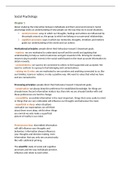
Social Psychology
Chapter 1
About studying the interaction between individuals and their social environment. Social
psychology seeks an understanding of why people act the way they do in social situations.
social processes: ways in which our thoughts, feelings and actions are influenced by
the people around us, the group to which we belong or our personal relationships.
cognitive processes: ways in which our memories, thoughts, emotions and motives
guide our understanding of the world and our actions.
Motivational principles: people direct their behaviour toward 3 important goals.
- mastery: we are motivated to understand ourself and the world and applying that
understanding to help us control outcomes and gain rewards in life. Striving for mastery
means trying to predict events in the social world based on the most accurate information to
obtain rewards.
- connectedness: we want to be connected to others to feel supported and accepted. We
want to conform to a group to feel belonging and connectedness.
- valuing me & mine: we are motivated to see ourselves and anything connected to us, like
our families, teams or nations, in only a positive way. We want to value that what we have
and are connected to.
Processing principles: people direct their behaviour toward 3 important goals.
- conservative: we always keep the preference for established knowledge, for things we
already know. Recent information matters less than info we are already familiar with and
these preferences are hard to change.
- accessibility: accessible information is the most important, things that come easily to mind
or things that are very noticeable will influence our thoughts and behaviour the most.
- superficial vs deep: when situations
contradict our expectations we will think
about them more deep, whilst when things
are normal we only make a superficial
picture of reality in our mind.
Perseverance bias: discredited information
will still influence your thoughts and
behaviour. Information always influences
your thoughts and decision making, even
information that you only see unconsciously,
like with subliminal priming.
The scientific study of social and cognitive
processes and the way individuals perceive,
influence and relate to each other.
, Chapter 3: first impressions
Primacy effect: first associations and impressions guide your further interpretation of new
stimuli. We quickly form a first impression based on someone’s physical appearance,
behaviour and environment. First impressions are often biased, but can be changed by
thinking deeper about someone.
beautiful is good heuristic: attributing more positive qualities to attractive people.
atypical faces are rated as being less reliable.
masculine faces are rated as more dominant.
salient cues attract attention in their context; characteristics that are different from
their environment stand out. But; things that stand out in one place might be really
normal in a different place (like tall boy, on basketball field).
Superficial processing
- using only one feature to form your impression (like young kids do)
- use accessible or salient features
- use of heuristics, like behaviour always corresponds with someone’s personality, but this is
not true obviously.
correspondence bias: attributing the cause of someone’s behaviour to their personality,
while the behaviour might as well be caused by environmental factors; people often leap to
conclusions that behaviour reflects inner characteristics fundamental attribution error.
collectivist cultures make this mistake way less; they look better at situational factors
than just simply ascribing the behaviour to the individual’s character.
Systematic processing
- need motivation and cognitive ability!!!
- use multiple features (older adolescents)
- can still be distorted by biases
- looking at causes of behaviour in a more analytical way, looking at environmental factors
Covariance theory
Behaviour can be caused by many things. The covariance theory describes when you can
actually ascribe the cause of behaviour to the person and his characteristics:
- distinctiveness: variation across situations; if the person would not do this in every
situation, the distinctiveness is high. Low distinctiveness when person always does it.
- consensus: variation across individuals; if everyone would do the same thing in this
situation, the consensus is high. If not everyone would do it, the consensus is low.
- consistency: variation over time; if the person is in this situation multiple times and does
the same thing every time, the consistency is high. Low consistency when something else.
Altijd, overal en iedereen consistency, distinctiveness en consensus
Mere exposure of something or someone will lead to familiarity and generally increased
liking.
Chapter 1
About studying the interaction between individuals and their social environment. Social
psychology seeks an understanding of why people act the way they do in social situations.
social processes: ways in which our thoughts, feelings and actions are influenced by
the people around us, the group to which we belong or our personal relationships.
cognitive processes: ways in which our memories, thoughts, emotions and motives
guide our understanding of the world and our actions.
Motivational principles: people direct their behaviour toward 3 important goals.
- mastery: we are motivated to understand ourself and the world and applying that
understanding to help us control outcomes and gain rewards in life. Striving for mastery
means trying to predict events in the social world based on the most accurate information to
obtain rewards.
- connectedness: we want to be connected to others to feel supported and accepted. We
want to conform to a group to feel belonging and connectedness.
- valuing me & mine: we are motivated to see ourselves and anything connected to us, like
our families, teams or nations, in only a positive way. We want to value that what we have
and are connected to.
Processing principles: people direct their behaviour toward 3 important goals.
- conservative: we always keep the preference for established knowledge, for things we
already know. Recent information matters less than info we are already familiar with and
these preferences are hard to change.
- accessibility: accessible information is the most important, things that come easily to mind
or things that are very noticeable will influence our thoughts and behaviour the most.
- superficial vs deep: when situations
contradict our expectations we will think
about them more deep, whilst when things
are normal we only make a superficial
picture of reality in our mind.
Perseverance bias: discredited information
will still influence your thoughts and
behaviour. Information always influences
your thoughts and decision making, even
information that you only see unconsciously,
like with subliminal priming.
The scientific study of social and cognitive
processes and the way individuals perceive,
influence and relate to each other.
, Chapter 3: first impressions
Primacy effect: first associations and impressions guide your further interpretation of new
stimuli. We quickly form a first impression based on someone’s physical appearance,
behaviour and environment. First impressions are often biased, but can be changed by
thinking deeper about someone.
beautiful is good heuristic: attributing more positive qualities to attractive people.
atypical faces are rated as being less reliable.
masculine faces are rated as more dominant.
salient cues attract attention in their context; characteristics that are different from
their environment stand out. But; things that stand out in one place might be really
normal in a different place (like tall boy, on basketball field).
Superficial processing
- using only one feature to form your impression (like young kids do)
- use accessible or salient features
- use of heuristics, like behaviour always corresponds with someone’s personality, but this is
not true obviously.
correspondence bias: attributing the cause of someone’s behaviour to their personality,
while the behaviour might as well be caused by environmental factors; people often leap to
conclusions that behaviour reflects inner characteristics fundamental attribution error.
collectivist cultures make this mistake way less; they look better at situational factors
than just simply ascribing the behaviour to the individual’s character.
Systematic processing
- need motivation and cognitive ability!!!
- use multiple features (older adolescents)
- can still be distorted by biases
- looking at causes of behaviour in a more analytical way, looking at environmental factors
Covariance theory
Behaviour can be caused by many things. The covariance theory describes when you can
actually ascribe the cause of behaviour to the person and his characteristics:
- distinctiveness: variation across situations; if the person would not do this in every
situation, the distinctiveness is high. Low distinctiveness when person always does it.
- consensus: variation across individuals; if everyone would do the same thing in this
situation, the consensus is high. If not everyone would do it, the consensus is low.
- consistency: variation over time; if the person is in this situation multiple times and does
the same thing every time, the consistency is high. Low consistency when something else.
Altijd, overal en iedereen consistency, distinctiveness en consensus
Mere exposure of something or someone will lead to familiarity and generally increased
liking.