Participles
Participles come up a lot in Latin translations, and are used in many different ways to
make grammar constructions (ie they are used in forming the ablative absolute) so it is
vital you understand what they are and how to form them.
A participle is an adjective formed from a verb (so it is used if you need to describe
someone based on what they are doing eg. the smiling girl, the crying boy etc). Participles
have endings that show its number, gender and case (like an adjective) and they also
have different tense (like a verb).
Most Latin verbs have three participles:
Present active - portans - carrying
Perfect passive - portatus (having been) carried
Future active - portaturus - about to carry (don’t worry about this one for now)
Present Active Participle
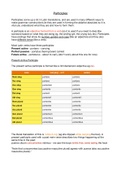
The present active participle is formed like a 3rd declension adjective eg rex.
case ‘carrying’ - m/f neuter
Nom sing portans portans
Voc sing portans portans
Acc sing portantem portans
Gen sing portantis portantis
Dat sing portanti portanti
Abl sing portante/i portante/i
Nom plural portantes portantia
Voc plural portantes portantia
Acc plural portantes portantia
Gen plural portantium portantium
Dat plural portantibus portantibus
Abl plural portantibus portantibus
The literal translation of this is ‘while X-ing’ (eg she tripped while carrying the box). A
present participle used with a past main verse describes two things happening at the
same time in the past:
pueros cibum consumentes vidimus - we saw the boys (while they were) eating the food
*Note that consumentes (accusative masculine plural) agrees with pueros (also accusative
masculine plural).*
Participles come up a lot in Latin translations, and are used in many different ways to
make grammar constructions (ie they are used in forming the ablative absolute) so it is
vital you understand what they are and how to form them.
A participle is an adjective formed from a verb (so it is used if you need to describe
someone based on what they are doing eg. the smiling girl, the crying boy etc). Participles
have endings that show its number, gender and case (like an adjective) and they also
have different tense (like a verb).
Most Latin verbs have three participles:
Present active - portans - carrying
Perfect passive - portatus (having been) carried
Future active - portaturus - about to carry (don’t worry about this one for now)
Present Active Participle
The present active participle is formed like a 3rd declension adjective eg rex.
case ‘carrying’ - m/f neuter
Nom sing portans portans
Voc sing portans portans
Acc sing portantem portans
Gen sing portantis portantis
Dat sing portanti portanti
Abl sing portante/i portante/i
Nom plural portantes portantia
Voc plural portantes portantia
Acc plural portantes portantia
Gen plural portantium portantium
Dat plural portantibus portantibus
Abl plural portantibus portantibus
The literal translation of this is ‘while X-ing’ (eg she tripped while carrying the box). A
present participle used with a past main verse describes two things happening at the
same time in the past:
pueros cibum consumentes vidimus - we saw the boys (while they were) eating the food
*Note that consumentes (accusative masculine plural) agrees with pueros (also accusative
masculine plural).*