Numerals
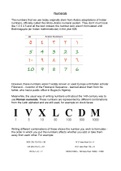
The numbers that we use today originally stem from Arabic adaptations of Indian
numbers, officially called the Hindu-Arabic numeral system. They don’t much look
like 1 2 3 4 5 and all the rest: indeed, the number zero wasn’t formulated until
Brahmagupta (an Indian mathematician) in the year 628.
However, these numbers weren’t widely known or used Europe until Italian scholar
Fibonacci - inventor of the Fibonacci Sequence - learned about them from his
father, who had a public office in Bugia (in Algeria).
Meanwhile, the usual way of writing numbers until about the 14th century was to
use Roman numerals. These numbers are represented by different combinations
from the Latin alphabet and are still used, for example on clock faces:
Writing different combinations of these shows the number you wish to formulate -
the order in which you put the numbers affects whether you add or take them
away from each other. For example:
XXX (10+10+10) = 30 IV (1 less than 5) = 4
LXI (50+10+1) = 61 IX (1 less than 10) = 9
VII (5+1+1) = 7 MCM (1000 + 100 less than 1000) = 1900
The numbers that we use today originally stem from Arabic adaptations of Indian
numbers, officially called the Hindu-Arabic numeral system. They don’t much look
like 1 2 3 4 5 and all the rest: indeed, the number zero wasn’t formulated until
Brahmagupta (an Indian mathematician) in the year 628.
However, these numbers weren’t widely known or used Europe until Italian scholar
Fibonacci - inventor of the Fibonacci Sequence - learned about them from his
father, who had a public office in Bugia (in Algeria).
Meanwhile, the usual way of writing numbers until about the 14th century was to
use Roman numerals. These numbers are represented by different combinations
from the Latin alphabet and are still used, for example on clock faces:
Writing different combinations of these shows the number you wish to formulate -
the order in which you put the numbers affects whether you add or take them
away from each other. For example:
XXX (10+10+10) = 30 IV (1 less than 5) = 4
LXI (50+10+1) = 61 IX (1 less than 10) = 9
VII (5+1+1) = 7 MCM (1000 + 100 less than 1000) = 1900