Cost and Cost Behavior
Learning Outcomes
Identify the different cost concepts found in Management Accounting
Link the cost concepts to the stage in the decision-making process which the respective cost concepts address
Identify different cost concepts in practical scenarios
Identify different cost objects
Identify the behaviour of different types of costs – viz. fixed, semi-fixed or stepped fixed, semi-variable and variable
Identify in a practical scenario how costs might behave and the impact thereof on the information provided to management
Identify the use of linear regression in splitting costs into their variable and fixed components
Differentiate between relevant and irrelevant costs for decision-making purposes
Understand when an opportunity cost arises and how this impacts on the costs for decision-making purposes
Differentiate between marginal costs and marginal revenue and how these impact on decision-making
Differentiate between controllable and uncontrollable costs for control purposes
Determine the fixed (a) and variable (b) components in the relationship between the independent variable (x) and the
dependent variable (y) using the high-low method
Calculate and discuss cost-volume-profit ratios
Understand and apply break-even analysis
Calculate and explain the margin of safety
Discuss the assumptions of cost-volume-profit analysis
Cost and Cost behaviour can be broken down into 3 smaller parts :
1. Cost classification – this refers to the multiple way in which costs can be classified
(for reporting purposes).
2. Cost behaviour – this focuses on the decision making a how costs behave (given the
nature of theunderlying transaction / event).
3. Cost volume profit – this is the pulling together of various cost types to
provide importantinformation, useful for decision making.
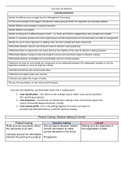
Product Costing, Decision Making & Control
Product Costing Decision making Control
Make sure we accurately reflect Giving internal decision makers Making sure the objectives of
the right price of an item. correct information to make the organisation is kept.
correct decisions in the future.
Correctly account for information
linked to the pricing of a product Prospective
, Cost and Cost Behavior
Product Costing
Objective:
- determination of a selling price
- profit determination
- placement of value on inventory on hand
Production volumes exceeded sales volumes and the product cost was over-cost
- closing inventory (credit item in the statement of comprehensive income) exceeds opening
inventory (debit item).
- Each net credit item (product), is over-stated = profits overstated.
Sales volumes exceeded production volumes and the product cost was under-cost
- Opening inventory (debit item) exceeds closing inventory (credit item).
- Each net debit item (product) is under-stated, profits = understated.
1. Manufacturing (factory / production) costs
- Service :salaries, cost of equipment used.
- Include
a) Direct labour:
o measurable per unit of output
o employees are remunerated per unit produced
o paid per hour with an expected output of units in an hour
b) Direct materials: cost of raw materials directly traceable and measurable per unit of
output
c) Overheads : neither raw materials nor labour
o Indirect: cannot be traced directly to the products, but are incurred in the
manufacturing process.
consumable stores expenses
all indirect wages
all indirect expenses
o Direct: is directly traceable and measurable per unit of output it represents a direct
overhead/expense
Learning Outcomes
Identify the different cost concepts found in Management Accounting
Link the cost concepts to the stage in the decision-making process which the respective cost concepts address
Identify different cost concepts in practical scenarios
Identify different cost objects
Identify the behaviour of different types of costs – viz. fixed, semi-fixed or stepped fixed, semi-variable and variable
Identify in a practical scenario how costs might behave and the impact thereof on the information provided to management
Identify the use of linear regression in splitting costs into their variable and fixed components
Differentiate between relevant and irrelevant costs for decision-making purposes
Understand when an opportunity cost arises and how this impacts on the costs for decision-making purposes
Differentiate between marginal costs and marginal revenue and how these impact on decision-making
Differentiate between controllable and uncontrollable costs for control purposes
Determine the fixed (a) and variable (b) components in the relationship between the independent variable (x) and the
dependent variable (y) using the high-low method
Calculate and discuss cost-volume-profit ratios
Understand and apply break-even analysis
Calculate and explain the margin of safety
Discuss the assumptions of cost-volume-profit analysis
Cost and Cost behaviour can be broken down into 3 smaller parts :
1. Cost classification – this refers to the multiple way in which costs can be classified
(for reporting purposes).
2. Cost behaviour – this focuses on the decision making a how costs behave (given the
nature of theunderlying transaction / event).
3. Cost volume profit – this is the pulling together of various cost types to
provide importantinformation, useful for decision making.
Product Costing, Decision Making & Control
Product Costing Decision making Control
Make sure we accurately reflect Giving internal decision makers Making sure the objectives of
the right price of an item. correct information to make the organisation is kept.
correct decisions in the future.
Correctly account for information
linked to the pricing of a product Prospective
, Cost and Cost Behavior
Product Costing
Objective:
- determination of a selling price
- profit determination
- placement of value on inventory on hand
Production volumes exceeded sales volumes and the product cost was over-cost
- closing inventory (credit item in the statement of comprehensive income) exceeds opening
inventory (debit item).
- Each net credit item (product), is over-stated = profits overstated.
Sales volumes exceeded production volumes and the product cost was under-cost
- Opening inventory (debit item) exceeds closing inventory (credit item).
- Each net debit item (product) is under-stated, profits = understated.
1. Manufacturing (factory / production) costs
- Service :salaries, cost of equipment used.
- Include
a) Direct labour:
o measurable per unit of output
o employees are remunerated per unit produced
o paid per hour with an expected output of units in an hour
b) Direct materials: cost of raw materials directly traceable and measurable per unit of
output
c) Overheads : neither raw materials nor labour
o Indirect: cannot be traced directly to the products, but are incurred in the
manufacturing process.
consumable stores expenses
all indirect wages
all indirect expenses
o Direct: is directly traceable and measurable per unit of output it represents a direct
overhead/expense