Chapter 2: An Introduction to Cost Terms and Concepts
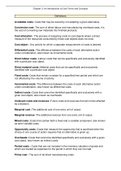
Definitions
Avoidable costs: Costs that may be saved by not adopting a given alternative.
Conversion cost: The sum of direct labour and manufacturing overhead costs; it is
the cost of converting raw materials into finished products.
Cost allocation : The process of assigning costs to cost objects where a direct
measure of the resources consumed by these cost objects does not exist.
Cost object : Any activity for which a separate measurement of costs is desired.
Differential costs :The difference between the costs of each alternative action
under consideration, also known as incremental costs.
Direct labour costs :Labour costs that can be specifically and exclusively identified
with a particular cost object.
Direct material costs :Material costs that can be specifically and exclusively
identified with a particular cost object.
Fixed costs: Costs that remain constant for a specified time period and which are
not affected by the volume of activity.
Incremental costs: The difference between the costs of each alternative action
under consideration, also known as differential costs.
Indirect costs :Costs that cannot be identified specifically and exclusively with a
given cost object, also known as overheads.
Irrelevant costs and revenues :Future costs and revenues that will not be affected
by a decision.
Marginal cost :The additional cost of one extra unit of output.
Marginal revenue :The additional revenue from one extra unit of output.
Mixed costs :Costs that contain both a fixed and a variable component, also known
as semi-variable costs.
Opportunity costs :Costs that measure the opportunity that is sacrificed when the
choice of one course of action requires that an alternative is given up.
Overheads :Costs that cannot be identified specifically and exclusively with a given
cost object, also known as indirect costs.
Period costs : Costs that are not included in the inventory valuation of goods and
which are treated as expenses for the period in which they are incurred.
Prime cost : The sum of all direct manufacturing costs.
Definitions
Avoidable costs: Costs that may be saved by not adopting a given alternative.
Conversion cost: The sum of direct labour and manufacturing overhead costs; it is
the cost of converting raw materials into finished products.
Cost allocation : The process of assigning costs to cost objects where a direct
measure of the resources consumed by these cost objects does not exist.
Cost object : Any activity for which a separate measurement of costs is desired.
Differential costs :The difference between the costs of each alternative action
under consideration, also known as incremental costs.
Direct labour costs :Labour costs that can be specifically and exclusively identified
with a particular cost object.
Direct material costs :Material costs that can be specifically and exclusively
identified with a particular cost object.
Fixed costs: Costs that remain constant for a specified time period and which are
not affected by the volume of activity.
Incremental costs: The difference between the costs of each alternative action
under consideration, also known as differential costs.
Indirect costs :Costs that cannot be identified specifically and exclusively with a
given cost object, also known as overheads.
Irrelevant costs and revenues :Future costs and revenues that will not be affected
by a decision.
Marginal cost :The additional cost of one extra unit of output.
Marginal revenue :The additional revenue from one extra unit of output.
Mixed costs :Costs that contain both a fixed and a variable component, also known
as semi-variable costs.
Opportunity costs :Costs that measure the opportunity that is sacrificed when the
choice of one course of action requires that an alternative is given up.
Overheads :Costs that cannot be identified specifically and exclusively with a given
cost object, also known as indirect costs.
Period costs : Costs that are not included in the inventory valuation of goods and
which are treated as expenses for the period in which they are incurred.
Prime cost : The sum of all direct manufacturing costs.