OPMT 1197
Business Statistics
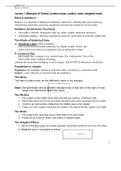
Lecture 1: Measures of Central Location (mean, median, mode, weighted mean)
What is statistics?
Statistics is a collection of methods for planning experiments, obtaining data, then organizing,
summarizing, presenting, analyzing, interpreting and drawing conclusions based on data.
Statistics: Divided into Two Parts:
1. Descriptive statistics: Summarize data (eg. tables, graphs, numerical measures)
2. Inferential statistics: Drawing conclusions about the whole data set from the sample data.
Two Kinds of Statistical Data:
A: Quantitative Data: (always numeric)
often results from measuring something (e.g. height, weight, income, age)
makes sense to do numerical calculations such as finding the average
B: Categorical Data
puts people into a category (e.g. marital status, live with parents? Yes or No)
often results from counting something
calculate the proportion belonging to each category, but do NOT do numerical calculations
Population vs. Sample
Population: the complete collection of all data values of interest in a particular study
Sample: a sub-collection of elements from the population
The Mean
The mean is also known as the arithmetic mean or the average.
̅= ∑
Note: One potentially serious problem with the mean is that one or two high (or low)
values can extensively distort the mean.
The Median
1. The median is the middle value when the data are sorted in numerical order.
2. Half the data values are less than the median and half the data values are greater than the median.
3. If there is an odd number of data then the middle value is the median.
4. If there is an even number of data then the median is the mean of the two values in the middle.
The Mode
1. The mode is the value that occurs most often in the set of data.
2. A data set can have no mode, one mode or multiple modes.
The Weighted Mean
1. Not all of the data values are equally important, some data counts for more than the others.
2. Weight ( ) is assigned to each data point ( ) to reflect the importance.
3. Weighted mean is calculated as follows:
∑
̅=
∑
1
Business Statistics
Lecture 1: Measures of Central Location (mean, median, mode, weighted mean)
What is statistics?
Statistics is a collection of methods for planning experiments, obtaining data, then organizing,
summarizing, presenting, analyzing, interpreting and drawing conclusions based on data.
Statistics: Divided into Two Parts:
1. Descriptive statistics: Summarize data (eg. tables, graphs, numerical measures)
2. Inferential statistics: Drawing conclusions about the whole data set from the sample data.
Two Kinds of Statistical Data:
A: Quantitative Data: (always numeric)
often results from measuring something (e.g. height, weight, income, age)
makes sense to do numerical calculations such as finding the average
B: Categorical Data
puts people into a category (e.g. marital status, live with parents? Yes or No)
often results from counting something
calculate the proportion belonging to each category, but do NOT do numerical calculations
Population vs. Sample
Population: the complete collection of all data values of interest in a particular study
Sample: a sub-collection of elements from the population
The Mean
The mean is also known as the arithmetic mean or the average.
̅= ∑
Note: One potentially serious problem with the mean is that one or two high (or low)
values can extensively distort the mean.
The Median
1. The median is the middle value when the data are sorted in numerical order.
2. Half the data values are less than the median and half the data values are greater than the median.
3. If there is an odd number of data then the middle value is the median.
4. If there is an even number of data then the median is the mean of the two values in the middle.
The Mode
1. The mode is the value that occurs most often in the set of data.
2. A data set can have no mode, one mode or multiple modes.
The Weighted Mean
1. Not all of the data values are equally important, some data counts for more than the others.
2. Weight ( ) is assigned to each data point ( ) to reflect the importance.
3. Weighted mean is calculated as follows:
∑
̅=
∑
1