Behavioural approach to treating phobias
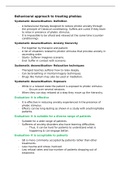
Systematic desensitisation- Definition
- A behavioural therapy designed to reduce phobic anxiety through
the principle of Classical conditioning. Suffers are cured if they learn
to relax in presence of phobic stimulus.
- It is impossible to be afraid and relaxed at the same time (counter-
conditioning).
Systematic desensitisation- Anxiety hierarchy
- Put together by therapist and patient.
- A list of situations related to phobic stimulus that provoke anxiety in
ascending order.
- Starts- Sufferer imagines scenario.
- End- Suffer in contact with scenario.
Systematic desensitisation- Relaxation techniques
- Therapist teaches sufferer how to relax deeply.
- Can be breathing or mental imagery techniques.
- Drugs like Valium may also be used or mediation.
Systematic desensitisation- Exposure
- While in a relaxed state the patient is exposed to phobic stimulus.
→ Occurs over several sessions.
- When they can stay relaxed at a step they move up the hierarchy.
Evaluation- It is effective
- It is effective in reducing anxiety experienced in the presence of
phobic stimulus.
- Effects can be long-lasting as shown in a study with arachnophobia
patients.
Evaluation- It is suitable for a diverse range of patients
- Suitable for a wide range of patients.
- Sufferers of anxiety disorders also have learning difficulties.
→ Thus, it can be hard for patients to understand what is
happening & can engage better.
Evaluation- It is acceptable to patients
- SD is more commonly accepted by patients rather than other
treatments.
- Less trauma and stress involved.
- Low refusal rates and low number of patients dropping out of
treatment.
Systematic desensitisation- Definition
- A behavioural therapy designed to reduce phobic anxiety through
the principle of Classical conditioning. Suffers are cured if they learn
to relax in presence of phobic stimulus.
- It is impossible to be afraid and relaxed at the same time (counter-
conditioning).
Systematic desensitisation- Anxiety hierarchy
- Put together by therapist and patient.
- A list of situations related to phobic stimulus that provoke anxiety in
ascending order.
- Starts- Sufferer imagines scenario.
- End- Suffer in contact with scenario.
Systematic desensitisation- Relaxation techniques
- Therapist teaches sufferer how to relax deeply.
- Can be breathing or mental imagery techniques.
- Drugs like Valium may also be used or mediation.
Systematic desensitisation- Exposure
- While in a relaxed state the patient is exposed to phobic stimulus.
→ Occurs over several sessions.
- When they can stay relaxed at a step they move up the hierarchy.
Evaluation- It is effective
- It is effective in reducing anxiety experienced in the presence of
phobic stimulus.
- Effects can be long-lasting as shown in a study with arachnophobia
patients.
Evaluation- It is suitable for a diverse range of patients
- Suitable for a wide range of patients.
- Sufferers of anxiety disorders also have learning difficulties.
→ Thus, it can be hard for patients to understand what is
happening & can engage better.
Evaluation- It is acceptable to patients
- SD is more commonly accepted by patients rather than other
treatments.
- Less trauma and stress involved.
- Low refusal rates and low number of patients dropping out of
treatment.