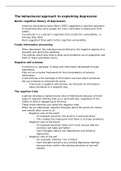
The behavioural approach to explaining depression
Becks cognitive theory of depression
- American psychiatrist Aaron Beck (1967) suggested a cognitive approach
to explaining why some people are more vulnerable to depression than
others.
- In particular it is a person’s cognitions that create this vulnerability, i.e.
the way they think.
- Beck suggested three parts to this cognitive vulnerability.
Faulty information processing
- When depressed, the individual would attend to the negative aspects of a
situation and ignore the positives.
- The sufferer would also tend to blow small problems out of proportion and
think in ‘black and white’ terms.
Negative self-schemas
- A schema is a ‘package’ of ideas and information developed through
experience.
- They act as a mental framework for the interpretation of sensory
information.
- A self-schema is the package of information we have about ourselves.
- We use schemas to interpret the world.
→ If we have a negative self-schema, we interpret all information
about ourselves in a negative way.
The negative triad
- A person develops a dysfunctional view of themselves because of three
types of negative thinking that occur automatically, regardless of the
reality of what is happening at the time.
- These three elements are called the negative triad.
- When we are depressed, negative thoughts about the world, the future
and oneself often come to us.
→ Negative view of the world
→ An example would be ‘the world is a cold hard place’.
→ This created the impression that there is no hope anywhere.
→ Negative view of the future
→ An example would be ‘there isn’t much chance that the
economy will really get better’.
→ Such thoughts reduce any hopefulness and enhance
depression.
→ Negative view of the self
→ For example, thinking ‘I am a failure’.
→ Such thoughts enhance any existing depressive feelings
because they confirm the existing emotions of low self-
esteem.
, Evaluation
It has good supporting evidence
- A range of evidence supports the idea that depression is associated with
faulty information processing, negative self-schemas and the cognitive
triad of negative automatic thinking.
- For example, Grazioli and Terry (2000) assessed 65 pregnant women for
cognitive vulnerability and depression before and after birth.
→ They found that those women judged to have been in high cognitive
vulnerability were more likely to suffer post-natal depression.
- Clark and Beck (1999) reviewed research on this topic and concluded that
there was solid support for all these cognitive vulnerability factors.
- Critically, these cognitions can be seen before depression develops,
suggesting that Beck may be right about cognition causing depression, at
least in some cases.
It has a practical application in CBT
- A further strength of Beck’s cognitive explanation is that it forms the basis
of a cognitive behaviour therapy (CBT).
- All cognitive aspects of depression can be identified and challenged in
CBT.
→ These include components of the negative triad that are easily
identifiable.
→ This means that a therapist can challenge them and encourage the
patient to test whether they are true
→ This is a strength of the explanation because it translated
well into successful therapy.
It doesn’t explain all aspects of depression
- Beck’s theory neatly explains the basic symptoms of depression; however,
depression is complex.
- Some depressed patients are deeply angry, and Beck cannot easily
explain this extreme emotion.
- Some sufferers of depression suffer from hallucinations and bizarre beliefs.
- Very occasionally depressed patients suffer from Cotard Syndrome, the
delusion that they are zombies (Jarrett, 2013).
- Beck’s theory cannot easily explain these cases.
Becks cognitive theory of depression
- American psychiatrist Aaron Beck (1967) suggested a cognitive approach
to explaining why some people are more vulnerable to depression than
others.
- In particular it is a person’s cognitions that create this vulnerability, i.e.
the way they think.
- Beck suggested three parts to this cognitive vulnerability.
Faulty information processing
- When depressed, the individual would attend to the negative aspects of a
situation and ignore the positives.
- The sufferer would also tend to blow small problems out of proportion and
think in ‘black and white’ terms.
Negative self-schemas
- A schema is a ‘package’ of ideas and information developed through
experience.
- They act as a mental framework for the interpretation of sensory
information.
- A self-schema is the package of information we have about ourselves.
- We use schemas to interpret the world.
→ If we have a negative self-schema, we interpret all information
about ourselves in a negative way.
The negative triad
- A person develops a dysfunctional view of themselves because of three
types of negative thinking that occur automatically, regardless of the
reality of what is happening at the time.
- These three elements are called the negative triad.
- When we are depressed, negative thoughts about the world, the future
and oneself often come to us.
→ Negative view of the world
→ An example would be ‘the world is a cold hard place’.
→ This created the impression that there is no hope anywhere.
→ Negative view of the future
→ An example would be ‘there isn’t much chance that the
economy will really get better’.
→ Such thoughts reduce any hopefulness and enhance
depression.
→ Negative view of the self
→ For example, thinking ‘I am a failure’.
→ Such thoughts enhance any existing depressive feelings
because they confirm the existing emotions of low self-
esteem.
, Evaluation
It has good supporting evidence
- A range of evidence supports the idea that depression is associated with
faulty information processing, negative self-schemas and the cognitive
triad of negative automatic thinking.
- For example, Grazioli and Terry (2000) assessed 65 pregnant women for
cognitive vulnerability and depression before and after birth.
→ They found that those women judged to have been in high cognitive
vulnerability were more likely to suffer post-natal depression.
- Clark and Beck (1999) reviewed research on this topic and concluded that
there was solid support for all these cognitive vulnerability factors.
- Critically, these cognitions can be seen before depression develops,
suggesting that Beck may be right about cognition causing depression, at
least in some cases.
It has a practical application in CBT
- A further strength of Beck’s cognitive explanation is that it forms the basis
of a cognitive behaviour therapy (CBT).
- All cognitive aspects of depression can be identified and challenged in
CBT.
→ These include components of the negative triad that are easily
identifiable.
→ This means that a therapist can challenge them and encourage the
patient to test whether they are true
→ This is a strength of the explanation because it translated
well into successful therapy.
It doesn’t explain all aspects of depression
- Beck’s theory neatly explains the basic symptoms of depression; however,
depression is complex.
- Some depressed patients are deeply angry, and Beck cannot easily
explain this extreme emotion.
- Some sufferers of depression suffer from hallucinations and bizarre beliefs.
- Very occasionally depressed patients suffer from Cotard Syndrome, the
delusion that they are zombies (Jarrett, 2013).
- Beck’s theory cannot easily explain these cases.