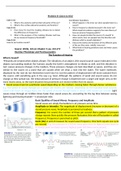
Problem 8: Listen to this!
Case 1: LG Coordinator Questions
1. What is the anatomy and function (all parts) of the ear? 1. What happens in the inner ear when people listen to a
2. What is the cochlea (all parts) anatomy and function? sound?
Case 2: LG 2. How is frequency coded/processed in the inner ear?
1. How many Hz must the masking stimulus be to detect What empirical evidence supports the main theory of
the differences in frequency? how we process frequency/pitch?
2. What is the purpose of the masking stimulus and how 3. How can people localize the source of a sound? In
do we measure frequency thresholds? other words, how can people hear the direction and
Case 3: LG distance which a sound originates?
How do we localize sounds? 4. Discuss the names and functions of the different parts
of the ear (the outer, middle, inner ear)
5. What kinds of hearing problems exist and what causes
Source: Wolfe, 3rd ed, Chapter 9, pp. 243-272 the problems?
Hearing: Physiology and Psychoacoustics
The Function of Hearing
What is Sound?
Sounds are created when objects vibrate. The vibrations of an object. (the sound source) cause molecules in the
objects surrounding medium (for humans usually the Earth’s atmosphere) to vibrate as well, and this vibration in
turn causes pressure changes in the medium. These pressure changes are best described as waves, and they are
similar to the waves on a pond that are caused when we drop a rock into the water. The water molecules
displaced by the rock do not themselves travel very far, but the pattern of displacement will move outward from
the source until something gets in the way e.g. boat. Although the patterns of pond and sound waves do not
change as they spread out, the initial amount of pressure change is dispersed over a larger and larger area as the
wave moves away, so the wave becomes less prominent as it moves farther from its source.
Sound waves travel at a particular speed depending on the medium, moving faster through denser substances.
E.g. the speed of sound through air is about 340 meters per second, depending on the humidity level (sounds
travel a bit faster on muggy days), but the speed of sound through water is about 1500 meters per second. Light
waves move through air 1million times faster than sound waves do, accounting for the lag time between seeing
lightning and hearing thunder—1 second per mile.
Basic Qualities of Sound Waves: Frequency and Amplitude
Sound waves are simply fluctuations in air pressure across time.
Amplitude or intensity: The magnitude of displacement (increase or decrease) of a
sound pressure wave. Amplitude is perceived as loudness.
Frequency: For sound, the number of times per second that a pattern of pressure
change repeats (how quickly the pressure fluctuates; this rate of fluctuation is called
frequency). Frequency is perceived as pitch.
Hertz (Hz): A unit of measure for sound wave frequency. One hertz equals one cycle
per second. E.g. the pressure in a 500-Hz wave goes from its highest point down to
its lowest point and back up to its highest point 500 times every second.
, Amplitude is associated with the perceptual quality of loudness: the more intense a sound wave is, the louder
it will sound.
Frequency is associated with pitch: low frequency sounds correspond to low pitches (e.g. low notes played by
a tuba), and high frequency sounds correspond to high pitches (e.g. high notes from a piccolo).
Young may be able to detect sounds from 20 to 20,000 Hz. Some animals hear sounds that have lower and
higher frequencies than those heard by humans. Sonar systems used by some boats use sound frequencies
above 60,000 Hz.
Decibel (dB): A unit of measure for the physical intensity of sound. Decibels define the difference between
two sounds as the ratio between two sound pressures. Each 10:1 sound pressure ratio equals 20 dB, and a
100:1 ration equals 40 dB.
Equation: dB=20 log (p/p0) variable p corresponds to the pressure intensity of the sound being described.
The constant term p0 is a reference pressure and is typically defined in auditory research contexts to be 0.0002
dyne per square centimetre (dyne/cm2), and levels are defined as dB SPL (sound pressure level). This level
(0.0002 dyne/cm2) is close to the minimum pressure that can be detected at frequencies for which hearing is
most sensitive and decibel values greater than zero describe the ratio between a sound being measured and
0.0002 dyne/cm2.
The range for human hearing extends from 0 to over 120 dB SPL, this decibel range corresponds to a ration of
greater than 1,000,000:1
Relatively small decibel changes can correspond to large physical change
,Sine Waves and Complex Sounds
Sine wave/pure tone: A waveform for which variation as a function of time is a sine function. All sounds
can be described as a combination of sine waves.
Spectrum: A representation of the relative energy (intensity) present at each frequency.
Harmonic spectra: The spectrum of a complex sound in which energy is at integer multiples of the
fundamental frequency. They are typically caused by a simple vibrating source, such as the string of a
guitar or the reed of a saxophone. Each frequency component in such a sound is called a “harmonic”.
Fundamental frequency: The lowest frequency component of a complex periodic sound. All the other
harmonics have frequencies that are integer multiples of the fundamental.
Timbre(tamber): The psychological sensation by which a listener can judge that two sounds with the
same loudness and pitch are dissimilar. Timbre quality is conveyed by harmonics and other high
frequencies.(piano and trumpet playing the same note, but you still can distinguish them)
Basic Structure of the Mammalian Auditory System
Outer Ear: the external sound-gathering portion of the ear, consisting of
the pinna and the ear canal.
Pinna: the outer, funnel part of the ear, where sounds are first collected
from the environment. Only mammals have pinnae. The particular
shapes of pinnae play an important role in our ability to localize sound
sources.
Ear canal: the canal that conducts sound vibrations from the pinna to
the tympanic membrane and prevents damage to the tympanic
membrane. It extends about 25mm into the head. The length and shape
of the ear canal enhances sound frequencies between about 2000 and
6000 Hz.
Tympanic membrane (eardrum): A thin sheet of skin at the end of the
outer ear canal. It vibrates in response to sound (moving in and out, in
, Middle Ear: The tympanic membrane is the
border between the outer ear and the middle
ear. The middle ear is an air-filled chamber
containing the middle bones, or ossicles that
amplify sound waves. The middle ear conveys
and amplifies vibration from the tympanic
membrane to the oval window.
Ossicles: any of three tiny bones of the middle
ear: malleus, incus, and stapes.
Malleus: one of the three ossicles. The malleus is
connected to the tympanic membrane and so
receives vibration from the tympanic membrane
and is attached to the incus.
Incus: the middle of the three ossicles,
connecting the malleus and the stapes.
Stapes: one of the three ossicles. Connected to
the incus on the one end, the stapes presses
against the oval window of the cochlea on the
other end. This way it transmits the vibrations of
sound waves that the malleus is receiving from
the tympanic membrane (by being connected to
the incus which is connected to the malleus) to
the oval window.
Oval window: the flexible opening to the cochlea through which the stapes transmits vibration to the fluid
inside (paralymph). The oval window is another membrane that forms the border between the middle ear and
the inner ear.
Ossicles smallest bones in the human body, they amplify sound vibrations in two ways:
1) The joints between the bones are hinged in a way that makes them work like levers: a modest amount of
energy on one side of the fulcrum (joint) becomes larger on the other. This lever action increases the amount of
pressure changes by about a third.
2) The second way the ossicles increase the energy transmitted to the inner ear is by concentrating energy from a
larger to a smaller surface area: the tympanic membrane, which moves the malleus, is about 18 times as large
as the oval window, which is moved by the stapes. Therefore, pressure on the oval window is magnified 18
times relative to the pressure on the tympanic membrane.
The amplification provided by the ossicles is essential to our ability to hear faint sounds because the inner
ear, is made up of a collection of fluid-filled chambers. Because it takes more energy to move liquid than it does
to move air, this fluid creates an impedance mismatch: if soundwaves were transmitted to the oval window
directly, many would simply bounce back without moving the oval window at all.
Ossicles play an important role for loud sounds too.
The middle ear has two muscles.(Smallest muscles in the body)
Tensor tympani: the muscle attached to the malleus; tensing the tensor tympani decreases vibration.
Stapedius: the muscle attached to the stapes; tensing the stapedius decreases vibration.
For both, their purpose is to tense when sounds are very loud, restricting the movement of the ossicles and
thus muffling pressure chnages that might be large enough to damage the delictae structures in the inner ear .
They also tense to keep the auditory system from being overwhelmed by sounds generated by our own body.
E.g. talking, swallowing.
Acoustic reflex: a reflex that protects the ear from the intense sounds, via contraction of the stapedius and
tensor tympani muscles. Unfortunately this acoustic reflex follows the onset of loud sounds by about one-fifth
of a second. It helps in environments that are loud for sustained periods. But it cannot protect against abrupt
loud sounds, such as a gunshot.
Case 1: LG Coordinator Questions
1. What is the anatomy and function (all parts) of the ear? 1. What happens in the inner ear when people listen to a
2. What is the cochlea (all parts) anatomy and function? sound?
Case 2: LG 2. How is frequency coded/processed in the inner ear?
1. How many Hz must the masking stimulus be to detect What empirical evidence supports the main theory of
the differences in frequency? how we process frequency/pitch?
2. What is the purpose of the masking stimulus and how 3. How can people localize the source of a sound? In
do we measure frequency thresholds? other words, how can people hear the direction and
Case 3: LG distance which a sound originates?
How do we localize sounds? 4. Discuss the names and functions of the different parts
of the ear (the outer, middle, inner ear)
5. What kinds of hearing problems exist and what causes
Source: Wolfe, 3rd ed, Chapter 9, pp. 243-272 the problems?
Hearing: Physiology and Psychoacoustics
The Function of Hearing
What is Sound?
Sounds are created when objects vibrate. The vibrations of an object. (the sound source) cause molecules in the
objects surrounding medium (for humans usually the Earth’s atmosphere) to vibrate as well, and this vibration in
turn causes pressure changes in the medium. These pressure changes are best described as waves, and they are
similar to the waves on a pond that are caused when we drop a rock into the water. The water molecules
displaced by the rock do not themselves travel very far, but the pattern of displacement will move outward from
the source until something gets in the way e.g. boat. Although the patterns of pond and sound waves do not
change as they spread out, the initial amount of pressure change is dispersed over a larger and larger area as the
wave moves away, so the wave becomes less prominent as it moves farther from its source.
Sound waves travel at a particular speed depending on the medium, moving faster through denser substances.
E.g. the speed of sound through air is about 340 meters per second, depending on the humidity level (sounds
travel a bit faster on muggy days), but the speed of sound through water is about 1500 meters per second. Light
waves move through air 1million times faster than sound waves do, accounting for the lag time between seeing
lightning and hearing thunder—1 second per mile.
Basic Qualities of Sound Waves: Frequency and Amplitude
Sound waves are simply fluctuations in air pressure across time.
Amplitude or intensity: The magnitude of displacement (increase or decrease) of a
sound pressure wave. Amplitude is perceived as loudness.
Frequency: For sound, the number of times per second that a pattern of pressure
change repeats (how quickly the pressure fluctuates; this rate of fluctuation is called
frequency). Frequency is perceived as pitch.
Hertz (Hz): A unit of measure for sound wave frequency. One hertz equals one cycle
per second. E.g. the pressure in a 500-Hz wave goes from its highest point down to
its lowest point and back up to its highest point 500 times every second.
, Amplitude is associated with the perceptual quality of loudness: the more intense a sound wave is, the louder
it will sound.
Frequency is associated with pitch: low frequency sounds correspond to low pitches (e.g. low notes played by
a tuba), and high frequency sounds correspond to high pitches (e.g. high notes from a piccolo).
Young may be able to detect sounds from 20 to 20,000 Hz. Some animals hear sounds that have lower and
higher frequencies than those heard by humans. Sonar systems used by some boats use sound frequencies
above 60,000 Hz.
Decibel (dB): A unit of measure for the physical intensity of sound. Decibels define the difference between
two sounds as the ratio between two sound pressures. Each 10:1 sound pressure ratio equals 20 dB, and a
100:1 ration equals 40 dB.
Equation: dB=20 log (p/p0) variable p corresponds to the pressure intensity of the sound being described.
The constant term p0 is a reference pressure and is typically defined in auditory research contexts to be 0.0002
dyne per square centimetre (dyne/cm2), and levels are defined as dB SPL (sound pressure level). This level
(0.0002 dyne/cm2) is close to the minimum pressure that can be detected at frequencies for which hearing is
most sensitive and decibel values greater than zero describe the ratio between a sound being measured and
0.0002 dyne/cm2.
The range for human hearing extends from 0 to over 120 dB SPL, this decibel range corresponds to a ration of
greater than 1,000,000:1
Relatively small decibel changes can correspond to large physical change
,Sine Waves and Complex Sounds
Sine wave/pure tone: A waveform for which variation as a function of time is a sine function. All sounds
can be described as a combination of sine waves.
Spectrum: A representation of the relative energy (intensity) present at each frequency.
Harmonic spectra: The spectrum of a complex sound in which energy is at integer multiples of the
fundamental frequency. They are typically caused by a simple vibrating source, such as the string of a
guitar or the reed of a saxophone. Each frequency component in such a sound is called a “harmonic”.
Fundamental frequency: The lowest frequency component of a complex periodic sound. All the other
harmonics have frequencies that are integer multiples of the fundamental.
Timbre(tamber): The psychological sensation by which a listener can judge that two sounds with the
same loudness and pitch are dissimilar. Timbre quality is conveyed by harmonics and other high
frequencies.(piano and trumpet playing the same note, but you still can distinguish them)
Basic Structure of the Mammalian Auditory System
Outer Ear: the external sound-gathering portion of the ear, consisting of
the pinna and the ear canal.
Pinna: the outer, funnel part of the ear, where sounds are first collected
from the environment. Only mammals have pinnae. The particular
shapes of pinnae play an important role in our ability to localize sound
sources.
Ear canal: the canal that conducts sound vibrations from the pinna to
the tympanic membrane and prevents damage to the tympanic
membrane. It extends about 25mm into the head. The length and shape
of the ear canal enhances sound frequencies between about 2000 and
6000 Hz.
Tympanic membrane (eardrum): A thin sheet of skin at the end of the
outer ear canal. It vibrates in response to sound (moving in and out, in
, Middle Ear: The tympanic membrane is the
border between the outer ear and the middle
ear. The middle ear is an air-filled chamber
containing the middle bones, or ossicles that
amplify sound waves. The middle ear conveys
and amplifies vibration from the tympanic
membrane to the oval window.
Ossicles: any of three tiny bones of the middle
ear: malleus, incus, and stapes.
Malleus: one of the three ossicles. The malleus is
connected to the tympanic membrane and so
receives vibration from the tympanic membrane
and is attached to the incus.
Incus: the middle of the three ossicles,
connecting the malleus and the stapes.
Stapes: one of the three ossicles. Connected to
the incus on the one end, the stapes presses
against the oval window of the cochlea on the
other end. This way it transmits the vibrations of
sound waves that the malleus is receiving from
the tympanic membrane (by being connected to
the incus which is connected to the malleus) to
the oval window.
Oval window: the flexible opening to the cochlea through which the stapes transmits vibration to the fluid
inside (paralymph). The oval window is another membrane that forms the border between the middle ear and
the inner ear.
Ossicles smallest bones in the human body, they amplify sound vibrations in two ways:
1) The joints between the bones are hinged in a way that makes them work like levers: a modest amount of
energy on one side of the fulcrum (joint) becomes larger on the other. This lever action increases the amount of
pressure changes by about a third.
2) The second way the ossicles increase the energy transmitted to the inner ear is by concentrating energy from a
larger to a smaller surface area: the tympanic membrane, which moves the malleus, is about 18 times as large
as the oval window, which is moved by the stapes. Therefore, pressure on the oval window is magnified 18
times relative to the pressure on the tympanic membrane.
The amplification provided by the ossicles is essential to our ability to hear faint sounds because the inner
ear, is made up of a collection of fluid-filled chambers. Because it takes more energy to move liquid than it does
to move air, this fluid creates an impedance mismatch: if soundwaves were transmitted to the oval window
directly, many would simply bounce back without moving the oval window at all.
Ossicles play an important role for loud sounds too.
The middle ear has two muscles.(Smallest muscles in the body)
Tensor tympani: the muscle attached to the malleus; tensing the tensor tympani decreases vibration.
Stapedius: the muscle attached to the stapes; tensing the stapedius decreases vibration.
For both, their purpose is to tense when sounds are very loud, restricting the movement of the ossicles and
thus muffling pressure chnages that might be large enough to damage the delictae structures in the inner ear .
They also tense to keep the auditory system from being overwhelmed by sounds generated by our own body.
E.g. talking, swallowing.
Acoustic reflex: a reflex that protects the ear from the intense sounds, via contraction of the stapedius and
tensor tympani muscles. Unfortunately this acoustic reflex follows the onset of loud sounds by about one-fifth
of a second. It helps in environments that are loud for sustained periods. But it cannot protect against abrupt
loud sounds, such as a gunshot.