PSM – science in times of ‘alternative facts’ and political correctness
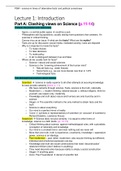
Lecture 1: Introduction
Part A: Clashing views on Science (p.11-14)
Preface: the problem with facts today
- Agora = a central public space → could be a pub
- Philosophers ask big questions, usually raising more questions than answers. An
exercise in critical thinking.
- Corona virus as an issue → what are the facts? What are the myths?
- Facts are up for discussion (social media, mediated society), facts are disputed
- Why is it important to know the facts?
o To make choices
o To take decisions
o To make policy
o In all: to distinguish between true and false
- Where do we usually look for facts?
o Science: natural and social sciences
o Science is the “crowning achievement of the human mind”
▪ Natural facts e.g., water freezes
▪ Social facts e.g., we are more literate now than in 1475
▪ Technological facts
Two philosophical positions about science
- Scientism → ‘science is vastly superior to all other attempts at securing knowledge:
its laws provide certainty’ (book, p. 11)
o We have certainty through science. Facts, science is the truth, rationality
o Modernism = = modern thinking: rational-secular (= without religion), think for
yourself, use reason only; modernity
o Knowledge and truth about nature and humans are only found by and in
science
o Slogan → The scientific method is the only method to obtain facts and the
truth
o Science is about everything
o Our mind is a perfect mirror of reality
o ‘Icons’ (= symbols or representatives) of scientism (or ‘accused’ of scientism):
Richard Dawkins, Lawrence Krauss
- Scepticism → Science does not give certainty, it is equal to other forms of
knowledge, science is a faith (book, pp. 12-13)
o Critical thinking about science, against methodological rules, with a pluralistic
conception of rationality and knowledge
o Our mind is a crooked mirror; we know nothing and we never will
o More than one truth, truth is experience, uncertainty, knowledge = oppressive
power, science is an ideology
o Post modernism = post (after) modernism: also secular thinking but different:
individual and emotional expression are key
o Knowledge and truth are social constructions that need ‘deconstruction’
relativism/nihilism (don’t believe in anything)
o They need deconstruction because reality is simply a social construction
o Slogan → anything goes
o Icons: Paul Feyerabend → denial of scientific fact
,PSM – science in times of ‘alternative facts’ and political correctness
- Ongoing debate, keeps coming back in the history of philosophy of science
Anything Goes?
- Philosophical scepticism is critical thinking about science within the boundaries of
philosophy → epistemic (knowledge) scepticism
- A radical interpretation of philosophical scepticism has become like a raging fire in
society (= relativism = everything is relative; science is just an opinion)
- Scientism vs scepticism is the background of the issue/societal debate in society:
o ‘alternative facts’
o ‘fact free politics’
o fake news
o post-truth’ era
o political correctness, freedom of speech, identity politics and conformism
- Misinformation or disinformation
- Scepticism examples in society → vaccinations, climate change, flat earth
- Relativism → there is no such thing as truth, everyone has their own truth
Part B: Exploring the world scientifically (Watt &
Van den Berg, p.1-10)
Exploring humans: How do we investigate the world?
- Humans are explorative, curiosity defines human consciousness
- Observations provides us with evidence for explorations
- Two basic exploration styles
o Naïve inquiry → Non formalized, non systematic and non controlled form of
collecting and summarizing information into naive theories (Watt & Van den
Berg, 2002. p. 3)
o Scientific Inquiry → ‘highly formalized, systematic and controlled inquiry’
‘observations and reasoning are error prone’ (Watt & van den Berg, 2002, p.
3) By using the scientific method, always aware of the temporality of their
conclusions
- Naïve inquiry
o Common sense: what we do in daily life
o Premodern thinking: religious thinking, belief in a given truth (e.g. by a god)
o Non-sophisticated ways of knowing reality (fixing belief)
o Methods of knowing
▪ Tenacity: what is commonly known is true
▪ Authority: high regarded person speaks the truth
▪ Reasonable man: reason and logical consistency is key to this method
of knowing (Watt & Van den Berg, 2002, p. 6-7)
o E.g. superstitions, astrology, religion, conspiracy
o Biases, convictions, popular scepticism, some forms of postmodernism, myth
o ‘Slogan → ‘I have this theory’: The use of the word theory when a hypothesis
or speculation is meant, not scientific
- Scientific Inquiry
o ‘Science shifts the locus of truth from single individuals to groups, by
establishing a set of mutually agreed upon rules for establishing truth.’ (Watt
& Van den Berg, p. 7)
o -The scientific method -Modern thinking -Analytical-empirical approach;
experimental research – empirical cycle
,PSM – science in times of ‘alternative facts’ and political correctness
o Critical shift in perspective compared to naive inquiry
o Internal beliefs should be supported by external evidence
o Methodological rigour, modelling
o Slogan → Truth is an objective reality ‘out there’ and our ideas do not alter
that reality We develop theories that are true
The 5 pillars of the scientific method
- “A theory is a set of interrelated constructs (concepts), definitions, and propositions
that present a systematic view of phenomena by specifying relations among
variables, with the purpose of explaining and predicting the phenomena.” (Kerlinger,
1986, in Watt & Van den Berg, 2002, p. 2; explanation p.2-3)
- Develop theories by using the scientific method: testing theories, control of
alternative explanations, attention for the nature of relationships, use observable
evidence (Watt & Van den Berg, 2002, p. 4-6)
- Scientific method:
, PSM – science in times of ‘alternative facts’ and political correctness
o 1. The use and selection of concepts (variables)
o 2. Linking concepts (variables) to propositions (hypotheses)
o 3. Testing theories with observable evidence
o 4. The definition of concepts (variables)
o 5. The publication of definitions and procedures
o 6. Control of alternative explanation
o 7. Unbiased selection of evidence
o 8. Reconciliation of theory and observation
- Goal of science is to find true, and content-rich statements, laws, or theories relating
to a given domain of phenomena (Schurz, p. 19) (e.g. communication)
o 1st pillar → Empiricism, science is about observable phenomena
o 2nd pillar → realism
o 3rd pillar → objectivity
o 4th pillar → Logic, reasoning
o 5th pillar → critical thinking, humans are fallible, could always be wrong
- Scientists are careful with what they say because they are unsure.
A bird’s eye view of the course. Why are we studying this? How is it relevant?
- Philosophy of science
o Special branch of philosophy: analyses the methods of inquiry used in the
sciences
o Main questions in philosophy of science:
▪ What are the sources of knowledge?
▪ What is science and how does it differ from nonscience?
▪ How do we handle knowledge and science today?
▪ What is rational, what is truth and what is real?
▪ What is wisdom about science?
o Meta theory (= theory about theory, e.g. what is the theory behind
communication science theories?)
- The story of enlightenment = one of the greatest intellectual projects in human history
- Key Points:
o Facts are problematic these days (and they have always been)
o There are two philosophical positions on science (and every position in
between): scientism and scepticism
o Connected to modern and post modern (and sometimes relativistic thinking).
Anything goes? Does it?
o Humans are exploring creatures and have two contrasting ways of knowing
and researching: naive inquiry and scientific inquiry (the scientific method)
o Science aims to find true, objective and real theories by using observation,
logic and a critical attitude How did we (as humankind) end up here?
o How can science reach it’s goal? What have philosophers thought about
science through the ages and what have they done to defy scepticism and
relativism?
Lecture 1: Introduction
Part A: Clashing views on Science (p.11-14)
Preface: the problem with facts today
- Agora = a central public space → could be a pub
- Philosophers ask big questions, usually raising more questions than answers. An
exercise in critical thinking.
- Corona virus as an issue → what are the facts? What are the myths?
- Facts are up for discussion (social media, mediated society), facts are disputed
- Why is it important to know the facts?
o To make choices
o To take decisions
o To make policy
o In all: to distinguish between true and false
- Where do we usually look for facts?
o Science: natural and social sciences
o Science is the “crowning achievement of the human mind”
▪ Natural facts e.g., water freezes
▪ Social facts e.g., we are more literate now than in 1475
▪ Technological facts
Two philosophical positions about science
- Scientism → ‘science is vastly superior to all other attempts at securing knowledge:
its laws provide certainty’ (book, p. 11)
o We have certainty through science. Facts, science is the truth, rationality
o Modernism = = modern thinking: rational-secular (= without religion), think for
yourself, use reason only; modernity
o Knowledge and truth about nature and humans are only found by and in
science
o Slogan → The scientific method is the only method to obtain facts and the
truth
o Science is about everything
o Our mind is a perfect mirror of reality
o ‘Icons’ (= symbols or representatives) of scientism (or ‘accused’ of scientism):
Richard Dawkins, Lawrence Krauss
- Scepticism → Science does not give certainty, it is equal to other forms of
knowledge, science is a faith (book, pp. 12-13)
o Critical thinking about science, against methodological rules, with a pluralistic
conception of rationality and knowledge
o Our mind is a crooked mirror; we know nothing and we never will
o More than one truth, truth is experience, uncertainty, knowledge = oppressive
power, science is an ideology
o Post modernism = post (after) modernism: also secular thinking but different:
individual and emotional expression are key
o Knowledge and truth are social constructions that need ‘deconstruction’
relativism/nihilism (don’t believe in anything)
o They need deconstruction because reality is simply a social construction
o Slogan → anything goes
o Icons: Paul Feyerabend → denial of scientific fact
,PSM – science in times of ‘alternative facts’ and political correctness
- Ongoing debate, keeps coming back in the history of philosophy of science
Anything Goes?
- Philosophical scepticism is critical thinking about science within the boundaries of
philosophy → epistemic (knowledge) scepticism
- A radical interpretation of philosophical scepticism has become like a raging fire in
society (= relativism = everything is relative; science is just an opinion)
- Scientism vs scepticism is the background of the issue/societal debate in society:
o ‘alternative facts’
o ‘fact free politics’
o fake news
o post-truth’ era
o political correctness, freedom of speech, identity politics and conformism
- Misinformation or disinformation
- Scepticism examples in society → vaccinations, climate change, flat earth
- Relativism → there is no such thing as truth, everyone has their own truth
Part B: Exploring the world scientifically (Watt &
Van den Berg, p.1-10)
Exploring humans: How do we investigate the world?
- Humans are explorative, curiosity defines human consciousness
- Observations provides us with evidence for explorations
- Two basic exploration styles
o Naïve inquiry → Non formalized, non systematic and non controlled form of
collecting and summarizing information into naive theories (Watt & Van den
Berg, 2002. p. 3)
o Scientific Inquiry → ‘highly formalized, systematic and controlled inquiry’
‘observations and reasoning are error prone’ (Watt & van den Berg, 2002, p.
3) By using the scientific method, always aware of the temporality of their
conclusions
- Naïve inquiry
o Common sense: what we do in daily life
o Premodern thinking: religious thinking, belief in a given truth (e.g. by a god)
o Non-sophisticated ways of knowing reality (fixing belief)
o Methods of knowing
▪ Tenacity: what is commonly known is true
▪ Authority: high regarded person speaks the truth
▪ Reasonable man: reason and logical consistency is key to this method
of knowing (Watt & Van den Berg, 2002, p. 6-7)
o E.g. superstitions, astrology, religion, conspiracy
o Biases, convictions, popular scepticism, some forms of postmodernism, myth
o ‘Slogan → ‘I have this theory’: The use of the word theory when a hypothesis
or speculation is meant, not scientific
- Scientific Inquiry
o ‘Science shifts the locus of truth from single individuals to groups, by
establishing a set of mutually agreed upon rules for establishing truth.’ (Watt
& Van den Berg, p. 7)
o -The scientific method -Modern thinking -Analytical-empirical approach;
experimental research – empirical cycle
,PSM – science in times of ‘alternative facts’ and political correctness
o Critical shift in perspective compared to naive inquiry
o Internal beliefs should be supported by external evidence
o Methodological rigour, modelling
o Slogan → Truth is an objective reality ‘out there’ and our ideas do not alter
that reality We develop theories that are true
The 5 pillars of the scientific method
- “A theory is a set of interrelated constructs (concepts), definitions, and propositions
that present a systematic view of phenomena by specifying relations among
variables, with the purpose of explaining and predicting the phenomena.” (Kerlinger,
1986, in Watt & Van den Berg, 2002, p. 2; explanation p.2-3)
- Develop theories by using the scientific method: testing theories, control of
alternative explanations, attention for the nature of relationships, use observable
evidence (Watt & Van den Berg, 2002, p. 4-6)
- Scientific method:
, PSM – science in times of ‘alternative facts’ and political correctness
o 1. The use and selection of concepts (variables)
o 2. Linking concepts (variables) to propositions (hypotheses)
o 3. Testing theories with observable evidence
o 4. The definition of concepts (variables)
o 5. The publication of definitions and procedures
o 6. Control of alternative explanation
o 7. Unbiased selection of evidence
o 8. Reconciliation of theory and observation
- Goal of science is to find true, and content-rich statements, laws, or theories relating
to a given domain of phenomena (Schurz, p. 19) (e.g. communication)
o 1st pillar → Empiricism, science is about observable phenomena
o 2nd pillar → realism
o 3rd pillar → objectivity
o 4th pillar → Logic, reasoning
o 5th pillar → critical thinking, humans are fallible, could always be wrong
- Scientists are careful with what they say because they are unsure.
A bird’s eye view of the course. Why are we studying this? How is it relevant?
- Philosophy of science
o Special branch of philosophy: analyses the methods of inquiry used in the
sciences
o Main questions in philosophy of science:
▪ What are the sources of knowledge?
▪ What is science and how does it differ from nonscience?
▪ How do we handle knowledge and science today?
▪ What is rational, what is truth and what is real?
▪ What is wisdom about science?
o Meta theory (= theory about theory, e.g. what is the theory behind
communication science theories?)
- The story of enlightenment = one of the greatest intellectual projects in human history
- Key Points:
o Facts are problematic these days (and they have always been)
o There are two philosophical positions on science (and every position in
between): scientism and scepticism
o Connected to modern and post modern (and sometimes relativistic thinking).
Anything goes? Does it?
o Humans are exploring creatures and have two contrasting ways of knowing
and researching: naive inquiry and scientific inquiry (the scientific method)
o Science aims to find true, objective and real theories by using observation,
logic and a critical attitude How did we (as humankind) end up here?
o How can science reach it’s goal? What have philosophers thought about
science through the ages and what have they done to defy scepticism and
relativism?