Chapter 17 - Effects of Heat and Its Transmission
I. Expansion and Contraction
When heated, molecules and atoms vibrate faster. As atoms vibrate faster, the space
between atoms increases until the bonds between the molecules break off
When cooled, molecules and atoms vibrate slower. As atoms vibrate slower, the
space between atoms decreases and molecules bond more closely
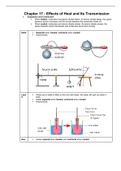
Solid Expands when heated, contracts when cooled
Experiments:
Liqui When pot or kettle is filled to the brim with water, the water will spill out when it
d boils
Water expands when heated, contracts when cooled
Experiments:
Gas Gases expand when heated, and contracts when cooled
, II. Measuring Temperature
Common unit of temperature: Celsius (°C)
o Celsius starts at 0 (melting point of ice)
SI unit for temperature: Kelvin (°K)
o Kelvin starts at absolute zero (the absence of all heat)
Kelvin = Celsius + 273.15
Mercury is used to measure temperature in the thermometer.
o NO ADVANTAGES, very poisonous.
o Mercury results in several diseases.
III. Effects of Heat in Everyday Life
When an object expands or contracts, large forces are produced, which could either
help us or cause problems
Example of common problems:
Problems Solutions
Roads and pathways - on hot Tiles on pavement and walls are laid with expansion gaps
days, roads may crack or pop
out
MRT and railway tracks - Gaps are present in tracks to allow expansion
become misshaped due to
expansion
Bridges and metal girders - Built with expansion gaps or a free end resting on wheels
damaged during hot weather
I. Expansion and Contraction
When heated, molecules and atoms vibrate faster. As atoms vibrate faster, the space
between atoms increases until the bonds between the molecules break off
When cooled, molecules and atoms vibrate slower. As atoms vibrate slower, the
space between atoms decreases and molecules bond more closely
Solid Expands when heated, contracts when cooled
Experiments:
Liqui When pot or kettle is filled to the brim with water, the water will spill out when it
d boils
Water expands when heated, contracts when cooled
Experiments:
Gas Gases expand when heated, and contracts when cooled
, II. Measuring Temperature
Common unit of temperature: Celsius (°C)
o Celsius starts at 0 (melting point of ice)
SI unit for temperature: Kelvin (°K)
o Kelvin starts at absolute zero (the absence of all heat)
Kelvin = Celsius + 273.15
Mercury is used to measure temperature in the thermometer.
o NO ADVANTAGES, very poisonous.
o Mercury results in several diseases.
III. Effects of Heat in Everyday Life
When an object expands or contracts, large forces are produced, which could either
help us or cause problems
Example of common problems:
Problems Solutions
Roads and pathways - on hot Tiles on pavement and walls are laid with expansion gaps
days, roads may crack or pop
out
MRT and railway tracks - Gaps are present in tracks to allow expansion
become misshaped due to
expansion
Bridges and metal girders - Built with expansion gaps or a free end resting on wheels
damaged during hot weather