100% satisfaction guarantee Immediately available after payment Both online and in PDF No strings attached 4.6 TrustPilot
logo-home
Exam (elaborations)

PYC3703 Cognitive Psychology (2021 - Semester 1 and Semester 2 - Assignment 4)

Rating
5.0
(1)
Sold
2
Pages
11
Grade
A+
Uploaded on
19-08-2021
Written in
2021/2022

PYC3703 – Cognitive Psychology 2021 – Semester 1 and Semester 2 – Assignment 4 Question #1: Familiarity is associated with semantic memory because it is not associated with the circumstances under which knowledge was acquired. Recollection is associated with episodic memory because it includes details about what was happening when the knowledge was acquired and an awareness of the event as it was experienced in the past. These two ways of remembering have been measured using the … procedure. 1. semanticisation of remote 2. remember/know 3. personal semantic 4. autobiographical Question #2 Which one of the following is the best example of specifically explicit memory task? 1. You are shown a set of photos, and you are asked which ones are familiar because you have seen them before. 2. You supply free associations more quickly to words you have seen before than to unfamiliar words. 3. You are shown some word fragments, and you complete the words more quickly if you have seen them before. 4. You dial a familiar phone number more quickly than an unfamiliar phone number. Question #3: [The] ... is a result of priming, which occurs when the presentation of one stimulus changes the way a person responds to another. Individuals are thus more likely to rate statements they have read or heard before as being true simply because they have been exposed to them before. 1. classical conditioning 2. incidental encoding 3. propaganda effect 4. operant conditioning Question 4: The serial recall of a list of items can be impaired if ... 1. the list is followed by as tone 2. the list is read too slowly 3. the list is followed by speech 4. the list is visually presented Question 5: The best explanation for the suffix effect is ... 1. decay theory 2. long term memory overload 3. interference theory 4. lack of attention Question 6: What specific kind of memory task does the encoding specificity effect work best with? 1. recognition memory tests 2. matching 3. true or false 4. recall memory tests Question 7: The beneficial effects of active involvement have also been demonstrated literally by the so-called ... 1. testing effect 2. encoding specificity 3. context reinstatement 4. enactment effect Question 8: According to the levels-of-processing framework, as originally proposed, if you were shown semantically related words (e.g., dog and animal), rhyming words (e.g., dog and log), as well as unrelated words, the words most easily recalled would be the ... 1. words concretely connected 2. semantically related words 3. unrelated words 4. All words would be recalled about equally Question 9: One of the main findings of research on flashbulb memories is that although people report that memories surrounding flashbulb events are especially vivid, they are often ... 1. too emotionally coloured 2. very quickly forgotten 3. inaccurate or lacking in detail 4. not very believable Question 10: The idea that we remember life events better because we encounter the information over and over in what we read, see on TV, and talk about with other people is called the ... 1. narrative rehearsal hypothesis 2. cognitive hypothesis 3. life-narrative hypothesis 4. reminiscence hypothesis Question 11: According to the ... approach to memory, what people report as memories are based on what actually happened plus additional factors such as other knowledge, experiences, and expectations. 1. event-specific 2. source 3. misinformation 4. constructive Question 12: Jackie went to the grocery store to pick up yogurt, bread, and apples. First, she picked up a hand basket for carrying her groceries, and then she searched the store. After finding what she needed, she stood in a check-out line. Then, the cashier put her items in a bag, and soon after, Jackie left the store. As readers of this event, we understand that Jackie paid for the groceries, even though it wasn't mentioned, because we are relying on a grocery store ... 1. script 2. misattribution 3. narrative 4. schema Question 13: Unconscious plagiarism of the work of others is known as ... 1. cryptomnesia 2. narrative rehearsal 3. repeated reproduction 4. repeated recall Question 14: Your friend has been sick for several days, so you go over to her home to make her some chicken soup. Searching for a spoon, you first reach in a top drawer beside the dishwasher. Then, you turn to the big cupboard beside the stove to search for a pan. In your search, you have relied on a kitchen ... 1. source memory 2. script 3. scan technique 4. schema Question 15: The misinformation effect occurs when a person’s memory for an event is modified by misleading information presented ... 1. before the event 2. during the event 3. after the event 4. all of these Question 16: Which of the following is the most accurate statement regarding post-event information and the misinformation effect? 1. The misinformation effect does not occur when people are told explicitly that the post-event information may be incorrect. 2. Misinformation effects are significantly reduced when post-event information is provided, but only if that information is given within just a few minutes of the initial event. 3. Even when participants are told that the post-event information is incorrect, the misinformation effect can still occur. 4. The provision of accurate post-event information provided a paradoxical (and as of yet unexplained) increase in the misinformation effect. Question 17: The information processing approach describes problem-solving as a process involving ... 1. design fixation 2. search 3. creative cognition 4. insight Question 18: In the Tower of Hanoi problem, the ... state involves having three discs stacked on the left peg, with the middle and right pegs empty. 1. initial 2. transitory 3. goal 4. intermediate Question 19: Kaplan and Simon's (1990) experiment presented different versions of the mutilated checkerboard problem. The main purpose of their experiment was to demonstrate that ... 1. the way the problem is represented can influence the ease of problem solving. 2. people arrive at the solution to an insight problem suddenly, but proceed more methodically towards the solution of a non-insight problem. 3. a person's mental set can hinder finding a solution to a problem. 4. people often have to backtrack within the problem space to arrive at an answer to a problem. Question 20: Iyengar and Lepper (2000) showed that having more choice often leads to ... 1. more purchasing and more satisfaction with the chosen alternatives. 2. more purchasing but less satisfaction with the chosen alternatives. 3. less purchasing and less satisfaction with the chosen alternatives. 4. less purchasing but more satisfaction with the chosen alternative. Question 21: All of the students are tired. Some tired people are irritable. Some of the students are irritable. It is likely that most people will judge this syllogism as ... 1. invalid because of the influence of the atmosphere effect. 2. invalid because this syllogism does not involve a pragmatic reasoning schema. 3. valid because this is indeed a valid syllogism and the logic is apparent. 4. valid because this conclusion is believable. Question 22: The Gestalt psychologists also introduced the idea that restructuring is associated with ... the sudden realisation of a problem's solution. 1. insight 2. two-string problem 3. fixation 4. the mental set Question 23: Mr Jones always passes back exams to his algebra class in descending order (the highest grade is handed out first). Today, Lisa was the first to receive her exam. Joy complained, remarking, "Lisa, you always get the highest grade in algebra. It was true all last year and so far, this year." Lisa was not sure if this was correct. To figure out if this was true, Lisa should ... 1. search her memory for instances when she did not get her exam back first. 2. search her memory for instances when she did get her exam back first. 3. wait until the next exam is passed back to see if she gets hers back first. 4. search her memory for instances when she did get her exam back first and for instances when she did not. Question 24: Which of the following statements would most likely invoke the operation of a permission schema? 1. If I get an A on my cognitive psychology exam, I can go out with my friends Saturday night. 2. No artists can be beekeepers, but some beekeepers must be chemists. 3. All A are B. All B are C. Therefore; all A are C. 4. I forgot to charge my cell phone last night; therefore I missed an important call today. Question 25: Given its definition, expected utility theory is most applicable to deciding whether to ... 1. break up or stay involved with a current girlfriend. 2. buy first class or coach tickets for a spring break trip. 3. go out for a University hockey or basketball game. 4. take astronomy or geology as a physical science elective course. Question 26: Cecile has dreamed of owning her own home for years, and she can finally afford a small cottage in an older neighbourhood. She notices that she feels more positive about her home when she drives home by the abandoned shacks, but she hates her home when driving past the fancy mansions with their large lawns. Cecile's emotions are influenced by ... 1. the principle of diversity 2. confirmation bias 3. the law of large numbers 4. the framing effect Question 27: Karim works for Citrus Squeeze, a company that makes orange juice. Sales of their calcium-enhanced orange juice have been poor, and the product was cancelled. His factory still had three cases of cartons, and Karim was told he could take them if he wanted them. Karim made several birdfeeders for his backyard with the cartons and planted tree seedlings in some of them; he used the remaining ones to build a “fort” for his four-year-old son. Karim's use of the cartons represents ... 1. convergent thinking 2. insight 3. divergent thinking 4. hierarchical organization Question 28: According to the review by Baas et al. (2008), which mood will enhance creativity the most? 1. anger 2. sadness 3. cheerful 4. content Question 29: The ability to shift experience from one problem-solving situation to a similar problem is known as ... 1. analogical encoding 2. insight 3. analogical transfer 4. in vivo problem solving Question 30: ... occur when a correlation between two events appears to exist, but in reality, there is no correlation, or it is much weaker than it is assumed to be. 1. stereotypes 2. base rates 3. illusionary correlations 4. intermediate states

Show more Read less
Institution
Course


Whoops! We can’t load your doc right now. Try again or contact support.

Written for

Institution
Course

Document information

Uploaded on
August 19, 2021
File latest updated on
July 15, 2022
Number of pages
11
Written in
2021/2022
Type
Exam (elaborations)
Contains
Questions & answers

Subjects

Content preview

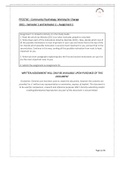
Assignment 04


This assignment is compulsory; you must submit it! It is based on chapters 5, 6, 7, 8, 12 and
13 of the prescribed book: Cognitive Psychology (2018).

Note that this assignment contributes towards your year mark (see page 8 of this tutorial
letter). Select the most appropriate option in cases where you think that more than one could
be correct.

QUESTION 1

Familiarity is associated with semantic memory because it is not associated with the
circumstances under which knowledge was acquired. Recollection is associated with episodic
memory because it includes details about what was happening when the knowledge was
acquired and an awareness of the event as it was experienced in the past. These two ways of
remembering have been measured using the - - - - - procedure.

1. semanticization of remote
2. remember/know
3. personal semantic
4. autobiographical

Option 2 is the correct answer. Petrican et al. (2010) determined how people’s memory for
public events changes over time by presenting descriptions of events that had happened over
a 50-year period to older adults (average age = 63 years) and asking them to respond
remember if they had a personal experience associated with the event or recollected seeing
details about the event on TV or in the newspaper. They were to respond know if they were
familiar with the event but couldn’t recollect any personal experience or details related to
media coverage of the event. If they couldn’t remember the event at all, they were to respond
don’t know (CP, p. 179).

QUESTION 2

Which one of the following is the best example of a specifically explicit memory task?

1. You are shown a set of photos, and you are asked which ones are familiar because
you have seen them before.
2. You supply free associations more quickly to words you have seen before than to
unfamiliar words.
3. You are shown some word fragments, and you complete the words more quickly if you
have seen them before.
4. You dial a familiar phone number more quickly than an unfamiliar phone number.

Option 1 is correct. Note that you are required to identify familiar photos, and the task therefore
specifically probes explicit memory (see CP, p.178). In the other tasks both explicit and implicit
memory processes are involved.


Reviews from verified buyers

Showing all reviews
4 year ago

5.0

1 reviews

5
1
4
0
3
0
2
0
1
0
Trustworthy reviews on Stuvia

All reviews are made by real Stuvia users after verified purchases.

Get to know the seller

Seller avatar
Reputation scores are based on the amount of documents a seller has sold for a fee and the reviews they have received for those documents. There are three levels: Bronze, Silver and Gold. The better the reputation, the more your can rely on the quality of the sellers work.
studentworx University of South Africa (Unisa)
Follow You need to be logged in order to follow users or courses
Sold
460
Member since
6 year
Number of followers
313
Documents
0
Last sold
1 year ago
Studentworx

4.2

69 reviews

5
38
4
17
3
9
2
2
1
3

Recently viewed by you

Why students choose Stuvia

Created by fellow students, verified by reviews

Quality you can trust: written by students who passed their tests and reviewed by others who've used these notes.

Didn't get what you expected? Choose another document

No worries! You can instantly pick a different document that better fits what you're looking for.

Pay as you like, start learning right away

No subscription, no commitments. Pay the way you're used to via credit card and download your PDF document instantly.

Student with book image

“Bought, downloaded, and aced it. It really can be that simple.”

Alisha Student

Frequently asked questions