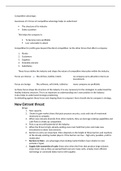
Competitive advantage:
Awareness of 5 forces of competitive advantage helps to understand
The structure of its industry
Stake a position
This helps the company in:
To become more profitable
Less vulnerable to attack
Competition for profits goes beyond the direct competition. So the other forces that affect a company:
1. Rivalry
2. Customers
3. Suppliers
4. Potential entrants
5. Substitutes
These forces define the industry and shape the nature of competitive interaction within the industry.
Forces are intense like Airlines, textiles, hotels no company earns attractive returns on
Investments.
Forces are benign like software, soft drinks, toiletries many company are profitable
As these forces shape the structure of the industry it is very necessary for the strategists to understand the
healthy industry structure. This is as important as understanding one’s own position in the industry.
It also helps to understand strategic positioning.
So defending against these forces and shaping them in company’s favor should also be company’s strategy.
New Entrant threat:
Brings
1. New capacity
2. Desire to gain market share that puts pressure on price, costs and rate of investment
necessary to compete.
3. When new entrants diversify from other markets, they can leverage existing capabilities and
cash flows to shake up competition.
4. Puts a cap on profit potential of the industry.
5. When the threat is high, already existing ones must hold their price and make new
investments to deter new entrants.
6. Barriers to entry are important. Entry depends on the height of these barriers and reactions
of the already existing market players. If the barriers are low – high entry possible- profit is
moderated.
Barriers to Entry: are advantages that existing market holders have relative to new
entrants.7 types
1. Supply side economies of scale: these arise when the firms that produce large volumes
enjoy lower cost as they can spread fixed cost over many units, employ more efficient
technology or command better terms with supplier.
Awareness of 5 forces of competitive advantage helps to understand
The structure of its industry
Stake a position
This helps the company in:
To become more profitable
Less vulnerable to attack
Competition for profits goes beyond the direct competition. So the other forces that affect a company:
1. Rivalry
2. Customers
3. Suppliers
4. Potential entrants
5. Substitutes
These forces define the industry and shape the nature of competitive interaction within the industry.
Forces are intense like Airlines, textiles, hotels no company earns attractive returns on
Investments.
Forces are benign like software, soft drinks, toiletries many company are profitable
As these forces shape the structure of the industry it is very necessary for the strategists to understand the
healthy industry structure. This is as important as understanding one’s own position in the industry.
It also helps to understand strategic positioning.
So defending against these forces and shaping them in company’s favor should also be company’s strategy.
New Entrant threat:
Brings
1. New capacity
2. Desire to gain market share that puts pressure on price, costs and rate of investment
necessary to compete.
3. When new entrants diversify from other markets, they can leverage existing capabilities and
cash flows to shake up competition.
4. Puts a cap on profit potential of the industry.
5. When the threat is high, already existing ones must hold their price and make new
investments to deter new entrants.
6. Barriers to entry are important. Entry depends on the height of these barriers and reactions
of the already existing market players. If the barriers are low – high entry possible- profit is
moderated.
Barriers to Entry: are advantages that existing market holders have relative to new
entrants.7 types
1. Supply side economies of scale: these arise when the firms that produce large volumes
enjoy lower cost as they can spread fixed cost over many units, employ more efficient
technology or command better terms with supplier.