Cell structure
Eukaryotic cells
Eukaryotic cells are complex and include all animal and plant cells whereas
prokaryotic cells are smaller and simpler eg, bacteria.
Plant cells have the same organelles as animal cells with a few extras:
A cell wall with plasmodesmata – channels for exchanging substances with
adjacent cells
A vacuole – compartment that contains cell sap
Chloroplasts
Organelles
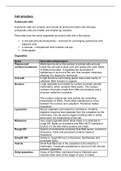
Name Description/Explanation
Plasma (cell Membrane found on the surface of animal cells and just
surface) membrane inside the cell wall of plant cells and prokaryotic cells. Made
of lipids and protein. It regulates the movement of
substances in and out of the cell. Has receptor molecules
allowing it to respond to hormones.
Cell wall A rigid structure surrounding plants cells made mainly of
cellulose. Main function is support.
Nucleus Large organelle surrounded by nuclear envelope (double
membrane), which contains many pores. The nucleus
contains chromatin (made from DNA and proteins) and a
structure called the nucleolus.
The nucleus controls the cells activity (by controlling
transcription of DNA). Pores allow substances to move
between the nucleus and cytoplasm. Nucleolus makes
ribosomes.
Lysosome Round organelle surrounded by membrane. Contains
digestive enzymes kept separate from the cytoplasm by the
membrane. Can be used to digest invading cells or break
down worn out components of the cell.
Ribosome Very small organelle which floats freely or is attached to
rough ER. Made up of proteins and RNA (NOT membrane
bound). It’s the site where proteins are made.
Rough ER System of membranes enclosing fluid filled space, covered in
ribosomes. Folds and processes proteins made at
ribosomes.
Smooth ER Similar to rough ER but no ribosomes. Synthesises and
processes lipids.
Vesicle Small fluid-filled sac in the cytoplasm surrounded by a
membrane. Transports substances in and out of the cell and
between organelles.
Golgi apparatus Group of fluid filled, membrane bound, flattened sacs.
Vesicles often seen at the edges of sacs. It makes
, lysosomes as well as packages new lipids and proteins.
Mitochondrion Have a double membrane – inner one folded into cristae.
Inside is the matrix containing enzymes involved in
respiration. It’s the site of aerobic respiration, where ATP is
produced. Found i large numbers in very active cells.
Chloroplast Surrounded by double membrane and also has membranes
inside called thylakoid membranes. Membranes are stacked
up to form grana and grana are linked by lamellae – thin, flat
pieces of thylakoid membrane. The site where
photosynthesis takes place.
Centriole Small hollow cylinders made of microtubules. Found in
animal cells but only some plant cells. Involved in separation
of chromosomes during cell division.
Cilia Hair like structures found on surface membrane of some
animal cells. In cross section, they have an outer membrane
and a ring of nine pairs of protein microtubules with two
microtubules in the middle. These allow the cilia to move
substances along the surface of the cell.
Flagellum Stick out from the cell surface and are surrounded by the
plasmas membrane – two microtubules in the centre and
nine pairs round the edge. Microtubules contract to make the
flagella move.
The cytoplasm is made up of two parts:
Cytosol = liquid containing glucose, water, and amino acids. Its where all the
reactions take place in the cell. Pressure in the cytosol pushes against
membrane to give it its shape.
Cytoskeleton = network of protein threads arranged in microtubules (hollow
cylinders) and microfilaments (solid threads). The microtubules can attach to
cell organelles to move them around the cell (ATP needed – active process)
Support
Strengthen and maintain cell shape
Transport materials
Movement of the cell
Division of labour
Proteins made at ribosomes.
Ribosomes on rough ER make proteins that are excreted or attached to the
cell membrane whereas free ribosomes in the cytoplasm make proteins that
stay in the cytoplasm.
New proteins produced on the rougher are processed and folded on the rough
ER.
Transported from ER to golgi apparatus in vesicles.
At the golgi, proteins undergo further processing.
Proteins enter more vesicles to be transported around the cell.
, Prokaryotic cells
Extremely small – 2 micrometers
DNA is circular
No nucleus – DNA free in cytoplasm
Cell wall made of polysaccharide but not cellulose eg peptidoglycan
Few organelles and no membrane bound organelles
Flagella made from protein flagellin, arrange in helix
Small ribosomes
Microscopes
Magnification = the degree to which the size of an image is larger than the object
itself. The larger the magnification, the greater the size of the image.
Overall magnification = eyepiece magnification X objective magnification
Resolution = the ability to distinguish between two separate objects
Light microscope Laser scanning Transmission Scanning electron
confocal Microscope electron microscope microscope
Relies upon light Uses laser beams to Uses electromagnets Scans a beam of
reflected through a produce a computerised to focus beam of electrons over the
mirror passing image. Specimen being electrons transmitted surface of the
through 2 lenses to scanned is tagged with through specimen. specimen. Electrons
produce a magnified fluorescent dye. When Denser parts of are knocked off the
image. laser hits dye, it emits specimen absorb more surface of the
Cheap fluorescent light which electrons so appear specimen which are
Easier to prepare is picked up by a darker. gathered in a
slide detector. Mag = x500,000 + cathode ray to form
Mag = x1500 Clearer image Resolution = 0.2nm an image.
Resolution = 0.2 Depth focusing Have to add lead Specimens can
micrometers Layer images (3D) salts to help scatter be 3D
Sample must be High levels of electrons (better Mag = less than
thin for light to contrast contrast) – can 500,000
pass through – Mag = x25,000 build up and form Resolution = 2nm
staining (acetic Resolution = 5 nm ‘artefacts’ on
orcein for DNA) specimen
Artefact = structures that result from the specimen preparation process that aren’t
representative of the tissues of the original structure.
For light microscopes, sample can be stained to create contrast. Different parts of
the cell will take up more stain than others. Methylene blue stains DNA. More than
one stain can be used at once.
For electron microscopes, specimens can be dipped in solution of heavy metals like
lead. The metal ions scatter the electrons creating contrast.
, To measure cells, we use an eyepiece graticule and a stage micrometer. The eye
piece graticule is fitted into the eyepiece and has small divisions but no units. The
stage micrometer is placed on the stage, it a microscope slide with an accurate
scale and is used to work out the value of the divisions on the eyepiece graticule at a
particular magnification.
Biological molecules
Water
Overall the molecule has no charge
The nucleus of the oxygen atom has a tendency to pull the shared electrons
in the covalent bond towards itself (more electronegative) and away from the
hydrogen atoms
This gives the oxygen atom a slight negative charge and hydrogen atoms a
slight positive charge
A hydrogen bond is where the slightly positive pole of one water molecule
attracts the slightly negative pole of another water molecule
Hydrogen bonds are transient – easily made, easily broken
Water has a high specific heat capacity (energy needed to heat 1g of water
by 1 degree celcius) because hydrogen bonds can absorb lots of energy so
lots of energy is needed to heat it up. As a result, aquatic habitats are
relatively stable which is better for organisms.
Hydrogen bonds give water a high latent heat of evaporation because a lot
of energy is required to break bonds. This means a lot of energy is used up
when water evaporates. Good for cooling down organisms – sweat
evaporates and takes heat with it.
Water is very cohesive. Cohesion is the attraction between molecules of the
same type. Water molecules are very cohesive because they’re polar. This
helps water to flow, making it great for transporting substances – transpiration
stream.
Water polarity makes it a good solvent. A lot of important substances in
biological reactions are ionic. The ions will get totally surrounded by the water
molecules which are attracted to it – they’ll dissolve.
Water’s less dense when solid as water molecules are held further apart in
ice than they are in water because each water molecule forms four hydrogen
bonds with another water molecule, making a lattice shape. This makes ice
less dense than water. Good for aquatic organisms in cold temperatures as
ice forms insulating layer and water below doesn’t freeze.
Carbohydrates
Eukaryotic cells
Eukaryotic cells are complex and include all animal and plant cells whereas
prokaryotic cells are smaller and simpler eg, bacteria.
Plant cells have the same organelles as animal cells with a few extras:
A cell wall with plasmodesmata – channels for exchanging substances with
adjacent cells
A vacuole – compartment that contains cell sap
Chloroplasts
Organelles
Name Description/Explanation
Plasma (cell Membrane found on the surface of animal cells and just
surface) membrane inside the cell wall of plant cells and prokaryotic cells. Made
of lipids and protein. It regulates the movement of
substances in and out of the cell. Has receptor molecules
allowing it to respond to hormones.
Cell wall A rigid structure surrounding plants cells made mainly of
cellulose. Main function is support.
Nucleus Large organelle surrounded by nuclear envelope (double
membrane), which contains many pores. The nucleus
contains chromatin (made from DNA and proteins) and a
structure called the nucleolus.
The nucleus controls the cells activity (by controlling
transcription of DNA). Pores allow substances to move
between the nucleus and cytoplasm. Nucleolus makes
ribosomes.
Lysosome Round organelle surrounded by membrane. Contains
digestive enzymes kept separate from the cytoplasm by the
membrane. Can be used to digest invading cells or break
down worn out components of the cell.
Ribosome Very small organelle which floats freely or is attached to
rough ER. Made up of proteins and RNA (NOT membrane
bound). It’s the site where proteins are made.
Rough ER System of membranes enclosing fluid filled space, covered in
ribosomes. Folds and processes proteins made at
ribosomes.
Smooth ER Similar to rough ER but no ribosomes. Synthesises and
processes lipids.
Vesicle Small fluid-filled sac in the cytoplasm surrounded by a
membrane. Transports substances in and out of the cell and
between organelles.
Golgi apparatus Group of fluid filled, membrane bound, flattened sacs.
Vesicles often seen at the edges of sacs. It makes
, lysosomes as well as packages new lipids and proteins.
Mitochondrion Have a double membrane – inner one folded into cristae.
Inside is the matrix containing enzymes involved in
respiration. It’s the site of aerobic respiration, where ATP is
produced. Found i large numbers in very active cells.
Chloroplast Surrounded by double membrane and also has membranes
inside called thylakoid membranes. Membranes are stacked
up to form grana and grana are linked by lamellae – thin, flat
pieces of thylakoid membrane. The site where
photosynthesis takes place.
Centriole Small hollow cylinders made of microtubules. Found in
animal cells but only some plant cells. Involved in separation
of chromosomes during cell division.
Cilia Hair like structures found on surface membrane of some
animal cells. In cross section, they have an outer membrane
and a ring of nine pairs of protein microtubules with two
microtubules in the middle. These allow the cilia to move
substances along the surface of the cell.
Flagellum Stick out from the cell surface and are surrounded by the
plasmas membrane – two microtubules in the centre and
nine pairs round the edge. Microtubules contract to make the
flagella move.
The cytoplasm is made up of two parts:
Cytosol = liquid containing glucose, water, and amino acids. Its where all the
reactions take place in the cell. Pressure in the cytosol pushes against
membrane to give it its shape.
Cytoskeleton = network of protein threads arranged in microtubules (hollow
cylinders) and microfilaments (solid threads). The microtubules can attach to
cell organelles to move them around the cell (ATP needed – active process)
Support
Strengthen and maintain cell shape
Transport materials
Movement of the cell
Division of labour
Proteins made at ribosomes.
Ribosomes on rough ER make proteins that are excreted or attached to the
cell membrane whereas free ribosomes in the cytoplasm make proteins that
stay in the cytoplasm.
New proteins produced on the rougher are processed and folded on the rough
ER.
Transported from ER to golgi apparatus in vesicles.
At the golgi, proteins undergo further processing.
Proteins enter more vesicles to be transported around the cell.
, Prokaryotic cells
Extremely small – 2 micrometers
DNA is circular
No nucleus – DNA free in cytoplasm
Cell wall made of polysaccharide but not cellulose eg peptidoglycan
Few organelles and no membrane bound organelles
Flagella made from protein flagellin, arrange in helix
Small ribosomes
Microscopes
Magnification = the degree to which the size of an image is larger than the object
itself. The larger the magnification, the greater the size of the image.
Overall magnification = eyepiece magnification X objective magnification
Resolution = the ability to distinguish between two separate objects
Light microscope Laser scanning Transmission Scanning electron
confocal Microscope electron microscope microscope
Relies upon light Uses laser beams to Uses electromagnets Scans a beam of
reflected through a produce a computerised to focus beam of electrons over the
mirror passing image. Specimen being electrons transmitted surface of the
through 2 lenses to scanned is tagged with through specimen. specimen. Electrons
produce a magnified fluorescent dye. When Denser parts of are knocked off the
image. laser hits dye, it emits specimen absorb more surface of the
Cheap fluorescent light which electrons so appear specimen which are
Easier to prepare is picked up by a darker. gathered in a
slide detector. Mag = x500,000 + cathode ray to form
Mag = x1500 Clearer image Resolution = 0.2nm an image.
Resolution = 0.2 Depth focusing Have to add lead Specimens can
micrometers Layer images (3D) salts to help scatter be 3D
Sample must be High levels of electrons (better Mag = less than
thin for light to contrast contrast) – can 500,000
pass through – Mag = x25,000 build up and form Resolution = 2nm
staining (acetic Resolution = 5 nm ‘artefacts’ on
orcein for DNA) specimen
Artefact = structures that result from the specimen preparation process that aren’t
representative of the tissues of the original structure.
For light microscopes, sample can be stained to create contrast. Different parts of
the cell will take up more stain than others. Methylene blue stains DNA. More than
one stain can be used at once.
For electron microscopes, specimens can be dipped in solution of heavy metals like
lead. The metal ions scatter the electrons creating contrast.
, To measure cells, we use an eyepiece graticule and a stage micrometer. The eye
piece graticule is fitted into the eyepiece and has small divisions but no units. The
stage micrometer is placed on the stage, it a microscope slide with an accurate
scale and is used to work out the value of the divisions on the eyepiece graticule at a
particular magnification.
Biological molecules
Water
Overall the molecule has no charge
The nucleus of the oxygen atom has a tendency to pull the shared electrons
in the covalent bond towards itself (more electronegative) and away from the
hydrogen atoms
This gives the oxygen atom a slight negative charge and hydrogen atoms a
slight positive charge
A hydrogen bond is where the slightly positive pole of one water molecule
attracts the slightly negative pole of another water molecule
Hydrogen bonds are transient – easily made, easily broken
Water has a high specific heat capacity (energy needed to heat 1g of water
by 1 degree celcius) because hydrogen bonds can absorb lots of energy so
lots of energy is needed to heat it up. As a result, aquatic habitats are
relatively stable which is better for organisms.
Hydrogen bonds give water a high latent heat of evaporation because a lot
of energy is required to break bonds. This means a lot of energy is used up
when water evaporates. Good for cooling down organisms – sweat
evaporates and takes heat with it.
Water is very cohesive. Cohesion is the attraction between molecules of the
same type. Water molecules are very cohesive because they’re polar. This
helps water to flow, making it great for transporting substances – transpiration
stream.
Water polarity makes it a good solvent. A lot of important substances in
biological reactions are ionic. The ions will get totally surrounded by the water
molecules which are attracted to it – they’ll dissolve.
Water’s less dense when solid as water molecules are held further apart in
ice than they are in water because each water molecule forms four hydrogen
bonds with another water molecule, making a lattice shape. This makes ice
less dense than water. Good for aquatic organisms in cold temperatures as
ice forms insulating layer and water below doesn’t freeze.
Carbohydrates