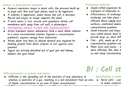
Osmosis in plants/active transport- Exchanging materials-
● Osmosis maintains turgor in plant cells, the pressure build up ● Single-celled organisms ha
to keep cells firm and rigid, plants need to be hypotonic transport of molecules in a
● If solution is hypertonic, water leaves the cell, it becomes ● Effectiveness of exchange
flaccid and turgor no longer supports the plant exchange can take place, t
● If more water is lost, vacuole and cytoplasm shrink, cell efficient blood supply move
membrane pulls away from cell wall, is plasmolysis surfaces, ventilated makes
● Investigating osmosis in plant cells required practical concentration gradient
● Active transport moves substances from a more dilute solution ● Small intestine and lungs
to a more concentrated solution (against a concentration sacs called alveoli, have lar
gradient), requires energy from respiration provide large sa, short diff
● Allows plant root hairs to absorb mineral ions required for ● Fish - gills, made up of st
healthy growth from dilute solution in soil, against conc. concentration gradient nee
gradient ● Plant roots and leaves - la
● Sugars are actively absorbed out of your gut and kidney more efficient, flat, thin le
tubules into your blood sa and steep concentration
Diffusion/osmosis in animals and plants-
B1 : Cell str
● Diffusion is the spreading out of the particles of any substance in Specialisation in plant/
solution, or particles of a gas, resulting in a net movement from an area ● Nerve cells - carry
of higher concentration to an area of lower concentration to make connectio
,Stem cell dilemas-
● Embryonic stem cells - violation of human rights as embryo can’t give
permission, religious beliefs means can’t accept interference with human
reproduction, research slow, difficult, and expensive
● Adult stem cells - might be infected with viruses, transferring infection to
patients, may trigger immune response, waste of money and time, can be spent
in other areas of medicine
● Embryonic stem cells can be found in amniotic field and umbilical cord blood,
reducing ethical issues
● Therapeutic cloning - using cells from an adult to produce a cloned early embryo,
providing source of matched embryonic stem cells, can be used for medical
treatments as new organs won’t be rejected
B2
Stem cells-
● Stem cells - undifferentiated cells that give rise to many cells of the same
type
, Making digestion efficient-
● Pepsin, a protease enzyme, works best in acidic pH, so your stomach
produces HCL to allow your stomach protease enzymes to work
effectively and kill most of the bacteria
● Stomach produces thick layer of mucus that coats stomach walls and
protects it from being digested by acid and enzymes
● Food then moves to the small intestine, an alkaline pH, so pH needs
to change from acidic, so bile is produced from liver, is squirted onto
through bile duct, it neutralises the acid, provides alkaline conditions
● SA - important for enzymes to have largest possible sa, hard for lipase
enzymes to act, liver produces bile, emulsifies fats in your food, so bile
breaks up large drops of fat to smaller droplets, provides bigger sa,
lipase can then break down quicker
B3 : Organisation
Catalysts and enzymes/f
● A catalyst speeds up
and is not used up
How the digestive system works- ● Enzymes are large p
● Digestive enzymes are produced by specialised cells and in lining of
● Osmosis maintains turgor in plant cells, the pressure build up ● Single-celled organisms ha
to keep cells firm and rigid, plants need to be hypotonic transport of molecules in a
● If solution is hypertonic, water leaves the cell, it becomes ● Effectiveness of exchange
flaccid and turgor no longer supports the plant exchange can take place, t
● If more water is lost, vacuole and cytoplasm shrink, cell efficient blood supply move
membrane pulls away from cell wall, is plasmolysis surfaces, ventilated makes
● Investigating osmosis in plant cells required practical concentration gradient
● Active transport moves substances from a more dilute solution ● Small intestine and lungs
to a more concentrated solution (against a concentration sacs called alveoli, have lar
gradient), requires energy from respiration provide large sa, short diff
● Allows plant root hairs to absorb mineral ions required for ● Fish - gills, made up of st
healthy growth from dilute solution in soil, against conc. concentration gradient nee
gradient ● Plant roots and leaves - la
● Sugars are actively absorbed out of your gut and kidney more efficient, flat, thin le
tubules into your blood sa and steep concentration
Diffusion/osmosis in animals and plants-
B1 : Cell str
● Diffusion is the spreading out of the particles of any substance in Specialisation in plant/
solution, or particles of a gas, resulting in a net movement from an area ● Nerve cells - carry
of higher concentration to an area of lower concentration to make connectio
,Stem cell dilemas-
● Embryonic stem cells - violation of human rights as embryo can’t give
permission, religious beliefs means can’t accept interference with human
reproduction, research slow, difficult, and expensive
● Adult stem cells - might be infected with viruses, transferring infection to
patients, may trigger immune response, waste of money and time, can be spent
in other areas of medicine
● Embryonic stem cells can be found in amniotic field and umbilical cord blood,
reducing ethical issues
● Therapeutic cloning - using cells from an adult to produce a cloned early embryo,
providing source of matched embryonic stem cells, can be used for medical
treatments as new organs won’t be rejected
B2
Stem cells-
● Stem cells - undifferentiated cells that give rise to many cells of the same
type
, Making digestion efficient-
● Pepsin, a protease enzyme, works best in acidic pH, so your stomach
produces HCL to allow your stomach protease enzymes to work
effectively and kill most of the bacteria
● Stomach produces thick layer of mucus that coats stomach walls and
protects it from being digested by acid and enzymes
● Food then moves to the small intestine, an alkaline pH, so pH needs
to change from acidic, so bile is produced from liver, is squirted onto
through bile duct, it neutralises the acid, provides alkaline conditions
● SA - important for enzymes to have largest possible sa, hard for lipase
enzymes to act, liver produces bile, emulsifies fats in your food, so bile
breaks up large drops of fat to smaller droplets, provides bigger sa,
lipase can then break down quicker
B3 : Organisation
Catalysts and enzymes/f
● A catalyst speeds up
and is not used up
How the digestive system works- ● Enzymes are large p
● Digestive enzymes are produced by specialised cells and in lining of