⏲
Week 4 - Pathophysiology
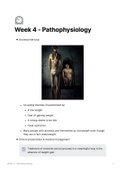
Anorexia Nervosa
An eating disorder characterized by:
A low weight
Fear of gaining weight
A strong desire to be thin
Food restriction
Many people with anorexia see themselves as overweight even though
they are in fact underweight
Clinical presentation & medical management
🗒 Treatment of anorexia cannot proceed in a meaningful way in the
absence of weight gain
Week 4 - Pathophysiology 1
, Once the patient is medically stable, psychiatric treatment can begin
Behavior modification techniques are used to assist the patient in
weight gain
the efficacy of psychotherapy has not been established
Bulimia Nervosa
An emotional disorder involving distortion of body image and an
obsessive desire to lose weight, in which bouts of extreme overeating
are followed by depression & self-induced vomiting, purging, or fasting
Treatment
In bulimia patients, complex restorative procedures should not be
planned until the gorging & vomiting cycle has been broken
once the patient overall health status is stable, restoration of teeth with
severe erosion can begin
⇒ Now possible to construct damaged teeth with minimal dental
preparation & with less expense (with resin composite & adhesive systems)
Clinical presentation & medical management
Anti-depression medication, cognitive-behavioral therapy. &
interpersonal therapy are all effective in bulimia patients
Week 4 - Pathophysiology 2
, Extreme electrolyte imbalance, severe bulimic symptoms: may require
hospitalization
Attempts should be made to stop the gorging-regurgitation cycle, or at
least to limit the load of food ingested, to minimize the chance of
aspiration or gastric rupture
Upper Gastrointestinal Disorders
Dysphagia
Etiology
Physical obstruction (tumors, diverticula)
Muscular/neurological disorder (stroke)
Normal aging
Pathogenesis depends on the etiology
Extra-oral characteristics
Aspiration of food/oral fluids → pneumonia
Regurgitation
Malnourishment
Perioral & intraoral characteristics
Upper esophagus associated with pain 2 - 5 sec after swallowing
Lower esophagus associated with pain 1015 sec later
Oral malodor
Increased risk of infections
Dental implications
Patient positioning
Caries risk management
Home care modification
treatment
Week 4 - Pathophysiology 3
Week 4 - Pathophysiology
Anorexia Nervosa
An eating disorder characterized by:
A low weight
Fear of gaining weight
A strong desire to be thin
Food restriction
Many people with anorexia see themselves as overweight even though
they are in fact underweight
Clinical presentation & medical management
🗒 Treatment of anorexia cannot proceed in a meaningful way in the
absence of weight gain
Week 4 - Pathophysiology 1
, Once the patient is medically stable, psychiatric treatment can begin
Behavior modification techniques are used to assist the patient in
weight gain
the efficacy of psychotherapy has not been established
Bulimia Nervosa
An emotional disorder involving distortion of body image and an
obsessive desire to lose weight, in which bouts of extreme overeating
are followed by depression & self-induced vomiting, purging, or fasting
Treatment
In bulimia patients, complex restorative procedures should not be
planned until the gorging & vomiting cycle has been broken
once the patient overall health status is stable, restoration of teeth with
severe erosion can begin
⇒ Now possible to construct damaged teeth with minimal dental
preparation & with less expense (with resin composite & adhesive systems)
Clinical presentation & medical management
Anti-depression medication, cognitive-behavioral therapy. &
interpersonal therapy are all effective in bulimia patients
Week 4 - Pathophysiology 2
, Extreme electrolyte imbalance, severe bulimic symptoms: may require
hospitalization
Attempts should be made to stop the gorging-regurgitation cycle, or at
least to limit the load of food ingested, to minimize the chance of
aspiration or gastric rupture
Upper Gastrointestinal Disorders
Dysphagia
Etiology
Physical obstruction (tumors, diverticula)
Muscular/neurological disorder (stroke)
Normal aging
Pathogenesis depends on the etiology
Extra-oral characteristics
Aspiration of food/oral fluids → pneumonia
Regurgitation
Malnourishment
Perioral & intraoral characteristics
Upper esophagus associated with pain 2 - 5 sec after swallowing
Lower esophagus associated with pain 1015 sec later
Oral malodor
Increased risk of infections
Dental implications
Patient positioning
Caries risk management
Home care modification
treatment
Week 4 - Pathophysiology 3