

Electronics
Operational amplifier
A device which is integrated into circuits to produce an amplification or gain to the voltage
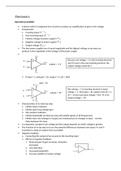
Components:
−¿ ¿
1. Inverting input (V )
−¿ ¿
2. Non-inverting input (V )
3. Positive voltage of power supply (+V s )
4. Negative voltage of power supply (-V s )
5. Output voltage (V out ¿
The two power supplies are of equal magnitude and the highest voltage an op-amp can
produce is the magnitude of the voltage of the power supply
2 Because net voltage = 1 in the inverting terminal
and if it was in the non-inverting terminal, the
output = -1 V
3 output voltage would be 1
If input = 5, and gain = 20, output = 5 x 20 = 100V
gain = 10
9
Net voltage = 1 in inverting terminal so input
4
output = -9V voltage = -1. Since gain = 10, output must be -1 x
10 = -10 but max input voltage = 9(or -9) so its
5
output voltage = -9V
-9
Characteristics of an ideal op-amp
1. Infinite input resistance
2. Infinite open loop voltage gain
3. Zero output resistance
4. Infinite bandwidth (an ideal op-amp will amplify signals of all frequencies)
5. Infinite slew rate (changes in output are instantaneous to changes in input – no time
delay between the two)
A comparator compares two voltage and the output depends on which voltage is greater.
The function of an op-amp is to use the potential differences between two inputs V+ and V−
to produce a large an output Vout as possible
Negative feedback
Connecting the output of an op-amp to the inverting input
Effects of negative feedback:
1. Reduced gain (if gain increases, distortion
increases)
2. Less distortion
3. Increased bandwidth
4. Increase stability of output voltage
, Inverting amplifier
Uses negative feedback
Non-inverting input is connected to the 0V line (earthed)
Input voltage and part of Vout is connected to the inverting input
Virtual earth approximation – an approximation in which the two inputs of an op-
amp are nearly at the same potential
Virtual earthing – when a point is made equal to zero volts by giving an equal and
opposite potential difference so both cancel out
Feedback resistor Rf
Why is point P earth?
The gain is infinite. Since V+ is earthed, for the amplifier to not saturate, point P
must be 0.
Point P is virtual earth if the amplifier is not saturated
Gain = output voltage/input voltage
If current in input resistor R(in) = I(in)
Current in feedback resistor (Rf) = I(f)
I(f) = -I(in)
V (¿) V (out)
Then =-
R(¿) R(f )
−R( f ) V (out)
And =
R(¿) V (¿)
V (out) −R ( f )
Since = gain, = gain
V (¿) R ( ¿)
Non-inverting amplifier
Input voltage is applied to the non-inverting input and part of the output voltage is
fed to the inverting input
As long as the op-amp is unsaturated, the p.d. between the inverting and non-
inverting input is almost zero and they are equal
Operational amplifier
A device which is integrated into circuits to produce an amplification or gain to the voltage
Components:
−¿ ¿
1. Inverting input (V )
−¿ ¿
2. Non-inverting input (V )
3. Positive voltage of power supply (+V s )
4. Negative voltage of power supply (-V s )
5. Output voltage (V out ¿
The two power supplies are of equal magnitude and the highest voltage an op-amp can
produce is the magnitude of the voltage of the power supply
2 Because net voltage = 1 in the inverting terminal
and if it was in the non-inverting terminal, the
output = -1 V
3 output voltage would be 1
If input = 5, and gain = 20, output = 5 x 20 = 100V
gain = 10
9
Net voltage = 1 in inverting terminal so input
4
output = -9V voltage = -1. Since gain = 10, output must be -1 x
10 = -10 but max input voltage = 9(or -9) so its
5
output voltage = -9V
-9
Characteristics of an ideal op-amp
1. Infinite input resistance
2. Infinite open loop voltage gain
3. Zero output resistance
4. Infinite bandwidth (an ideal op-amp will amplify signals of all frequencies)
5. Infinite slew rate (changes in output are instantaneous to changes in input – no time
delay between the two)
A comparator compares two voltage and the output depends on which voltage is greater.
The function of an op-amp is to use the potential differences between two inputs V+ and V−
to produce a large an output Vout as possible
Negative feedback
Connecting the output of an op-amp to the inverting input
Effects of negative feedback:
1. Reduced gain (if gain increases, distortion
increases)
2. Less distortion
3. Increased bandwidth
4. Increase stability of output voltage
, Inverting amplifier
Uses negative feedback
Non-inverting input is connected to the 0V line (earthed)
Input voltage and part of Vout is connected to the inverting input
Virtual earth approximation – an approximation in which the two inputs of an op-
amp are nearly at the same potential
Virtual earthing – when a point is made equal to zero volts by giving an equal and
opposite potential difference so both cancel out
Feedback resistor Rf
Why is point P earth?
The gain is infinite. Since V+ is earthed, for the amplifier to not saturate, point P
must be 0.
Point P is virtual earth if the amplifier is not saturated
Gain = output voltage/input voltage
If current in input resistor R(in) = I(in)
Current in feedback resistor (Rf) = I(f)
I(f) = -I(in)
V (¿) V (out)
Then =-
R(¿) R(f )
−R( f ) V (out)
And =
R(¿) V (¿)
V (out) −R ( f )
Since = gain, = gain
V (¿) R ( ¿)
Non-inverting amplifier
Input voltage is applied to the non-inverting input and part of the output voltage is
fed to the inverting input
As long as the op-amp is unsaturated, the p.d. between the inverting and non-
inverting input is almost zero and they are equal


