STUDY NOTES
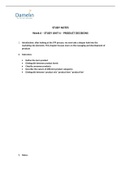
Week 8 – study unit 8 – pricing concepts
1. Introduction: in this unit, accurate knowledge of pricing will be explained, also a brief
overview of the objectives of pricing in marketing will be discussed as well as pricing
strategies
2. Outcomes:
Define price and pricing
Discuss pricing objectives
Outline and describe the determinates of the product price
Outline and explain a pricing strategy
3. Notes:
, - Pricing affects the sales and profits of an organisation
- Pricing is the only elements of the marketing mix that produces revenue, the other elements
produce costs
- Pricing communicates the value of the brand or product
Price – what is given up in an exchange to acquire good or a service
Revenue – the price charged to customers multiplied by the number of units sold (5 items @
R20 =Revenue = R100)
Profit – what is left over after all activities have been paid
Cost – the amount of money needed to do, make or buy something
PRICING OBJECTIVES
Objectives need to be specific, attainable and measurable in order to survive in a competitive
market. There are 3 objectives that a company can use:
Profit orientated pricing objectives – setting prices for products that will guarantee a
profitable sale. It is subdivided into:
o Profit maximisation – setting prices so that total revenue is as high as possible
relative to costs
o Satisfactory profits – a reasonable level of profits
o Target return on investment – measures the overall effectiveness of
management in generating profits with its available assets.
Sales oriented pricing objectives – based on market share, rand value and unit sales
o Market share – a firm’s product sales as a percentage of total sales for that
industry
o Sales maximisation – ignores profit, competition and market environment as
long as sales are increasing
Status quo pricing objectives – is an attempt to maintain existing prices or to meet the
competitor’s prices.
THE DEMAND DETERMINANT OF PRICE
- Demand is the quantity of a product that will be sold in the market at various prices for a
specific period.
Week 8 – study unit 8 – pricing concepts
1. Introduction: in this unit, accurate knowledge of pricing will be explained, also a brief
overview of the objectives of pricing in marketing will be discussed as well as pricing
strategies
2. Outcomes:
Define price and pricing
Discuss pricing objectives
Outline and describe the determinates of the product price
Outline and explain a pricing strategy
3. Notes:
, - Pricing affects the sales and profits of an organisation
- Pricing is the only elements of the marketing mix that produces revenue, the other elements
produce costs
- Pricing communicates the value of the brand or product
Price – what is given up in an exchange to acquire good or a service
Revenue – the price charged to customers multiplied by the number of units sold (5 items @
R20 =Revenue = R100)
Profit – what is left over after all activities have been paid
Cost – the amount of money needed to do, make or buy something
PRICING OBJECTIVES
Objectives need to be specific, attainable and measurable in order to survive in a competitive
market. There are 3 objectives that a company can use:
Profit orientated pricing objectives – setting prices for products that will guarantee a
profitable sale. It is subdivided into:
o Profit maximisation – setting prices so that total revenue is as high as possible
relative to costs
o Satisfactory profits – a reasonable level of profits
o Target return on investment – measures the overall effectiveness of
management in generating profits with its available assets.
Sales oriented pricing objectives – based on market share, rand value and unit sales
o Market share – a firm’s product sales as a percentage of total sales for that
industry
o Sales maximisation – ignores profit, competition and market environment as
long as sales are increasing
Status quo pricing objectives – is an attempt to maintain existing prices or to meet the
competitor’s prices.
THE DEMAND DETERMINANT OF PRICE
- Demand is the quantity of a product that will be sold in the market at various prices for a
specific period.