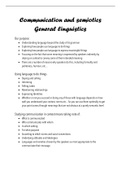
Communication and semiotics
General linguistics
Our purpose:
• Understanding language beyond the study of its grammar
• Exploring how people use language to do things
• Exploring how people use language to express meaningful things
• Focusing on the fact that some meaning is expressed by speakers indirectly by
relying on context to convey some of their intended meaning
• There are a number of reasons why speakers do this, including formality and
politeness, humour, etc…
Using language to do things
• Buying and selling
• Informing
• Telling Jokes
• Maintaining relationships
• Expressing Identities
• Whether or not you succeed in doing any of these with language depends on how
well you understand your context, norms etc... So you can use them optimally to get
your point across through meanings that are not obvious at a purely semantic level.
Studying communication in context means taking note of:
• What is communicated
• Who communicates with whom
• In which setting
• For what purpose
• According to which norms and social conventions
• Underlying attitudes and Ideologies
• Languages and varieties chosen by the speakers as most appropriate to the
communicate their message.
,Studying communication in context
• View all languages and communication as an integral part of the social and cultural
contexts or settings in which they occur.
• We can’t remove conversation from its context if we hope to understand its complex
range of meanings and nuances.
Ethnography of communication
• Dell Hymes gave us useful tools for thinking about language and communication
from the field of Ethnography.
• Ethnography seeks to understand how groups of people understand and perceive
their own social realities.
• It is done through participant observation, interviews, recordings various social
interactions, and the collection of documents and artifacts within the community.
• Dell Hymes, a revolutionary in the 1960s.
• Differed from the dominant theories and views of language at the time.
• Known as the formalist approach which tends to study sentences in isolation from
their contexts.
• Hymes argued that the study of language should focus on how people use language
in social contexts for real communication /real instances of language which occurs in
everyday contexts.
• He argued that knowing how to speak a language required more than just
grammatical rules.
o linguistic competence
• It also required knowing how use language appropriately in different contexts:
• To show respect, politeness, disagreement etc…
o Communicative competence
§ Unit of analysis (Hymes’ units of analysis):
§ Speech communities
§ Communicative situations
§ Communicative events
§ Communicative acts
• E.g. To the Rector
• Good morning Sir vs. Awe bru
• The meaning of a sentence like “Stop making a noise” changes with setting / context
because what we perceive as noisy changes in each setting.
• E.g. library vs. restaurant
, • Proves that our knowledge of how to use language is informed by more than just the
rules of grammar but also rules of politeness and appropriate forms of address
within various context
• Hy’t ʼn klein hartjie vs. unenhliziyo encane
• Both, in English mean “He has a small heart”.
• The meaning is contained in understanding the social context, and the meaning
assigned by the society
• The extract:
o What can you tell about the setting?
o You must go on what you know of church groups.
o Who are the speakers?
o 4 men , 2 women. Could be more
o Who is in charge?
o How can you tell? What he says.
o He regulates the conversation
o E.g. “ja.. We can indeed address what we wear”
o “but Josie, we really appreciate your response”
• In order to critically view an extract:
o distance yourself from it and look closely at the language that is used and
how it shapes people’s positions and relations
o Have some knowledge of the context in order to understand the nuances and
deeper meanings within a conversation
o This includes the immediate setting and the broader social and cultural
context.
Typical questions for ethnographers
• What kind of communicative event is it?
• What is it about and why is it happening?
• What kinds of beliefs and practices are associated with it?
• Why is the event important ( or not) to the participants?
• Where and when does it occur?
• Who may talk to whom… using which language variety
• What do the language choices tell us about the participants, their social relations and
their attitudes and ideologies?
• What kinds of dress or other acts of identity are associated with this event?
• How typical is the communicative event for the speech community?
General linguistics
Our purpose:
• Understanding language beyond the study of its grammar
• Exploring how people use language to do things
• Exploring how people use language to express meaningful things
• Focusing on the fact that some meaning is expressed by speakers indirectly by
relying on context to convey some of their intended meaning
• There are a number of reasons why speakers do this, including formality and
politeness, humour, etc…
Using language to do things
• Buying and selling
• Informing
• Telling Jokes
• Maintaining relationships
• Expressing Identities
• Whether or not you succeed in doing any of these with language depends on how
well you understand your context, norms etc... So you can use them optimally to get
your point across through meanings that are not obvious at a purely semantic level.
Studying communication in context means taking note of:
• What is communicated
• Who communicates with whom
• In which setting
• For what purpose
• According to which norms and social conventions
• Underlying attitudes and Ideologies
• Languages and varieties chosen by the speakers as most appropriate to the
communicate their message.
,Studying communication in context
• View all languages and communication as an integral part of the social and cultural
contexts or settings in which they occur.
• We can’t remove conversation from its context if we hope to understand its complex
range of meanings and nuances.
Ethnography of communication
• Dell Hymes gave us useful tools for thinking about language and communication
from the field of Ethnography.
• Ethnography seeks to understand how groups of people understand and perceive
their own social realities.
• It is done through participant observation, interviews, recordings various social
interactions, and the collection of documents and artifacts within the community.
• Dell Hymes, a revolutionary in the 1960s.
• Differed from the dominant theories and views of language at the time.
• Known as the formalist approach which tends to study sentences in isolation from
their contexts.
• Hymes argued that the study of language should focus on how people use language
in social contexts for real communication /real instances of language which occurs in
everyday contexts.
• He argued that knowing how to speak a language required more than just
grammatical rules.
o linguistic competence
• It also required knowing how use language appropriately in different contexts:
• To show respect, politeness, disagreement etc…
o Communicative competence
§ Unit of analysis (Hymes’ units of analysis):
§ Speech communities
§ Communicative situations
§ Communicative events
§ Communicative acts
• E.g. To the Rector
• Good morning Sir vs. Awe bru
• The meaning of a sentence like “Stop making a noise” changes with setting / context
because what we perceive as noisy changes in each setting.
• E.g. library vs. restaurant
, • Proves that our knowledge of how to use language is informed by more than just the
rules of grammar but also rules of politeness and appropriate forms of address
within various context
• Hy’t ʼn klein hartjie vs. unenhliziyo encane
• Both, in English mean “He has a small heart”.
• The meaning is contained in understanding the social context, and the meaning
assigned by the society
• The extract:
o What can you tell about the setting?
o You must go on what you know of church groups.
o Who are the speakers?
o 4 men , 2 women. Could be more
o Who is in charge?
o How can you tell? What he says.
o He regulates the conversation
o E.g. “ja.. We can indeed address what we wear”
o “but Josie, we really appreciate your response”
• In order to critically view an extract:
o distance yourself from it and look closely at the language that is used and
how it shapes people’s positions and relations
o Have some knowledge of the context in order to understand the nuances and
deeper meanings within a conversation
o This includes the immediate setting and the broader social and cultural
context.
Typical questions for ethnographers
• What kind of communicative event is it?
• What is it about and why is it happening?
• What kinds of beliefs and practices are associated with it?
• Why is the event important ( or not) to the participants?
• Where and when does it occur?
• Who may talk to whom… using which language variety
• What do the language choices tell us about the participants, their social relations and
their attitudes and ideologies?
• What kinds of dress or other acts of identity are associated with this event?
• How typical is the communicative event for the speech community?