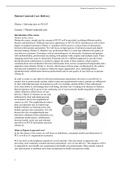
What is the WHO definition of Health?
The widely accepted definition of health is that given by the World Health Organization (1948) in
the preamble to its constitution, which is as follows:
"Health is a state of complete physical mental and social well being and not merely an absence
of disease or infirmity " (sickness or weakness)
In recent years, this statement has been amplified to include the ability to lead a “socially and
economically productive life".
The WHO definition of health has been criticized as being too broad. Some argue that health
cannot be defined as a "state" at all, but must be seen as a process of continuous adjustment to
the changing demands of living and of the changing meanings we give to life. It is a dynamic
concept. It helps people live well, work well and enjoy themselves. The WHO definition of health
is therefore considered by many as an idealistic goal than a realistic proposition. It refers to a
situation that may exist in some individuals but not in everyone all the time; it is not usually
observed in groups of human beings and in communities. Some consider it irrelevant to
everyday demands, as nobody qualifies as healthy, i.e., perfect biological, psychological and
social functioning. That is, if we accept the WHO definition, we are all sick.
In spite of the above limitations, the concept of health as defined by WHO is broad and positive
in its implications; it sets out the standard, the standard of "positive" health. It symbolizes the
aspirations of people and represents an overall objective or goal towards which nations should
strive.
What is an Operational definition of health?
"A condition or quality of the human organism expressing the adequate functioning of the
organism in given conditions, genetic or environmental”.
What is new philosophy of health
In recent years, we have acquired a new philosophy of health, which may be stated as
below:
Health is a fundamental human right
Health is the essence of productive life,and not the result of ever increasing expenditure on
medical care
Health is inter sectoral
Health is an integral part of development
The widely accepted definition of health is that given by the World Health Organization (1948) in
the preamble to its constitution, which is as follows:
"Health is a state of complete physical mental and social well being and not merely an absence
of disease or infirmity " (sickness or weakness)
In recent years, this statement has been amplified to include the ability to lead a “socially and
economically productive life".
The WHO definition of health has been criticized as being too broad. Some argue that health
cannot be defined as a "state" at all, but must be seen as a process of continuous adjustment to
the changing demands of living and of the changing meanings we give to life. It is a dynamic
concept. It helps people live well, work well and enjoy themselves. The WHO definition of health
is therefore considered by many as an idealistic goal than a realistic proposition. It refers to a
situation that may exist in some individuals but not in everyone all the time; it is not usually
observed in groups of human beings and in communities. Some consider it irrelevant to
everyday demands, as nobody qualifies as healthy, i.e., perfect biological, psychological and
social functioning. That is, if we accept the WHO definition, we are all sick.
In spite of the above limitations, the concept of health as defined by WHO is broad and positive
in its implications; it sets out the standard, the standard of "positive" health. It symbolizes the
aspirations of people and represents an overall objective or goal towards which nations should
strive.
What is an Operational definition of health?
"A condition or quality of the human organism expressing the adequate functioning of the
organism in given conditions, genetic or environmental”.
What is new philosophy of health
In recent years, we have acquired a new philosophy of health, which may be stated as
below:
Health is a fundamental human right
Health is the essence of productive life,and not the result of ever increasing expenditure on
medical care
Health is inter sectoral
Health is an integral part of development