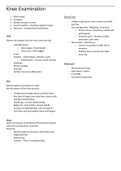
Knee Examination
1. Wash hands Special Tests
2. Introduce
3. Explain and gain consent - Collateral ligaments; hand on knee and ankle,
4. Correct position – standing upright to begin push leg
5. Exposure – wearing shorts/underwear - Cruciate ligaments: 90degrees, sit on foot
o Anterior draw = thumbs on patella and
pull towards
Look o Posterior draw = thumbs on tibial
Observe the patient from the front, back and side tuberosity, push away
- Menisci test = McMurray’s
- Joint deformity? o Can be very painful so offer this to
o Genu valgus = knock kneed examiner
o Genu varus = bow-legged o Stabilise femur and try and rotate
- Scars? lower leg
- Swelling – inflammation, infection, gout?
o Inflammation = trauma; septic arthritis
- Erythema What next?
- Muscle wasting
- Bruising? - Neurovascular status
- Do they have any walking aids? - Joint above + below
- X-ray/MRI
- Functional assessment
Feel
Ask the patient to lie down on a bed
Ask the patient if they have any pain
- Temperature changes above/on/below knee
- Run back of fingers over joint lines, muscle bulk
and ligaments/tendons
- Patella tap – test for fluid/swelling
- Bulge test – firm motion, around patella,
moving any potential fluid, will see bulge if +
- Grab knee and feel popliteal fossa with fingers
Move
Active and passive movements of flexing knee towards
chest and rotating femur outwards
Check for:
- Normal range of movement, both sides same
- Hyperextension
- Extensor lag
- Crepitus – Velcro/crackling feeling
1. Wash hands Special Tests
2. Introduce
3. Explain and gain consent - Collateral ligaments; hand on knee and ankle,
4. Correct position – standing upright to begin push leg
5. Exposure – wearing shorts/underwear - Cruciate ligaments: 90degrees, sit on foot
o Anterior draw = thumbs on patella and
pull towards
Look o Posterior draw = thumbs on tibial
Observe the patient from the front, back and side tuberosity, push away
- Menisci test = McMurray’s
- Joint deformity? o Can be very painful so offer this to
o Genu valgus = knock kneed examiner
o Genu varus = bow-legged o Stabilise femur and try and rotate
- Scars? lower leg
- Swelling – inflammation, infection, gout?
o Inflammation = trauma; septic arthritis
- Erythema What next?
- Muscle wasting
- Bruising? - Neurovascular status
- Do they have any walking aids? - Joint above + below
- X-ray/MRI
- Functional assessment
Feel
Ask the patient to lie down on a bed
Ask the patient if they have any pain
- Temperature changes above/on/below knee
- Run back of fingers over joint lines, muscle bulk
and ligaments/tendons
- Patella tap – test for fluid/swelling
- Bulge test – firm motion, around patella,
moving any potential fluid, will see bulge if +
- Grab knee and feel popliteal fossa with fingers
Move
Active and passive movements of flexing knee towards
chest and rotating femur outwards
Check for:
- Normal range of movement, both sides same
- Hyperextension
- Extensor lag
- Crepitus – Velcro/crackling feeling