
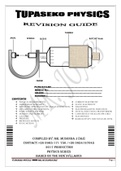
THIMBLE
ANVIL SPINDLE SLEEVE RATCHET Knob
FRAME
PUPIL'S NAME............................................................................
MOBILE No:.................................................................................
GRADE:......................................................................................
SCHOOOL:...................................................................................
CONTENTS
PHYSICAL MEASUREMENTS CURRENT ELECTRICITY
MASS WEIGHT & DENSITY STATIC ELECTRICITY
KINEMATIC (SPEED,VELOCITY AND ACCELERATION) MAGNETISM
DYNAMICS ( FORCE & MOTION) ELECTROMAGNETIC INDUCTION
WORK ENERGY & POWER MUTUAL INDUCTION (TRANSFORMER)
MOMENT AND STABILITY CATHODE RAY OSCILLASCOPE (CRO)
GAS LAWS ELECTRONICS
PRESSURE RADIOACTIVITY AND NUCLEAR ATOM
BROWNIAN MOTION
WAVE MOTION
COMPILED BY: MR. MUSONDA J [MJ]
CONTACT:+26 0965-171 750 /+26 0954197045
2017 PRODUCTION
PHYSICS SERIES
BASED ON THE NEW SYLLABUS
TUPASEKO PHYSICS MR. MUSONDA [MJ] Page 1
, PHYSICAL MEASUREMENTS
1. Write down the most appropriate instrument to use in the measuring of the following .
(a) Thickness of a mobile telephone scratch card
(b) Diameter of a thin metal rod.
(c) Thickness of your hard cover book.
(d) Diameter of a thin wire
(e) The width of the football pitch .
(f) The thickness of your hair.
[TOTAL: 6 MARKS]
2. (a) Define a
(i) Vector quantity
(ii) Scalar quantity
(b) Give four examples of a
(i) Vector quantity
(ii) Scalar quantity
(c) Differentiate a vector quantity from a scalar quantity. [9]
[TOTAL: 9MARKS]
3. (a) Of what accuracy is the vernier calliper in mm and in cm?
(b) What is the function of the following parts of a vernier calliper.
(i) Vernier scale
(ii) Main scale
(iii) Inner jaws
(iv) Outer jaws.
(v) Probe
(c) What is the reading in each of the following ?
cm cm
2 3 4 0 1 3
[8]
[TOTAL: 8MARKS]
4. Study the figure below and answer questions that follow.
Ratchet
86
mm 2
80
75
Scale A
Scale B
(a) State the function of the ratchet [1]
(b) Name the scales A and B . [2]
(c) State two precautions which should be taken when using the instrument above. [2]
(d) Name the instrument shown above and state its accuracy in
TUPASEKO PHYSICS MR. MUSONDA [MJ] Page 2
, (i) mm
(ii) cm [2]
(e) What is the reading on
(i) Scale A [1]
(ii) Scale B [1]
(f) What is the reading on the instrument above . [1]
[TOTAL: 10MARKS]
5. Study the micrometer screw guage below.
mm 0 1 2
65
60
(a) Explain in details how you can use the instrument above to measure the diameter of a copper wire. [4]
(b) What physical quantity does a micrometer screw guage measure? [1]
(c) What is the reading shown on the instrument above? [1]
(d) Name other instruments which could be used to measure the physical quantity mentioned in (c) above. [1]
(e) A micrometer screw guage registers a reading 4.25mm and the zero error is - 0.06mm .What is the actual
reading ? [1]
[TOTAL: 8MARKS]
6.The diagram below shows a pendulum
C
A
B
(a) What is a simple pendulum ? [1]
(b) The bob was found to have moved from point A to point B in 0.2 second and then to point C .Calculate the
periodic time of the pendulum. [1]
(c) Explain how the bob should move to make a complete swing. [2]
(d) What do we call the time taken for the pendulum to make a complete oscillation? [1]
[TOTAL: 5MARKS]
TUPASEKO PHYSICS MR. MUSONDA [MJ] Page 3
, 7. The diagram below represents a pendulum hung from a fixed support .Find the length of the pendulum .
10cm cotton thread
Bob
2cm
8. The diagram below shows a simple pendulum that oscillates between position A and C .It takes 2.05 s to go from
A to C and back To mid- point B
C
A
B
(a) (i) Calculate the period of the pendulum [1]
(ii) Calculate the frequency of the pendulum [1]
(b) Briefly describe how the period of the pendulum would be measured. [3]
[TOTAL: 3MARKS]
9. It takes 1.28 seconds a pendulum to swing from L to M and back .How long does the ball take to move from M to
Z?
L M
Z
Z
TUPASEKO PHYSICS MR. MUSONDA [MJ] Page 4
ANVIL SPINDLE SLEEVE RATCHET Knob
FRAME
PUPIL'S NAME............................................................................
MOBILE No:.................................................................................
GRADE:......................................................................................
SCHOOOL:...................................................................................
CONTENTS
PHYSICAL MEASUREMENTS CURRENT ELECTRICITY
MASS WEIGHT & DENSITY STATIC ELECTRICITY
KINEMATIC (SPEED,VELOCITY AND ACCELERATION) MAGNETISM
DYNAMICS ( FORCE & MOTION) ELECTROMAGNETIC INDUCTION
WORK ENERGY & POWER MUTUAL INDUCTION (TRANSFORMER)
MOMENT AND STABILITY CATHODE RAY OSCILLASCOPE (CRO)
GAS LAWS ELECTRONICS
PRESSURE RADIOACTIVITY AND NUCLEAR ATOM
BROWNIAN MOTION
WAVE MOTION
COMPILED BY: MR. MUSONDA J [MJ]
CONTACT:+26 0965-171 750 /+26 0954197045
2017 PRODUCTION
PHYSICS SERIES
BASED ON THE NEW SYLLABUS
TUPASEKO PHYSICS MR. MUSONDA [MJ] Page 1
, PHYSICAL MEASUREMENTS
1. Write down the most appropriate instrument to use in the measuring of the following .
(a) Thickness of a mobile telephone scratch card
(b) Diameter of a thin metal rod.
(c) Thickness of your hard cover book.
(d) Diameter of a thin wire
(e) The width of the football pitch .
(f) The thickness of your hair.
[TOTAL: 6 MARKS]
2. (a) Define a
(i) Vector quantity
(ii) Scalar quantity
(b) Give four examples of a
(i) Vector quantity
(ii) Scalar quantity
(c) Differentiate a vector quantity from a scalar quantity. [9]
[TOTAL: 9MARKS]
3. (a) Of what accuracy is the vernier calliper in mm and in cm?
(b) What is the function of the following parts of a vernier calliper.
(i) Vernier scale
(ii) Main scale
(iii) Inner jaws
(iv) Outer jaws.
(v) Probe
(c) What is the reading in each of the following ?
cm cm
2 3 4 0 1 3
[8]
[TOTAL: 8MARKS]
4. Study the figure below and answer questions that follow.
Ratchet
86
mm 2
80
75
Scale A
Scale B
(a) State the function of the ratchet [1]
(b) Name the scales A and B . [2]
(c) State two precautions which should be taken when using the instrument above. [2]
(d) Name the instrument shown above and state its accuracy in
TUPASEKO PHYSICS MR. MUSONDA [MJ] Page 2
, (i) mm
(ii) cm [2]
(e) What is the reading on
(i) Scale A [1]
(ii) Scale B [1]
(f) What is the reading on the instrument above . [1]
[TOTAL: 10MARKS]
5. Study the micrometer screw guage below.
mm 0 1 2
65
60
(a) Explain in details how you can use the instrument above to measure the diameter of a copper wire. [4]
(b) What physical quantity does a micrometer screw guage measure? [1]
(c) What is the reading shown on the instrument above? [1]
(d) Name other instruments which could be used to measure the physical quantity mentioned in (c) above. [1]
(e) A micrometer screw guage registers a reading 4.25mm and the zero error is - 0.06mm .What is the actual
reading ? [1]
[TOTAL: 8MARKS]
6.The diagram below shows a pendulum
C
A
B
(a) What is a simple pendulum ? [1]
(b) The bob was found to have moved from point A to point B in 0.2 second and then to point C .Calculate the
periodic time of the pendulum. [1]
(c) Explain how the bob should move to make a complete swing. [2]
(d) What do we call the time taken for the pendulum to make a complete oscillation? [1]
[TOTAL: 5MARKS]
TUPASEKO PHYSICS MR. MUSONDA [MJ] Page 3
, 7. The diagram below represents a pendulum hung from a fixed support .Find the length of the pendulum .
10cm cotton thread
Bob
2cm
8. The diagram below shows a simple pendulum that oscillates between position A and C .It takes 2.05 s to go from
A to C and back To mid- point B
C
A
B
(a) (i) Calculate the period of the pendulum [1]
(ii) Calculate the frequency of the pendulum [1]
(b) Briefly describe how the period of the pendulum would be measured. [3]
[TOTAL: 3MARKS]
9. It takes 1.28 seconds a pendulum to swing from L to M and back .How long does the ball take to move from M to
Z?
L M
Z
Z
TUPASEKO PHYSICS MR. MUSONDA [MJ] Page 4


