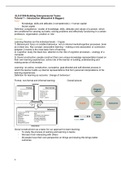
ELS-51306 Building Entrepreneurial Teams
Tutorial 1 – Introduction (Wesselink & Baggen)
Input
- Knowledge, skills and attitudes (=competencies) -> human capital
- Social capital
Definition competence: ‘cluster of knowledge, skills, attitudes and values of a person, which
are conditional for carrying out tasks, solving problems and effectively functioning in a certain
profession, organization, position or role.’
Process
Learning theories (on the individual level) – 3 types
1) Behavioural: focus on (visible) behaviour, not on internal mental/cognitive processes: brain
as a black box. Key concept: associative learning – making a new association or connection
between 2 events is the most basic form of learning.
2) Cognitive: study the black box: attention to the role of cognitive processes – analogy of a
computer.
3) Social constructive: people construct their own unique knowledge representation based on
their own learning experiences: active role of the learner in building understanding and
making sense of information.
Learning: ‘an active, constructive, cumulative, goal-directed and self-directed process in
which the learner builds up internal representations that form personal interpretations of his
learning experiences.’
Definition for learning as outcome: ‘change of behaviour.’
Formal, non-formal and informal learning: Overall picture:
Social constructivism as a basic for our approach to team learning:
- To study the process of working and learning in teams
- We learn from interacting with others
- All people have their own perspective on things and sharing this brings better
outcomes
1
, Tutorial 2 – Entrepreneurship, entrepreneurial behaviour, innovation, creativity, and
problem-solving (Baggen)
Why is working in teams interesting? Outcome
It has impact on:
- Organizations: increased productivity; improved quality; reduced cost price;
innovation/strategic renewal/entrepreneurship.
- Working relationships: commitment; shared responsibility.
- Working life: low absenteeism; tolerable work stress; low turnover ratio.
Entrepreneurship: ‘the pursuit of opportunity beyond resources controlled.’
- Uncertainty
- Opportunity
Entrepreneurial mindset: ‘value-creating meta competence’. It enriches life and helps solving
everyday issues.
IPO Model:
Tutorial 3 - Presentations
Tutorial 4 – Team Learning (Baggen)
Entrepreneurship versus intrapreneurship, differences and similarities in start-ups and larger
existing organizations:
Differences and similarities depend on:
Exploration versus exploitation (Dutta & Crossan, 2005)
Responsibilities (dual functioning: managing vs. newness) -> Schjoedt & Kraus
(2009)
How long the team exists (Decuyper et al., 2010)
Support/infrastructure: entrepreneurial teams: high levels of uncertainty and lack of
support systems (Schjoedt & Kraus, 2009)
Research in the context of independent entrepreneurship
Literature on entrepreneurial teams
o Relatively young field due to consistent focus on ‘hero’
BUT: teams are favoured by investors
o Direct link with performance and increased legitimacy
Relevant factors of independent entrepreneurship
Human capital:
- Knowledge/skills (technical, human, conceptual)
- Personality
- Experience
Social capital: networks
Why are networks important?
- New ideas
2
Tutorial 1 – Introduction (Wesselink & Baggen)
Input
- Knowledge, skills and attitudes (=competencies) -> human capital
- Social capital
Definition competence: ‘cluster of knowledge, skills, attitudes and values of a person, which
are conditional for carrying out tasks, solving problems and effectively functioning in a certain
profession, organization, position or role.’
Process
Learning theories (on the individual level) – 3 types
1) Behavioural: focus on (visible) behaviour, not on internal mental/cognitive processes: brain
as a black box. Key concept: associative learning – making a new association or connection
between 2 events is the most basic form of learning.
2) Cognitive: study the black box: attention to the role of cognitive processes – analogy of a
computer.
3) Social constructive: people construct their own unique knowledge representation based on
their own learning experiences: active role of the learner in building understanding and
making sense of information.
Learning: ‘an active, constructive, cumulative, goal-directed and self-directed process in
which the learner builds up internal representations that form personal interpretations of his
learning experiences.’
Definition for learning as outcome: ‘change of behaviour.’
Formal, non-formal and informal learning: Overall picture:
Social constructivism as a basic for our approach to team learning:
- To study the process of working and learning in teams
- We learn from interacting with others
- All people have their own perspective on things and sharing this brings better
outcomes
1
, Tutorial 2 – Entrepreneurship, entrepreneurial behaviour, innovation, creativity, and
problem-solving (Baggen)
Why is working in teams interesting? Outcome
It has impact on:
- Organizations: increased productivity; improved quality; reduced cost price;
innovation/strategic renewal/entrepreneurship.
- Working relationships: commitment; shared responsibility.
- Working life: low absenteeism; tolerable work stress; low turnover ratio.
Entrepreneurship: ‘the pursuit of opportunity beyond resources controlled.’
- Uncertainty
- Opportunity
Entrepreneurial mindset: ‘value-creating meta competence’. It enriches life and helps solving
everyday issues.
IPO Model:
Tutorial 3 - Presentations
Tutorial 4 – Team Learning (Baggen)
Entrepreneurship versus intrapreneurship, differences and similarities in start-ups and larger
existing organizations:
Differences and similarities depend on:
Exploration versus exploitation (Dutta & Crossan, 2005)
Responsibilities (dual functioning: managing vs. newness) -> Schjoedt & Kraus
(2009)
How long the team exists (Decuyper et al., 2010)
Support/infrastructure: entrepreneurial teams: high levels of uncertainty and lack of
support systems (Schjoedt & Kraus, 2009)
Research in the context of independent entrepreneurship
Literature on entrepreneurial teams
o Relatively young field due to consistent focus on ‘hero’
BUT: teams are favoured by investors
o Direct link with performance and increased legitimacy
Relevant factors of independent entrepreneurship
Human capital:
- Knowledge/skills (technical, human, conceptual)
- Personality
- Experience
Social capital: networks
Why are networks important?
- New ideas
2