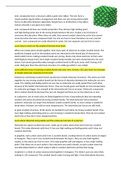
Ionic compounds have a structure called a giant ionic lattice. The ions form a
closely packed regular lattice arrangement and there are very strong electrostatic
forces of attraction between oppositely charged ions, in all direction in the lattice.
Sodium chloride is one giant ionic lattice.
Ionic compound all have very similar properties. They all have high melting point
and high boiling points due to the strong bonds between the ions. It takes a lot of energy to
overcome this attraction. When they are solid, they cannot conduct electricity as the ions cannot
move but when the ionic compound melt, the ions are free to move therefore can carry electric
current. Ionic compound are easily dissolved in water, the ions separate and are free to move.
Learn how to work out the empirical formula from book.
When non-metal atoms bonds together, they share pairs of electrons to make covalent bonds. The
positively charged nuclei of the bonded atoms are attracted to the shared pair of electrons by
electrostatic forces, making covalent bonds very strong. Atoms only share electrons in their outer
shell (highest energy level). Each single covalent bond provides one extra shared electron for each
atoms. Each atoms generally makes enough covalent bonds to fill up its outer shell. Having a full
outer shell gives them the electronic structure of a noble gas which is very stable.
Learn different ways of drawing covalent bonds (dot and cross, formula, 3D), plus learn the example
of simple molecular substances from book
Substances containing covalent bonds usually have simple molecular structures. The atoms are held
together by very strong covalent bonds but the forces of attraction between the molecules are very
weak. The melting and boiling points are very low as molecules are easily parted from each other
because of the feeble intermolecular forces. They are mostly gases and liquids at room temperature.
As molecular get bigger, the strength of the intermolecular forces increase. Molecular compounds
don’t conduct electricity because they are not charged and there are no free electrons or ions.
In a polymers, lots of small units are linked together to form a long molecule that has repeating
sections and atoms are joined by strong covalent bonds. The intermolecular forces between
polymers molecules are larger than between simple covalent bonds, so more energy is needed to
break them. Polymers are solid at room temperatures. The intermolecular forces are still weak.
In giant covalent structure, all the atoms are bonded to each other by strong covalent bonds. They
have high melting and boiling point as a lot of energy is needed to break them. They do not conduct
electricity as they don’t have charged particles.
Learn about diamond and graphite and the molecular formula of a polymer.
Diamond has a giant covalent structure, made up of carbon atoms that each form four covalent
bonds. This make diamond really hard. It has very high melting and boiling points and it does not
conduct electricity.
In graphite, each carbon atom only form 3 covalent bonds, creating sheets of carbon atoms arranged
in hexagons. There aren’t any covalent bonds between the layers, they are only held together
weakly, so the atoms are free to move. This make graphite soft and slippery. It has a high melting
point. Only three out of each carbon’s four electrons are used in bonds, so each carbon atom has
one delocalised electron, which makes it able to conduct electricity and thermal energy.
Graphene is a sheet of carbon atoms joined together in hexagons. The sheet is just one atom thick,
making it a 2D compound. The covalent bonds make it strong and light. It has delocalised electrons.
closely packed regular lattice arrangement and there are very strong electrostatic
forces of attraction between oppositely charged ions, in all direction in the lattice.
Sodium chloride is one giant ionic lattice.
Ionic compound all have very similar properties. They all have high melting point
and high boiling points due to the strong bonds between the ions. It takes a lot of energy to
overcome this attraction. When they are solid, they cannot conduct electricity as the ions cannot
move but when the ionic compound melt, the ions are free to move therefore can carry electric
current. Ionic compound are easily dissolved in water, the ions separate and are free to move.
Learn how to work out the empirical formula from book.
When non-metal atoms bonds together, they share pairs of electrons to make covalent bonds. The
positively charged nuclei of the bonded atoms are attracted to the shared pair of electrons by
electrostatic forces, making covalent bonds very strong. Atoms only share electrons in their outer
shell (highest energy level). Each single covalent bond provides one extra shared electron for each
atoms. Each atoms generally makes enough covalent bonds to fill up its outer shell. Having a full
outer shell gives them the electronic structure of a noble gas which is very stable.
Learn different ways of drawing covalent bonds (dot and cross, formula, 3D), plus learn the example
of simple molecular substances from book
Substances containing covalent bonds usually have simple molecular structures. The atoms are held
together by very strong covalent bonds but the forces of attraction between the molecules are very
weak. The melting and boiling points are very low as molecules are easily parted from each other
because of the feeble intermolecular forces. They are mostly gases and liquids at room temperature.
As molecular get bigger, the strength of the intermolecular forces increase. Molecular compounds
don’t conduct electricity because they are not charged and there are no free electrons or ions.
In a polymers, lots of small units are linked together to form a long molecule that has repeating
sections and atoms are joined by strong covalent bonds. The intermolecular forces between
polymers molecules are larger than between simple covalent bonds, so more energy is needed to
break them. Polymers are solid at room temperatures. The intermolecular forces are still weak.
In giant covalent structure, all the atoms are bonded to each other by strong covalent bonds. They
have high melting and boiling point as a lot of energy is needed to break them. They do not conduct
electricity as they don’t have charged particles.
Learn about diamond and graphite and the molecular formula of a polymer.
Diamond has a giant covalent structure, made up of carbon atoms that each form four covalent
bonds. This make diamond really hard. It has very high melting and boiling points and it does not
conduct electricity.
In graphite, each carbon atom only form 3 covalent bonds, creating sheets of carbon atoms arranged
in hexagons. There aren’t any covalent bonds between the layers, they are only held together
weakly, so the atoms are free to move. This make graphite soft and slippery. It has a high melting
point. Only three out of each carbon’s four electrons are used in bonds, so each carbon atom has
one delocalised electron, which makes it able to conduct electricity and thermal energy.
Graphene is a sheet of carbon atoms joined together in hexagons. The sheet is just one atom thick,
making it a 2D compound. The covalent bonds make it strong and light. It has delocalised electrons.