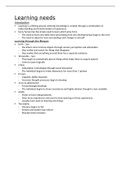
Learning needs
Introduction
Learning is a lifelong process whereby knowledge is created through a combination of
understanding and transformation of experience
Every human has the innate need to learn which arise from:
The need to learn new skills when proceeding from one developmental stage to the next
The need to adjust to new surroundings and changes in oneself
Learning through the lifespan
birth – 2yrs
the infant come to know objects through sensory perception and stimulation
they realise and search for things that disappear
they realise that everything around them has a separate existence
18 months – 5yrs
They begin to symbolically picture things when helps them to acquire speech
Cannot reason logically
4-8yrs
Articulation is developed through social interaction
The individual begins to make allowances for more than 1 opinion
8-12yrs
Linguistic ability improves
Concrete thought processes begin to develop
11yrs to adolescence
Formal thought develops
The individual begins to draw conclusions and highly abstract thought is now available
Adults
Prefer to learn independently,
Have more experiences and want to base learning on these experiences
Usually more open to learning new things
The elderly
Memory begins to fail
Sensory perception may reduce
Reaction time increases
Introduction
Learning is a lifelong process whereby knowledge is created through a combination of
understanding and transformation of experience
Every human has the innate need to learn which arise from:
The need to learn new skills when proceeding from one developmental stage to the next
The need to adjust to new surroundings and changes in oneself
Learning through the lifespan
birth – 2yrs
the infant come to know objects through sensory perception and stimulation
they realise and search for things that disappear
they realise that everything around them has a separate existence
18 months – 5yrs
They begin to symbolically picture things when helps them to acquire speech
Cannot reason logically
4-8yrs
Articulation is developed through social interaction
The individual begins to make allowances for more than 1 opinion
8-12yrs
Linguistic ability improves
Concrete thought processes begin to develop
11yrs to adolescence
Formal thought develops
The individual begins to draw conclusions and highly abstract thought is now available
Adults
Prefer to learn independently,
Have more experiences and want to base learning on these experiences
Usually more open to learning new things
The elderly
Memory begins to fail
Sensory perception may reduce
Reaction time increases