HC2 international law
State responsibility & the international court of Justice
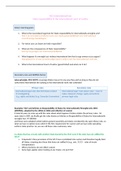
today’s learning goals:
1. What is the (secondary) legal test for State responsibility for internationally wrongful acts?
Wat is de secundaire juridische toets voor staatsaansprakelijkheid voor internationaal
onrechtmarige handelingen?
2. For which acts can States be held responsible?
3. What are the consequences of State responsibility?
Wat zijn de gevolgen van staatsaansprakelijkheid
4. What happens if a wrongful act violates international law that is erga omnes or jus cogens?
Wat gebeurd er al seen onrechtmatige daad in strijd is met het internationaal recht dat..
5. What is the International Court of Justice (gerechtshof) and what can it do?
Secondary rules and ARSIWA history
Lotus principle, PCIJ (1927): sovereign States may act in any way they wish so long as they do not
contravene international law (zolang ze het international recht niet schenden)
Primary rules Secondary rules
international legal rules that limit State conduct International legal “rules about rules” - how to
staatsgedrag make, interpret, change, apply and enforce
(e.g. rights and duties) (e.g. Genocide Convention) primary legal rules
Examples: VCLT and Articles on Responsibility of States for Internationally Wrongful Acts 2001
(ARSIWA), adopted by the UNGA in 2002 and reflective of custom
it took 50 years to come up with the rules about what happens if states violate the primary rules. 50
years later in 2001 we finally got the rules knows as Articles on Responsibility of States for internationally
wrongful Acts ARSWIA
and these were adopted united nations general assembly and states consistently rely upon these rules, so
what we have is opinion iures which it the first requirement for custom and we have wide spreading
uniform state practice. So, we can call these rules customary rules
Is a State that has a treaty with another State bound by the VCLT even if the state has not ratified the
VCLT?
It depends! Many provisions of the VCLT have crystallized into custom and therefore legally bind
all States, meaning also those that have not ratified it (e.g., arts. 31-33 – rules of treaty
interpretation)
Other provisions do not reflect custom
Same logic applies when looking at any treaty, not just VCLT
, (secondary) legal test for State responsibility for internationally wrongful acts
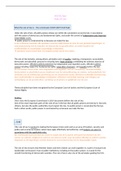
Article 2, ARSIWA (Articles on Responsibility of States for internationally wrongful Acts):
There is an internationally wrongful act of a State when conduct consisting of an action or omission:
Wanneer een gedraging bestaat uit handelen of nalaten
a. is attributable to the State under international law; and
is volgens het internationaal recht aan de staat toe te rekenen
b. constitutes a breach of an international obligation of the State.
vormt een schending van een internationale verplichting van de staat
Breach of duty: article 2(b), ARSIWA
1. International obligation
The first thing that you have to do as an international lawyer is that you have to identify an
international obligation.
2. Of a State
It has to be an obligation that belongs to a state has.
3. Act or omission
State can violate international law by acting but also by failing to act (doen of nalaten).
4. Breach (schending van) of international obligation (international verplichtingen)
You have to show that the act or omission violate international law. This is a question of
effidence sometimes
5. Breach occurred when obligation existed –> Er is sprake van een overtreding toen de verplichting
bestond
You need to show that the obligation existed
Attributable to a state: article 2(a), ARSIWA
State
Abstract legal concept that acts through individuals
Abstract juridisch concept dat handelt via individuen
Attribution
legal link between abstract State and individual conduct that breaches international law
juridisch verband tussen abstracte staat en individueel gedrag dat in strijd is met het internationaal recht
There are 3 ways to prove attribution
State responsibility & the international court of Justice
today’s learning goals:
1. What is the (secondary) legal test for State responsibility for internationally wrongful acts?
Wat is de secundaire juridische toets voor staatsaansprakelijkheid voor internationaal
onrechtmarige handelingen?
2. For which acts can States be held responsible?
3. What are the consequences of State responsibility?
Wat zijn de gevolgen van staatsaansprakelijkheid
4. What happens if a wrongful act violates international law that is erga omnes or jus cogens?
Wat gebeurd er al seen onrechtmatige daad in strijd is met het internationaal recht dat..
5. What is the International Court of Justice (gerechtshof) and what can it do?
Secondary rules and ARSIWA history
Lotus principle, PCIJ (1927): sovereign States may act in any way they wish so long as they do not
contravene international law (zolang ze het international recht niet schenden)
Primary rules Secondary rules
international legal rules that limit State conduct International legal “rules about rules” - how to
staatsgedrag make, interpret, change, apply and enforce
(e.g. rights and duties) (e.g. Genocide Convention) primary legal rules
Examples: VCLT and Articles on Responsibility of States for Internationally Wrongful Acts 2001
(ARSIWA), adopted by the UNGA in 2002 and reflective of custom
it took 50 years to come up with the rules about what happens if states violate the primary rules. 50
years later in 2001 we finally got the rules knows as Articles on Responsibility of States for internationally
wrongful Acts ARSWIA
and these were adopted united nations general assembly and states consistently rely upon these rules, so
what we have is opinion iures which it the first requirement for custom and we have wide spreading
uniform state practice. So, we can call these rules customary rules
Is a State that has a treaty with another State bound by the VCLT even if the state has not ratified the
VCLT?
It depends! Many provisions of the VCLT have crystallized into custom and therefore legally bind
all States, meaning also those that have not ratified it (e.g., arts. 31-33 – rules of treaty
interpretation)
Other provisions do not reflect custom
Same logic applies when looking at any treaty, not just VCLT
, (secondary) legal test for State responsibility for internationally wrongful acts
Article 2, ARSIWA (Articles on Responsibility of States for internationally wrongful Acts):
There is an internationally wrongful act of a State when conduct consisting of an action or omission:
Wanneer een gedraging bestaat uit handelen of nalaten
a. is attributable to the State under international law; and
is volgens het internationaal recht aan de staat toe te rekenen
b. constitutes a breach of an international obligation of the State.
vormt een schending van een internationale verplichting van de staat
Breach of duty: article 2(b), ARSIWA
1. International obligation
The first thing that you have to do as an international lawyer is that you have to identify an
international obligation.
2. Of a State
It has to be an obligation that belongs to a state has.
3. Act or omission
State can violate international law by acting but also by failing to act (doen of nalaten).
4. Breach (schending van) of international obligation (international verplichtingen)
You have to show that the act or omission violate international law. This is a question of
effidence sometimes
5. Breach occurred when obligation existed –> Er is sprake van een overtreding toen de verplichting
bestond
You need to show that the obligation existed
Attributable to a state: article 2(a), ARSIWA
State
Abstract legal concept that acts through individuals
Abstract juridisch concept dat handelt via individuen
Attribution
legal link between abstract State and individual conduct that breaches international law
juridisch verband tussen abstracte staat en individueel gedrag dat in strijd is met het internationaal recht
There are 3 ways to prove attribution