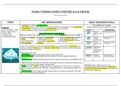
PS1030: UNDERSTANDING INDIVIDUALS & GROUPS
(Social psychology)
TOPIC A01 (KNOWLEDGE) A02/3 (EVIDENCE+EVAL)
- According to F, we have two basic drives: PSYCHOSEXUAL STAGES
1. Life instinct (Eros): humans are driven for survival, pleasure & reproduction. This creates libido. Child development occurs through five stages:
FREUD 2. Death instinct (Thanatos): humans are self-destructive. (eg. war/conflict).
(born in Freiberg in 1856, - Human motivation occurs to try and satisfy these needs ^^ STAGES CONSEQUENCES
lived in Vienna, died in ORAL Focus on Smoking, biting nails
London 1939) THE STRUCTURE OF PERSONALITY (0-1yrs) pleasure through
- Founder of the mouth
ID (Homer) Present at birth EGO (Marge) (develops apprx. age 2) SUPEREGO (Lisa) (final part, age 3-5)
Psychoanalytic theory ANAL Pleasure Become messy or
- Operates on the pleasure - Guided by the reality principle. - Based on morality principle (conscience)
principle. - Mediator between ID & SE. - Makes judgements on right/wrong (1-3yrs) through obsessive
- Source of all cravings, - Acts rationally, thinks, organizes, (represents moral standards, internalized expelling feces
impulses and drives us to creates balance, executive part of parent attitudes). Pleasure Narcissistic, possible
PHALLIC
satisfy selfish urges. personality. through genital homosexual
(3-5yrs)
area
- Role of the unconscious: Freud theorized that most of our mental activity is unconscious, and
LATENCY Identification
this has a significant influence on our behaviour & personality. The UC also contains repressed (6yrs-puberty) with one’s
childhood traumatic experiences. gender, defense
mechanisms
Three areas of the mind: develop
- CONSCIOUS: Material we are actively aware of at any given time. GENITAL Awakened Difficulty forming
- PRE-CONSCIOUS: Thoughts/ideas that are available for recall & capable of becoming (puberty+) sexual urges hetero relationships
conscious.
- UNCONSCIOUS: Memories/urges/fantasies we are unaware of due to their unacceptable nature.
- Repression: seen as a defense mechanism, can weaken and allow unconscious thoughts to be
conscious. Eg: alcohol, drugs, dreams, mental illness DREAMS: Solms (1997) research on the
- Dreams can have a latent (real) meaning from the unconscious. Their function is to preserve neuropsychology of dreaming shows activation of
sleep by representing wishes as fulfilled (eg. unacceptable desires, worries/stressed solved in a instinctual & emotional mechanisms in the brain that
dream). are involved w/ dreaming.
- Free association: Act of relaying thoughts as they come to you without censorship. This could
allow you to tap into your unconscious.
, - Defence mechanisms: acquired throughout the development of personality. They push UNCONSCIOUS: Bargh et al (2001) ppts primed with
disturbing/unacceptable content into the unconscious. They are psychologically adaptive. words that relate to cooperation subsequently
Reaction formation: converting socially unacceptable impulses into the opposite. behaved more co-operatively w/ other ppts in a task
Projection: perceiving others of having undesired traits that one inaccurately believes not to have
themselves. DEFENCE: (Dutton & Lake 1973) on RF. Non-
Displacement: altering the target of an impulse. (eg. violent/dominant father turns you to become prejudiced individuals given false physiological
hostile to authority figures) feedback about racial prejudices subsequently gave
Isolation: creating a mental barrier between a threatening thought/feeling more charity to a black individual than those who
Denial: refusal to accept certain facts that may be damaging to one sense of self. (smoker refusing weren’t given such feedback.
its damaging their health)
- Neo-Freudians: disagree with Freud’s highly sexualized view, but emphasize more the
importance of social environment/culture
- Components of an attitude: knowledge (cognitive), feeling (affect), action (behaviour) - KATZ (1960): FUNCTION OF ATTITUDES
- Attitude formation: attitudes are learned rather than innate: socialization process (Fishbein & = Knowledge (provide meaningful, structured
ATTITUDES Ajzen, 1975) environment)
(A relatively enduring set of = Mere-exposure effect (Zajionc,1968): repeated exposure to an object results in greater attraction = Instrumentality (means to an end/goal)
beliefs, feelings & intentions to that object = Ego defence (protecting one’s self-esteem)
towards an
object/person/symbol, etc.)
= Classical conditioning (Staats,1957): repeated association of a formerly neutral stimulus can = Value expressiveness (allowing ppl to display those
elicit a reaction when associated with another stimulus values that uniquely identifies them)
= Operant conditioning (Kimble,1961): responses which yield positive outcomes or eliminate
negative outcomes are strengthened
= Observational learning (Bandura,1971): Attitude formation is a social learning process. In
modelling, one person’s behaviour is modelled by the other
= Self perception (Bem,1972): our attitudes are informed by our behaviour & making internal
attributions for that behaviour. “why did I do that?”
- OSD strength: straightforward & easy
- Measuring attitudes: - OSD weakness: just evaluations
= Osgood’s semantic differential: doesn’t measure opinions, but evaluations of an object/person - LS strength: convivence, comparable scores, gives
on a set of semantic scales (numbers). Straightforward & easy. standardized measure
= Likert scale (numbers): statements that respondents indicate their strength of - LS weakness: forces ppl to agree/disagree, social
agreement/disagreement desirability,
= Physiological measures: skin resistance, heart rate, pupil dilation - PM strength: more objective
- PM weakness: extraneous variables
- How do attitudes change? - dissonance can be initiated in different ways:
= consistency theories: attitudes change to be consistent w/ each other. Attitudes change to be = forced compliance: (Festinger & Carlsmith, 1959)
consistent w/ behaviour. = decision making: (Brehm, 1956)
(Social psychology)
TOPIC A01 (KNOWLEDGE) A02/3 (EVIDENCE+EVAL)
- According to F, we have two basic drives: PSYCHOSEXUAL STAGES
1. Life instinct (Eros): humans are driven for survival, pleasure & reproduction. This creates libido. Child development occurs through five stages:
FREUD 2. Death instinct (Thanatos): humans are self-destructive. (eg. war/conflict).
(born in Freiberg in 1856, - Human motivation occurs to try and satisfy these needs ^^ STAGES CONSEQUENCES
lived in Vienna, died in ORAL Focus on Smoking, biting nails
London 1939) THE STRUCTURE OF PERSONALITY (0-1yrs) pleasure through
- Founder of the mouth
ID (Homer) Present at birth EGO (Marge) (develops apprx. age 2) SUPEREGO (Lisa) (final part, age 3-5)
Psychoanalytic theory ANAL Pleasure Become messy or
- Operates on the pleasure - Guided by the reality principle. - Based on morality principle (conscience)
principle. - Mediator between ID & SE. - Makes judgements on right/wrong (1-3yrs) through obsessive
- Source of all cravings, - Acts rationally, thinks, organizes, (represents moral standards, internalized expelling feces
impulses and drives us to creates balance, executive part of parent attitudes). Pleasure Narcissistic, possible
PHALLIC
satisfy selfish urges. personality. through genital homosexual
(3-5yrs)
area
- Role of the unconscious: Freud theorized that most of our mental activity is unconscious, and
LATENCY Identification
this has a significant influence on our behaviour & personality. The UC also contains repressed (6yrs-puberty) with one’s
childhood traumatic experiences. gender, defense
mechanisms
Three areas of the mind: develop
- CONSCIOUS: Material we are actively aware of at any given time. GENITAL Awakened Difficulty forming
- PRE-CONSCIOUS: Thoughts/ideas that are available for recall & capable of becoming (puberty+) sexual urges hetero relationships
conscious.
- UNCONSCIOUS: Memories/urges/fantasies we are unaware of due to their unacceptable nature.
- Repression: seen as a defense mechanism, can weaken and allow unconscious thoughts to be
conscious. Eg: alcohol, drugs, dreams, mental illness DREAMS: Solms (1997) research on the
- Dreams can have a latent (real) meaning from the unconscious. Their function is to preserve neuropsychology of dreaming shows activation of
sleep by representing wishes as fulfilled (eg. unacceptable desires, worries/stressed solved in a instinctual & emotional mechanisms in the brain that
dream). are involved w/ dreaming.
- Free association: Act of relaying thoughts as they come to you without censorship. This could
allow you to tap into your unconscious.
, - Defence mechanisms: acquired throughout the development of personality. They push UNCONSCIOUS: Bargh et al (2001) ppts primed with
disturbing/unacceptable content into the unconscious. They are psychologically adaptive. words that relate to cooperation subsequently
Reaction formation: converting socially unacceptable impulses into the opposite. behaved more co-operatively w/ other ppts in a task
Projection: perceiving others of having undesired traits that one inaccurately believes not to have
themselves. DEFENCE: (Dutton & Lake 1973) on RF. Non-
Displacement: altering the target of an impulse. (eg. violent/dominant father turns you to become prejudiced individuals given false physiological
hostile to authority figures) feedback about racial prejudices subsequently gave
Isolation: creating a mental barrier between a threatening thought/feeling more charity to a black individual than those who
Denial: refusal to accept certain facts that may be damaging to one sense of self. (smoker refusing weren’t given such feedback.
its damaging their health)
- Neo-Freudians: disagree with Freud’s highly sexualized view, but emphasize more the
importance of social environment/culture
- Components of an attitude: knowledge (cognitive), feeling (affect), action (behaviour) - KATZ (1960): FUNCTION OF ATTITUDES
- Attitude formation: attitudes are learned rather than innate: socialization process (Fishbein & = Knowledge (provide meaningful, structured
ATTITUDES Ajzen, 1975) environment)
(A relatively enduring set of = Mere-exposure effect (Zajionc,1968): repeated exposure to an object results in greater attraction = Instrumentality (means to an end/goal)
beliefs, feelings & intentions to that object = Ego defence (protecting one’s self-esteem)
towards an
object/person/symbol, etc.)
= Classical conditioning (Staats,1957): repeated association of a formerly neutral stimulus can = Value expressiveness (allowing ppl to display those
elicit a reaction when associated with another stimulus values that uniquely identifies them)
= Operant conditioning (Kimble,1961): responses which yield positive outcomes or eliminate
negative outcomes are strengthened
= Observational learning (Bandura,1971): Attitude formation is a social learning process. In
modelling, one person’s behaviour is modelled by the other
= Self perception (Bem,1972): our attitudes are informed by our behaviour & making internal
attributions for that behaviour. “why did I do that?”
- OSD strength: straightforward & easy
- Measuring attitudes: - OSD weakness: just evaluations
= Osgood’s semantic differential: doesn’t measure opinions, but evaluations of an object/person - LS strength: convivence, comparable scores, gives
on a set of semantic scales (numbers). Straightforward & easy. standardized measure
= Likert scale (numbers): statements that respondents indicate their strength of - LS weakness: forces ppl to agree/disagree, social
agreement/disagreement desirability,
= Physiological measures: skin resistance, heart rate, pupil dilation - PM strength: more objective
- PM weakness: extraneous variables
- How do attitudes change? - dissonance can be initiated in different ways:
= consistency theories: attitudes change to be consistent w/ each other. Attitudes change to be = forced compliance: (Festinger & Carlsmith, 1959)
consistent w/ behaviour. = decision making: (Brehm, 1956)