Introduction
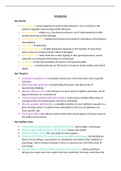
Key Words:
o Neuroethics = moral judgement e.g. the trolley dilemma = lots of activity in the
anterior cingulate cortex during conflict decisions.
o Neurotheology = religion e.g. Geschwind syndrome, out of body experiences after
temporo-parietal junction damage.
o Geschwind syndrome = behavioural phenomena evident in individuals with temporal
lobe epilepsy.
o Neurolaw = lie detection.
o Neural redundancy = complex behaviour depends on the function of many brain
areas; some can compensate for others if damaged.
o Neuroplasticity = when brain loss is slow (ageing or slow growing tumour), neural
networks can reorganise themselves to compensate.
o Lay ideas = social representations of science in the general public.
o Phrenology = examining bumps on the head as a measure of personality and mental
ability.
Key Theories:
Localisation hypothesis: it is possible to find areas of the brain that control specific
functions.
Brain overclaim syndrome: overestimating the power and discoveries of
neuroscience findings.
Reverse inference error: one structure can serve several cognitive processes, not all
logical inferences are symmetrical.
Group to group individual inference problem: brain scans in studies often show an
average picture of all participants, not just an individual.
Illusory causation phenomenon: a simplistic tendency to over-attribute causality to a
given stimulus when it is salient (most noticeable) or the focus of attention e.g.
brain, gender, age.
The Mozart effect: the cultural context determines which aspects of science travel to
the public consciousness.
Key Studies/cases:
Franz Gall & Johann Spurzheim and Neil Davie (2012): phrenology/ cranioscopy.
Phineas Gage (1848) and Broca and Wernicke: lesion case studies.
Scoville & Miller (1957): HM case study for neurosurgery.
Schwartz et al (2016), The role of neuroscience within psychology: interdisciplinary
future for psychology, neuroscience to compliment and extend other subfields of
psychology. Need a balance between a focus on neuroscience and other areas of
psychology.
Van Atteveldt et al (2014), Media reporting of neuroscience: articles published
during news waves were less neutral and more optimistic, the topic varied how the
Key Words:
o Neuroethics = moral judgement e.g. the trolley dilemma = lots of activity in the
anterior cingulate cortex during conflict decisions.
o Neurotheology = religion e.g. Geschwind syndrome, out of body experiences after
temporo-parietal junction damage.
o Geschwind syndrome = behavioural phenomena evident in individuals with temporal
lobe epilepsy.
o Neurolaw = lie detection.
o Neural redundancy = complex behaviour depends on the function of many brain
areas; some can compensate for others if damaged.
o Neuroplasticity = when brain loss is slow (ageing or slow growing tumour), neural
networks can reorganise themselves to compensate.
o Lay ideas = social representations of science in the general public.
o Phrenology = examining bumps on the head as a measure of personality and mental
ability.
Key Theories:
Localisation hypothesis: it is possible to find areas of the brain that control specific
functions.
Brain overclaim syndrome: overestimating the power and discoveries of
neuroscience findings.
Reverse inference error: one structure can serve several cognitive processes, not all
logical inferences are symmetrical.
Group to group individual inference problem: brain scans in studies often show an
average picture of all participants, not just an individual.
Illusory causation phenomenon: a simplistic tendency to over-attribute causality to a
given stimulus when it is salient (most noticeable) or the focus of attention e.g.
brain, gender, age.
The Mozart effect: the cultural context determines which aspects of science travel to
the public consciousness.
Key Studies/cases:
Franz Gall & Johann Spurzheim and Neil Davie (2012): phrenology/ cranioscopy.
Phineas Gage (1848) and Broca and Wernicke: lesion case studies.
Scoville & Miller (1957): HM case study for neurosurgery.
Schwartz et al (2016), The role of neuroscience within psychology: interdisciplinary
future for psychology, neuroscience to compliment and extend other subfields of
psychology. Need a balance between a focus on neuroscience and other areas of
psychology.
Van Atteveldt et al (2014), Media reporting of neuroscience: articles published
during news waves were less neutral and more optimistic, the topic varied how the