Cell Structure
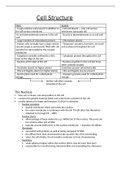
Plant Animal
- Tough cellulose wall present in addition to - Cell wall absent only cell surface
the cell surface membrane membrane surrounds cell
-Its and plasmodesmata present in the cell - No pits or plasmodesmata as no cell wall
wall
- Large numbers of chloroplasts present - Chloroplasts absent
- Mature cells normally have a large central - Temporary vacuoles, if present, are small
vacuole (single & permanent) filled with cell and scattered throughout the cell
sap which is surrounded by the vacuole
membrane
- Cytoplasm normally confined to a thin - Cytoplasm present throughout the cell
layer at the edge of the cell
- Nucleus at the edge of the cell - Nucleus anywhere in the cell but most
often centrally located
- Centrioles absent (in higher plants) Centrioles present (all animal cells)
- Cilia and flagella absent (in higher plants) - Cilia and flagella may be present
- Starch grains used for carbohydrate - Glycogen granules used for carbohydrate
storage storage
Neither will affect osmotic
potential of the cell
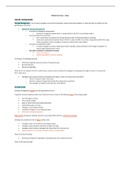
The Nucleus
May vary in shape, size and position in the cell
contains the genetic material (DNA) and controls the activities of the cell
usually spherical in shape and between 10-20 μm in diameter
Nuclear envelope
double membrane which surrounds the nucleus
the outer membrane is continuous with the ER. The ER often has ribosomes
attached to it (rough ER RER)
Nuclear pores
allow passage of large molecules e.g. mRNA Out of the nucleus. The pores are
too small to allow exit of DNA
typically around 3000 pores in the nuclear membrane diameter 40-100nm
Chromatin
associated with proteins as well as being composed of DNA
the diffuse form that chromosomes take up when the cell is not dividing
when the cell divides, the chromatin condenses to form chromosomes
Nucleolus
small spherical region within the nucleus (there may be more than one)
responsible for manufacturing ribosomal RNA and assembling the ribosomes
, Chloroplasts
Found in eukaryotic cells which can photosynthesise
flat disks - usually 3-10 μm in diameter and 1m thick
Chloroplast envelope
Double membrane
Controls entry/exit of substances
Stroma
Colourless, gelatinous matrix which contains enzymes necessary for the light
independent stage of photosynthesis
Small, circular piece of DNA, 70S ribosomes and oil droplets are found in the
stroma
Grana
Structures that looked like stacks of coins
typically 50 grana in a chloroplast and each is made up of 100 stacked
flattened sacs called thylakoids or lamellae
grana carry out the light dependent phase of photosynthesis during which
ATP is produced
Starch grains act as a temporary store of carbohydrates
Mitochondrion
Rod-shaped and 1-7m in length and o.5-1m in diameter
Double membrane
Controls entry and exit of substances
Inner membrane is folded to form extensions known as cristae
Cristae
Some extend across the whole width of the mitochondrion
Contain enzymes and other molecules involved in aerobic respiration
Provide a large surface area for a stage of aerobic respiration known as
oxidative phosphorylation which results in the synthesis of ATP molecules
Matrix
Semi-rigid structure containing proteins, lipids, 70S ribosomes and circular
DNA (the 70S ribosomes and circular DNA allows the mitochondria to
synthesize some of its own proteins)
Many enzymes involved in the Krebs cycle can be found in the matrix
e.g. NAD and co-enzymes
Endoplasmic Reticulum (ER)
Plant Animal
- Tough cellulose wall present in addition to - Cell wall absent only cell surface
the cell surface membrane membrane surrounds cell
-Its and plasmodesmata present in the cell - No pits or plasmodesmata as no cell wall
wall
- Large numbers of chloroplasts present - Chloroplasts absent
- Mature cells normally have a large central - Temporary vacuoles, if present, are small
vacuole (single & permanent) filled with cell and scattered throughout the cell
sap which is surrounded by the vacuole
membrane
- Cytoplasm normally confined to a thin - Cytoplasm present throughout the cell
layer at the edge of the cell
- Nucleus at the edge of the cell - Nucleus anywhere in the cell but most
often centrally located
- Centrioles absent (in higher plants) Centrioles present (all animal cells)
- Cilia and flagella absent (in higher plants) - Cilia and flagella may be present
- Starch grains used for carbohydrate - Glycogen granules used for carbohydrate
storage storage
Neither will affect osmotic
potential of the cell
The Nucleus
May vary in shape, size and position in the cell
contains the genetic material (DNA) and controls the activities of the cell
usually spherical in shape and between 10-20 μm in diameter
Nuclear envelope
double membrane which surrounds the nucleus
the outer membrane is continuous with the ER. The ER often has ribosomes
attached to it (rough ER RER)
Nuclear pores
allow passage of large molecules e.g. mRNA Out of the nucleus. The pores are
too small to allow exit of DNA
typically around 3000 pores in the nuclear membrane diameter 40-100nm
Chromatin
associated with proteins as well as being composed of DNA
the diffuse form that chromosomes take up when the cell is not dividing
when the cell divides, the chromatin condenses to form chromosomes
Nucleolus
small spherical region within the nucleus (there may be more than one)
responsible for manufacturing ribosomal RNA and assembling the ribosomes
, Chloroplasts
Found in eukaryotic cells which can photosynthesise
flat disks - usually 3-10 μm in diameter and 1m thick
Chloroplast envelope
Double membrane
Controls entry/exit of substances
Stroma
Colourless, gelatinous matrix which contains enzymes necessary for the light
independent stage of photosynthesis
Small, circular piece of DNA, 70S ribosomes and oil droplets are found in the
stroma
Grana
Structures that looked like stacks of coins
typically 50 grana in a chloroplast and each is made up of 100 stacked
flattened sacs called thylakoids or lamellae
grana carry out the light dependent phase of photosynthesis during which
ATP is produced
Starch grains act as a temporary store of carbohydrates
Mitochondrion
Rod-shaped and 1-7m in length and o.5-1m in diameter
Double membrane
Controls entry and exit of substances
Inner membrane is folded to form extensions known as cristae
Cristae
Some extend across the whole width of the mitochondrion
Contain enzymes and other molecules involved in aerobic respiration
Provide a large surface area for a stage of aerobic respiration known as
oxidative phosphorylation which results in the synthesis of ATP molecules
Matrix
Semi-rigid structure containing proteins, lipids, 70S ribosomes and circular
DNA (the 70S ribosomes and circular DNA allows the mitochondria to
synthesize some of its own proteins)
Many enzymes involved in the Krebs cycle can be found in the matrix
e.g. NAD and co-enzymes
Endoplasmic Reticulum (ER)