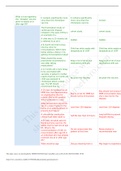
Schaffer’s stages of attachment
Key study
Method
- Schaffer & Emerson
- Sample- 60 babies, in Glasgow working class families
- Longitudinal study --> visited every month for a year & again at 18
months
- Looking at stranger & separation anxiety
Findings
- At 7 months- 50% had separation anxiety
- At 9 months- 80% had a specific attachment,
-30% had multiple attachments
Evaluation
Good external validity
- Strength- carried out in families’ own homes and most of the observation
was done by parents during ordinary activities & reported later.
- Means that behaviour was unlikely to be affecter by the presence of others.
- Thus, there is a good chance babies behaved naturally during observation.
- Thus, study has good external validity.
Longitudinal design
- Strength- same children were followed up and observed regularly.
- Longitudinal designs have better internal validity than cross-sectional
designs- no confounding variable in participant variables.
Limited sample characteristics
- Limitation- sample size of was good, however families involved were from
the same district & social class & over 50 years ago is too long.
- Child rearing practices vary from one culture to another, and one historical
period to another. These results do not necessarily generalise well to
together social and historical contexts.
Key study
Method
- Schaffer & Emerson
- Sample- 60 babies, in Glasgow working class families
- Longitudinal study --> visited every month for a year & again at 18
months
- Looking at stranger & separation anxiety
Findings
- At 7 months- 50% had separation anxiety
- At 9 months- 80% had a specific attachment,
-30% had multiple attachments
Evaluation
Good external validity
- Strength- carried out in families’ own homes and most of the observation
was done by parents during ordinary activities & reported later.
- Means that behaviour was unlikely to be affecter by the presence of others.
- Thus, there is a good chance babies behaved naturally during observation.
- Thus, study has good external validity.
Longitudinal design
- Strength- same children were followed up and observed regularly.
- Longitudinal designs have better internal validity than cross-sectional
designs- no confounding variable in participant variables.
Limited sample characteristics
- Limitation- sample size of was good, however families involved were from
the same district & social class & over 50 years ago is too long.
- Child rearing practices vary from one culture to another, and one historical
period to another. These results do not necessarily generalise well to
together social and historical contexts.