Explanations of Attachment- Learning Theory
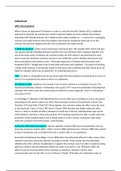
Classical conditioning
- Classical conditioning involves learning to associate two stimuli together
to respond to one as we already respond to the other.
- Food serves as an unconditioned stimulus.
→ Being fed gives us pleasure- it is an unconditioned stimulus.
→ Primary caregiver, the neutral stimulus, becomes associated with
food, the unconditioned stimulus, becoming a conditioned stimulus
producing 'pleasure’.
→ Once conditioning has taken place, the sight of the caregiver
produces a conditioned response of pleasure.
Operant conditioning
- Operant conditioning involves learning to
repeat behaviour, depending on its
consequences.
- If an action produces a pleasant
consequence, that behaviour is likely to be
repeated.
→ Babies cry for comfort because crying
is positively reinforced by attention.
→ The baby is reinforced for crying,
while the caregiver receives negative
reinforcement because the crying
stops.
→ This interplay of mutual reinforcement
strengthens an attachment.
Attachment as a secondary drive
- Hunger is a primary drive- it is innate and biological.
- As caregivers provide food, the primary drive of hunger becomes
generalised to them
- Attachment thus is a secondary drive learned by an association between
the caregiver and the satisfaction of a primary drive.
Classical conditioning
- Classical conditioning involves learning to associate two stimuli together
to respond to one as we already respond to the other.
- Food serves as an unconditioned stimulus.
→ Being fed gives us pleasure- it is an unconditioned stimulus.
→ Primary caregiver, the neutral stimulus, becomes associated with
food, the unconditioned stimulus, becoming a conditioned stimulus
producing 'pleasure’.
→ Once conditioning has taken place, the sight of the caregiver
produces a conditioned response of pleasure.
Operant conditioning
- Operant conditioning involves learning to
repeat behaviour, depending on its
consequences.
- If an action produces a pleasant
consequence, that behaviour is likely to be
repeated.
→ Babies cry for comfort because crying
is positively reinforced by attention.
→ The baby is reinforced for crying,
while the caregiver receives negative
reinforcement because the crying
stops.
→ This interplay of mutual reinforcement
strengthens an attachment.
Attachment as a secondary drive
- Hunger is a primary drive- it is innate and biological.
- As caregivers provide food, the primary drive of hunger becomes
generalised to them
- Attachment thus is a secondary drive learned by an association between
the caregiver and the satisfaction of a primary drive.