

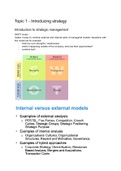
Topic 1 - Introducing strategy
Introduction to strategic management
SWOT model
makes it easy to combine external and internal parts of managerial models. Questions with
this model are for example:
- what are core strengths / weaknesses
- what is happening outside of the company, what are their opportunities?
- combine both
,Different streams within strategic management
What is strategy?
- long term plan
- long run goals and objectives and allocation of resources necessary to
actually carrying out these goals
- they should include different time horizons
- being different
min 1;20
,Topic 2 - External Analysis
External analysis
Macro-environment - where firms have very little influence on what is happening
Both older and newer theories state that the outside influences are uncertain, and people
want to prevent them.
- Older theories look at how we get stability?
- Newer theories looks as how we can use change as a driver for business
opportunities
PESTEL-analysis
Idea behind it is to map all the different factors of the macro-environment of the firm and
identify the potential impact of each of these factors
Politics, Economy, Social, Technology, Environment, Legal
Social; consumer opinions are very difficult to predict, but you have to take them into
account
Tips for project
Start in the following order:
- building scenarios
- Use PESTEL to identify drivers of change
- gather as much data as you can
- look for megatrends
- (i.e., online, green, sharing economy)
- inflection points and and/or exponential growth
- how people think about these subjects, is it growing exponentially/linearly
- estimate the impact on your organization
- and estimate high or low independence and uncertainty
, Industry analysis
An industry;
group of firms in a certain geographical area that offer similar products or services.
Why analyze them?
Competition between firms is often characterised by certain rules, dynamics and official
regulation. This causes similarity between firms, and differences between industries in terms
of profitability. So, if you better understand industry dynamics, you better understand which
industries are more likely to be profitable than others, and also how you can disrupt
industries.
Five forces of Porter
How profitable is an industry (and not how profitable is a firm in an industry)
Threat of new entry
- Time and cost new entry
- deals with how easy it is to set up a new firm in an industry
- if easy, a lot of new entrants, more competition, bad for profitability
- you can look at time and cost of new entry
- Economies of scale
- the amount of production or quantity that you produce and how that quantity
affects your cost price
- careful, at some point average costs can also go up (if firms become
immense, there has to be more coordination between different entities so the
firm can become less effective)
- Q3: minimal optimal scale, the minimum scale you need to have the lowest
average cost per unit. (see picture)
Introduction to strategic management
SWOT model
makes it easy to combine external and internal parts of managerial models. Questions with
this model are for example:
- what are core strengths / weaknesses
- what is happening outside of the company, what are their opportunities?
- combine both
,Different streams within strategic management
What is strategy?
- long term plan
- long run goals and objectives and allocation of resources necessary to
actually carrying out these goals
- they should include different time horizons
- being different
min 1;20
,Topic 2 - External Analysis
External analysis
Macro-environment - where firms have very little influence on what is happening
Both older and newer theories state that the outside influences are uncertain, and people
want to prevent them.
- Older theories look at how we get stability?
- Newer theories looks as how we can use change as a driver for business
opportunities
PESTEL-analysis
Idea behind it is to map all the different factors of the macro-environment of the firm and
identify the potential impact of each of these factors
Politics, Economy, Social, Technology, Environment, Legal
Social; consumer opinions are very difficult to predict, but you have to take them into
account
Tips for project
Start in the following order:
- building scenarios
- Use PESTEL to identify drivers of change
- gather as much data as you can
- look for megatrends
- (i.e., online, green, sharing economy)
- inflection points and and/or exponential growth
- how people think about these subjects, is it growing exponentially/linearly
- estimate the impact on your organization
- and estimate high or low independence and uncertainty
, Industry analysis
An industry;
group of firms in a certain geographical area that offer similar products or services.
Why analyze them?
Competition between firms is often characterised by certain rules, dynamics and official
regulation. This causes similarity between firms, and differences between industries in terms
of profitability. So, if you better understand industry dynamics, you better understand which
industries are more likely to be profitable than others, and also how you can disrupt
industries.
Five forces of Porter
How profitable is an industry (and not how profitable is a firm in an industry)
Threat of new entry
- Time and cost new entry
- deals with how easy it is to set up a new firm in an industry
- if easy, a lot of new entrants, more competition, bad for profitability
- you can look at time and cost of new entry
- Economies of scale
- the amount of production or quantity that you produce and how that quantity
affects your cost price
- careful, at some point average costs can also go up (if firms become
immense, there has to be more coordination between different entities so the
firm can become less effective)
- Q3: minimal optimal scale, the minimum scale you need to have the lowest
average cost per unit. (see picture)



