

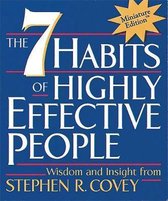
The 7 habits of highly effective people
Stephen R. Covey
25th edition - 2013
The content of the book
The first few pages are reviews by other authors or famous people.
Covey then starts with an acknowledgement where he thanks many people for their contribution to
the book.
Page 1 up to 7 contains a foreword to the 25th anniversary edition by Jim Collins.
Page 9 up to 13 contains a Covey family tribute by his children.
Page 16 up to 20 contains a foreword to the 2004 edition by Covey himself.
Inside-out page 23
The 7 Habits – and overview page 54
Habit 1: Be Proactive page 74
Habit 2: Begin with the End in Mind page 102
Habit 3: Put First Things First page 154
Habit 4: Think Win/Win page 215
Habit 5: Seek first to Understand, page 247
then to be understood
Habit 6: Synergize page 273
Habit 7: Sharpen the Saw page 299
Inside-out again page 320
Afterword: FAQ page 331
Appendix page 343
For the length of the summary, I will only be going over the most important parts of the book. These
are see in bold above. Check out the useful clips at the end of the summary.
, Part 1: Paradigms and Principles
Independence is the paradigm of I. I can do it. I am responsible.
The 7 Habits – An Overview Interdependence is the paradigm of we. We can do it. We can cooperate.
Habits defined Assets
A Habit can be defined as an intersection between knowledge, skill, and There are three kinds of assets: physical, financial, and human. The 7
desire. Knowledge is a the ‘what to do’ and the ‘why’. Skill is the ‘how to Habits is focussed on the human assets.
do it’. Desire is a motivation, the ‘wants to do it’. In order to make
something a habit in our lives we have to have all three.
The 7 Habits provide an incremental,, sequential, highly integrated
approach to the development of personal and interpersonal
effectiveness.
Maturity Continuum
Dependence is the paradigm of you. You take care of me. You are to
blame.
Stephen R. Covey
25th edition - 2013
The content of the book
The first few pages are reviews by other authors or famous people.
Covey then starts with an acknowledgement where he thanks many people for their contribution to
the book.
Page 1 up to 7 contains a foreword to the 25th anniversary edition by Jim Collins.
Page 9 up to 13 contains a Covey family tribute by his children.
Page 16 up to 20 contains a foreword to the 2004 edition by Covey himself.
Inside-out page 23
The 7 Habits – and overview page 54
Habit 1: Be Proactive page 74
Habit 2: Begin with the End in Mind page 102
Habit 3: Put First Things First page 154
Habit 4: Think Win/Win page 215
Habit 5: Seek first to Understand, page 247
then to be understood
Habit 6: Synergize page 273
Habit 7: Sharpen the Saw page 299
Inside-out again page 320
Afterword: FAQ page 331
Appendix page 343
For the length of the summary, I will only be going over the most important parts of the book. These
are see in bold above. Check out the useful clips at the end of the summary.
, Part 1: Paradigms and Principles
Independence is the paradigm of I. I can do it. I am responsible.
The 7 Habits – An Overview Interdependence is the paradigm of we. We can do it. We can cooperate.
Habits defined Assets
A Habit can be defined as an intersection between knowledge, skill, and There are three kinds of assets: physical, financial, and human. The 7
desire. Knowledge is a the ‘what to do’ and the ‘why’. Skill is the ‘how to Habits is focussed on the human assets.
do it’. Desire is a motivation, the ‘wants to do it’. In order to make
something a habit in our lives we have to have all three.
The 7 Habits provide an incremental,, sequential, highly integrated
approach to the development of personal and interpersonal
effectiveness.
Maturity Continuum
Dependence is the paradigm of you. You take care of me. You are to
blame.

