
Scientific news
One step closer to the cure of cancer
Are checkpoint inhibitors the new future?
Date: 16th of May 2021
Cancer is one of the most destructive diseases. It was responsible for almost 10
million deaths in 2020, according to the World Health Organization (WHO). Most of
these deaths were caused by lung cancer. Cancer is a collective name for diseases
caused by uncontrollable cell growth. More than 100 types of cancer exist. Studies
into effective cancer treatment have a high social relevance, since everyone knows a
patient who suffers from cancer.
The extensive cell growth results in tumors, which can occur in any part of the body. There
are two types of tumors: benign and malignant ones. The difference between both is that
benign tumors do not invade and compete with healthy tissues, while the latter does.
Therefore, only malignant tumors are considered cancerous. Though, it should be noted that
benign tumors could still be dangerous. This could be due to lack of space, for example in
the brain. Cancer is usually caused by an accumulation of factors. Risk factors include
genes, consumption of tobacco, alcohol and unhealthy food, exposure to radiation and air
pollution, physical activity and viral diseases caused by viruses such as Hepatitis B and C,
HPV and HIV. The chance of exposure to risk factors increases with age. If one or more of
these risk factors affect a cell, this cell could become cancerous. Cells have an extra layer of
protection to prevent this from happening, namely cell repair mechanisms. However, these
repair mechanisms weaken as one’s age increases. Because of this weakening and
1
, because of the accumulation of risk factors, the chance of developing cancer increases as
someone grows older. Some of the most well-known treatment options for cancer are
surgery, chemotherapy and radiation therapy. Surgery is applied when the tumor has a
clean margin, so no healthy tissue has to be unnecessarily removed. Without clean margins,
chemotherapy and radiation therapy could be used. Chemotherapy is a treatment based on
drugs targeted to tumors. Radiation therapy is the application of intense energy beams, such
as X-rays and protons, meant to kill cancer cells. The last two treatments affect cancer cells,
as well as healthy cells. Though these treatments have proven to be effective, they are more
often just a treatment instead of a cure. Checkpoint inhibitors seem to be more effective than
other therapies. Do checkpoint inhibitors really offer more the possibility of a cure, and do
they, in comparison to other treatments, only affect cancer cells?
Cancer and its treatments
Cancer is a complex disease. As said before, it is usually the result of the accumulation of
multiple risk factors. When a cell becomes cancerous, its deoxyribonucleic acid (DNA) has
been altered. DNA contains genes, which do not only determine the way humans look, but
also control many processes inside the human body. The usual sign of cancer is unlimited
growth, which is what produces the actual bulky tumors. Most tumors also display other
signs of altered DNA, mainly strategies to evade the immune system. Usually, the immune
system checks every cell to see if it belongs in the body. The process can be seen as some
sort of extreme border security: every cell displays certain proteins that act as a passport,
which the immune system recognizes and subsequently lets those cells through. Any cell
that does not display these proteins is attacked and killed. One of the most important
passport proteins is Programmed death-ligand 1 (PD-L1). T-cells, the assassins of the
immune system, are always in kill-mode, unless their own Programmed Death-1 (PD-1)
binds to a PD-L1. Then, the reaction is stopped. This is called a “checkpoint” of the immune
system - a prevention to not kill its own cells. A lot of the tumor cells also display PD-L1, and
thus are not attacked by T-cells. A new series of drugs has been developed to combat this
problem: Immune Checkpoint Inhibitors. They block the “checkpoints” of the immune
system, and allow T-cells to attack other cells even when they display PD-L1. However, this
is of course quite dangerous, as all cells in the body display PD-L1. Therefore, researchers
have found another checkpoint protein to inhibit: CTLA-4. Cytotoxic T-lymphocyte antigen-4,
as its full name is officially, is displayed by regulatory T-cells, but only upregulated in normal
T-cells after activation. This process is nearly specific for cancer - a few other diseases
portray it as well, but normal cells certainly do not. This makes it a perfect target for a
cancer-specific therapy, which is exactly what the drug Ipilimumab does. When CTLA-4 is
blocked by Ipilimumab, it cannot bind to its partner protein and therefore an “off” signal is not
sent. T-cells are now able to kill the cancer cells. So, the lack of a checkpoint protein brought
on by drugs such as Ipilimumab activates an immune response, resulting in elimination of
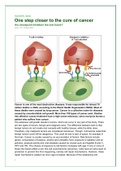
the cancer cells by immune cells. A drawing representing the place where Ipilimumab and
PD-1/PD-L1 inhibitors work can be seen above this article.
Clinical significance of checkpoint inhibitors
‘Old’ cancer therapies like chemotherapy, radiotherapy and surgery, which inhibit the growth
or destroy the tumor directly, are not specific for sick cells and therefore also destroy the
patients’ healthy cells. These therapies will barely improve the survival of the cancer
patients, which is why new treatments are needed that will extend the long-term survival
2
One step closer to the cure of cancer
Are checkpoint inhibitors the new future?
Date: 16th of May 2021
Cancer is one of the most destructive diseases. It was responsible for almost 10
million deaths in 2020, according to the World Health Organization (WHO). Most of
these deaths were caused by lung cancer. Cancer is a collective name for diseases
caused by uncontrollable cell growth. More than 100 types of cancer exist. Studies
into effective cancer treatment have a high social relevance, since everyone knows a
patient who suffers from cancer.
The extensive cell growth results in tumors, which can occur in any part of the body. There
are two types of tumors: benign and malignant ones. The difference between both is that
benign tumors do not invade and compete with healthy tissues, while the latter does.
Therefore, only malignant tumors are considered cancerous. Though, it should be noted that
benign tumors could still be dangerous. This could be due to lack of space, for example in
the brain. Cancer is usually caused by an accumulation of factors. Risk factors include
genes, consumption of tobacco, alcohol and unhealthy food, exposure to radiation and air
pollution, physical activity and viral diseases caused by viruses such as Hepatitis B and C,
HPV and HIV. The chance of exposure to risk factors increases with age. If one or more of
these risk factors affect a cell, this cell could become cancerous. Cells have an extra layer of
protection to prevent this from happening, namely cell repair mechanisms. However, these
repair mechanisms weaken as one’s age increases. Because of this weakening and
1
, because of the accumulation of risk factors, the chance of developing cancer increases as
someone grows older. Some of the most well-known treatment options for cancer are
surgery, chemotherapy and radiation therapy. Surgery is applied when the tumor has a
clean margin, so no healthy tissue has to be unnecessarily removed. Without clean margins,
chemotherapy and radiation therapy could be used. Chemotherapy is a treatment based on
drugs targeted to tumors. Radiation therapy is the application of intense energy beams, such
as X-rays and protons, meant to kill cancer cells. The last two treatments affect cancer cells,
as well as healthy cells. Though these treatments have proven to be effective, they are more
often just a treatment instead of a cure. Checkpoint inhibitors seem to be more effective than
other therapies. Do checkpoint inhibitors really offer more the possibility of a cure, and do
they, in comparison to other treatments, only affect cancer cells?
Cancer and its treatments
Cancer is a complex disease. As said before, it is usually the result of the accumulation of
multiple risk factors. When a cell becomes cancerous, its deoxyribonucleic acid (DNA) has
been altered. DNA contains genes, which do not only determine the way humans look, but
also control many processes inside the human body. The usual sign of cancer is unlimited
growth, which is what produces the actual bulky tumors. Most tumors also display other
signs of altered DNA, mainly strategies to evade the immune system. Usually, the immune
system checks every cell to see if it belongs in the body. The process can be seen as some
sort of extreme border security: every cell displays certain proteins that act as a passport,
which the immune system recognizes and subsequently lets those cells through. Any cell
that does not display these proteins is attacked and killed. One of the most important
passport proteins is Programmed death-ligand 1 (PD-L1). T-cells, the assassins of the
immune system, are always in kill-mode, unless their own Programmed Death-1 (PD-1)
binds to a PD-L1. Then, the reaction is stopped. This is called a “checkpoint” of the immune
system - a prevention to not kill its own cells. A lot of the tumor cells also display PD-L1, and
thus are not attacked by T-cells. A new series of drugs has been developed to combat this
problem: Immune Checkpoint Inhibitors. They block the “checkpoints” of the immune
system, and allow T-cells to attack other cells even when they display PD-L1. However, this
is of course quite dangerous, as all cells in the body display PD-L1. Therefore, researchers
have found another checkpoint protein to inhibit: CTLA-4. Cytotoxic T-lymphocyte antigen-4,
as its full name is officially, is displayed by regulatory T-cells, but only upregulated in normal
T-cells after activation. This process is nearly specific for cancer - a few other diseases
portray it as well, but normal cells certainly do not. This makes it a perfect target for a
cancer-specific therapy, which is exactly what the drug Ipilimumab does. When CTLA-4 is
blocked by Ipilimumab, it cannot bind to its partner protein and therefore an “off” signal is not
sent. T-cells are now able to kill the cancer cells. So, the lack of a checkpoint protein brought
on by drugs such as Ipilimumab activates an immune response, resulting in elimination of
the cancer cells by immune cells. A drawing representing the place where Ipilimumab and
PD-1/PD-L1 inhibitors work can be seen above this article.
Clinical significance of checkpoint inhibitors
‘Old’ cancer therapies like chemotherapy, radiotherapy and surgery, which inhibit the growth
or destroy the tumor directly, are not specific for sick cells and therefore also destroy the
patients’ healthy cells. These therapies will barely improve the survival of the cancer
patients, which is why new treatments are needed that will extend the long-term survival
2


