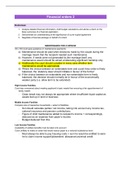
Financial orders 2
Outcomes:
1. Analyse detailed financial information, draft budget calculations and advise a client on the
likely outcomes of a financial application
2. Demonstrate an understanding of the significance of a pre-nuptial agreement
3. Negotiate a financial package on behalf of a client
MAINTENANCE FOR A SPOUSE
SS v NS court gave guidance on maintenance payments:
a) Maintenance should be paid when decisions made by the couple during the
marriage meant that the recipient needed such maintenance
b) However, if needs were not generated by the marriage itself, any
maintenance award should be aimed at alleviating significant hardship only
c) Additionally the court should consider in every case whether term
maintenance would be appropriate
d) Where the choice between an extendable term and a joint lives order is finely
balanced, the ‘statutory steer should militate in favour of the former’
e) If the choice between an extendable and non-extendable term is finely
balanced, the decision should normally be in favour of the economically
weaker party (i.e. allow term to be extended)
High Income Families
Court less concerned about meeting applicant’s basic needs than ensuring a fair apportionment of
family wealth
- Clean break may not always be appropriate where insufficient liquid capital as
assets tied up in land or business
Middle Income Families
Compare size of respective households + extent of liabilities
- Sol should calculate parties’ net income, taking into account any income tax,
national insurance and pension contributions.
- Figure of child maintenance added to recipient’s income + correspondingly
deduced as an expense from payer’s income
- Budget deduced from this
Low Income Families
Availability of welfare benefits must be taken into account
Court unlikely to make an order that would reduce payer to a notional subsistence level
- Must always be able to pay housing costs + sum he would be entitled to were
he to claim income support/jobseekers’ allowance/universal credit
, DEALING WITH THE CAPITAL ASSETS
The following property adjustment orders may be made:
a) Immediate sale
b) Outright transfers
c) Deferred trust of land
d) Deferred charge
Selling the Home
S24A court may order immediate sale of matrimonial home + division of proceeds between the
parties
- Appropriate were effecting an immediate clean break
- May be ordered out of necessity where there are insufficient resourced to
retain + maintain the house
If one party wishes to sell + other wishes to keep à can transfer interest in return for lump sum
Retaining the Home
Outright transfer
- Achieves clean break as it determines immediate + final ownership of home
Unlikely to be ordered unless transferee spouse has means to pay outgoings on the house (including mortgage)
Where transferor is giving up significant amount of capital à court seeks to compensate
- Order for transfer may be coupled with lump sum payment from the transferee to the
transferor
Deferred trusts of land
Compromise solution to problem of matrimonial home. Where inappropriate to sell immediately + outright
transfer too harsh à order for property to be held in parties’ joint names on trust of land
Mesher Order Triggering Events
a) Occupying spouse dies, remarries or voluntarily leaves the property; or
b) Youngest child reaches specified age (usually 17/18), or ceases to be in
full-time education
Use
Compromise solution à main short-coming that it = medium-term solution
Martin Order Operates similarly to the Mesher order but no reference made to children of family
- House need be sold only when occupying spouse chooses by leaving,
remarrying or dying.
Appropriate where one spouse in significantly weaker position than the other
Harvey Order Triggered similarly to Martin order but also provides for payment of an ‘occupation rent’ by
occupying spouse à reduces hardship of Martin order
- Obligation to pay rent triggered by children growing up/mortgage being
paid off (whichever occurs first)
Deferred Charge
Property remains in sole name of occupying spouse + non-occupying spouse’s interest retained by
charge of property.
- Charge enforceable once one of the triggering events of Mesher and Martin
order occur
If paying spouse cannot pay charge – property must be sold
Outcomes:
1. Analyse detailed financial information, draft budget calculations and advise a client on the
likely outcomes of a financial application
2. Demonstrate an understanding of the significance of a pre-nuptial agreement
3. Negotiate a financial package on behalf of a client
MAINTENANCE FOR A SPOUSE
SS v NS court gave guidance on maintenance payments:
a) Maintenance should be paid when decisions made by the couple during the
marriage meant that the recipient needed such maintenance
b) However, if needs were not generated by the marriage itself, any
maintenance award should be aimed at alleviating significant hardship only
c) Additionally the court should consider in every case whether term
maintenance would be appropriate
d) Where the choice between an extendable term and a joint lives order is finely
balanced, the ‘statutory steer should militate in favour of the former’
e) If the choice between an extendable and non-extendable term is finely
balanced, the decision should normally be in favour of the economically
weaker party (i.e. allow term to be extended)
High Income Families
Court less concerned about meeting applicant’s basic needs than ensuring a fair apportionment of
family wealth
- Clean break may not always be appropriate where insufficient liquid capital as
assets tied up in land or business
Middle Income Families
Compare size of respective households + extent of liabilities
- Sol should calculate parties’ net income, taking into account any income tax,
national insurance and pension contributions.
- Figure of child maintenance added to recipient’s income + correspondingly
deduced as an expense from payer’s income
- Budget deduced from this
Low Income Families
Availability of welfare benefits must be taken into account
Court unlikely to make an order that would reduce payer to a notional subsistence level
- Must always be able to pay housing costs + sum he would be entitled to were
he to claim income support/jobseekers’ allowance/universal credit
, DEALING WITH THE CAPITAL ASSETS
The following property adjustment orders may be made:
a) Immediate sale
b) Outright transfers
c) Deferred trust of land
d) Deferred charge
Selling the Home
S24A court may order immediate sale of matrimonial home + division of proceeds between the
parties
- Appropriate were effecting an immediate clean break
- May be ordered out of necessity where there are insufficient resourced to
retain + maintain the house
If one party wishes to sell + other wishes to keep à can transfer interest in return for lump sum
Retaining the Home
Outright transfer
- Achieves clean break as it determines immediate + final ownership of home
Unlikely to be ordered unless transferee spouse has means to pay outgoings on the house (including mortgage)
Where transferor is giving up significant amount of capital à court seeks to compensate
- Order for transfer may be coupled with lump sum payment from the transferee to the
transferor
Deferred trusts of land
Compromise solution to problem of matrimonial home. Where inappropriate to sell immediately + outright
transfer too harsh à order for property to be held in parties’ joint names on trust of land
Mesher Order Triggering Events
a) Occupying spouse dies, remarries or voluntarily leaves the property; or
b) Youngest child reaches specified age (usually 17/18), or ceases to be in
full-time education
Use
Compromise solution à main short-coming that it = medium-term solution
Martin Order Operates similarly to the Mesher order but no reference made to children of family
- House need be sold only when occupying spouse chooses by leaving,
remarrying or dying.
Appropriate where one spouse in significantly weaker position than the other
Harvey Order Triggered similarly to Martin order but also provides for payment of an ‘occupation rent’ by
occupying spouse à reduces hardship of Martin order
- Obligation to pay rent triggered by children growing up/mortgage being
paid off (whichever occurs first)
Deferred Charge
Property remains in sole name of occupying spouse + non-occupying spouse’s interest retained by
charge of property.
- Charge enforceable once one of the triggering events of Mesher and Martin
order occur
If paying spouse cannot pay charge – property must be sold