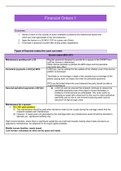
Financial Orders 1
Outcomes:
1. Advise a client on the courses of action available to preserve the matrimonial assets and
which are most appropriate in the circumstances
2. Apply the factors in s.25 MCA 1973 to a given set of facts
3. Formulate a reasoned counter-offer during written negotiations
Types of financial orders the court can make
Income orders MCA 1973
Maintenance pending suit- s.22 Regular payments designed to provide for a spouse in the SHORT term
until the divorce is determined.
When decree absolute is granted the MPS stops and full periodical
payments take effect.
Periodical payments s.23(1)(a) MCA s.23(1)(a)- can be ordered for the welfare of the children even if the divorce
petition is dismissed.
Terminate on re-marriage or death of the recipient but re-marriage of the
person paying does not impact the order for periodical payments.
PPO can be limited where the court believed the party should be able to
support themselves
Secured periodical payments s.23(1)(b) a) s.23(1)(b) and (e) ensured the recipient continues to receive the
periodical payments even if the payer’s income fluctuates or
problems of enforcement are anticipated. This order works by
charging an asset with a fixed sum by the court to which periodical
payments can be met or non-income producing asset may be
secured if of high enough value.
Maintenance for a spouse:
• SS v NS- gave guidance
(1) The maintenance should be paid when decisions made by the couple during the marriage meant that the
recipient needed such maintenance
(2) However, if needs were not generated by the marriage itself, any maintenance award should be directed to
alleviate any significant hardship only
High income families- where there is significant capital the court will look towards making clean break provisions as
opposed to maintenance- but depends on the liquid capital available.
Middle income families- needs based
Low income- calculated on what can be spare and needs
, Capital orders
Lump sum orders s.23(1)(c)and (f) the court can order a cash lump sum to be payable- either
to adjust the final division of the parties’ assets or to recompense the
applicant for expenses incurred prior to the application as a result of
inadequate support from the respondent for the applicant or child of the
family.
Property adjustment orders s.24 has the power to re-distribute family property between the parties-
irrespective of legal ownership
Orders for sale- only upon decree 24A can order the sale of property to which any of the parties are
absolute beneficially entitled to.
Pritchard v Pritchard- usual for the court to order a % of the sale as
opposed to a set sum
s.24A(2) gives the court wide discretion to make directions about the sale
as the court sees fit. Therefore, an analysis of s.25 will look at whether a
sale may be appropriate, whether there is potential for mortgages or
retention of the home
Deferred trust of land
• the immediate sale may be inappropriate
• outright transfer may be too harsh on the other spouse
• deferred trust holds the property in joint names, with one spouse
occupying the house pending sale
• allows the children to stay in the house
Mesher Order Triggering events that trigger the sale of the family house
First of the following events to occur will trigger the sale:
(a) the occupying spouse dies, remarries or voluntarily leaves the
property
(b) the youngest child reaches a specified age (17 or 18) or ceases full
time education- whichever is earlier
Martin order- where the spouse is in a Makes no reference to the family or children
significantly weaker position
The house is to be sold only when the occupying spouse chooses by
leaving or remarrying or when she dies.
Gives the right to remain in the property for life
• only used where the spouse is in a significantly weaker financial
position and the other spouse has the means to support themselves
in the future.
Pension sharing orders s.24B the benefits accrued by one party under their pension scheme may
be valuable and can be split between the parties
Pension sharing compensation orders
Outright transfer of the house Used in clean break provisions
Only ordered if the retaining party has the means to upkeep the house and
pay the bills and mortgage. If this is done the other spouse will most likely
, need a provision for another home and therefore a lump sum payment may
be ordered if there is a clean break.
Outcomes:
1. Advise a client on the courses of action available to preserve the matrimonial assets and
which are most appropriate in the circumstances
2. Apply the factors in s.25 MCA 1973 to a given set of facts
3. Formulate a reasoned counter-offer during written negotiations
Types of financial orders the court can make
Income orders MCA 1973
Maintenance pending suit- s.22 Regular payments designed to provide for a spouse in the SHORT term
until the divorce is determined.
When decree absolute is granted the MPS stops and full periodical
payments take effect.
Periodical payments s.23(1)(a) MCA s.23(1)(a)- can be ordered for the welfare of the children even if the divorce
petition is dismissed.
Terminate on re-marriage or death of the recipient but re-marriage of the
person paying does not impact the order for periodical payments.
PPO can be limited where the court believed the party should be able to
support themselves
Secured periodical payments s.23(1)(b) a) s.23(1)(b) and (e) ensured the recipient continues to receive the
periodical payments even if the payer’s income fluctuates or
problems of enforcement are anticipated. This order works by
charging an asset with a fixed sum by the court to which periodical
payments can be met or non-income producing asset may be
secured if of high enough value.
Maintenance for a spouse:
• SS v NS- gave guidance
(1) The maintenance should be paid when decisions made by the couple during the marriage meant that the
recipient needed such maintenance
(2) However, if needs were not generated by the marriage itself, any maintenance award should be directed to
alleviate any significant hardship only
High income families- where there is significant capital the court will look towards making clean break provisions as
opposed to maintenance- but depends on the liquid capital available.
Middle income families- needs based
Low income- calculated on what can be spare and needs
, Capital orders
Lump sum orders s.23(1)(c)and (f) the court can order a cash lump sum to be payable- either
to adjust the final division of the parties’ assets or to recompense the
applicant for expenses incurred prior to the application as a result of
inadequate support from the respondent for the applicant or child of the
family.
Property adjustment orders s.24 has the power to re-distribute family property between the parties-
irrespective of legal ownership
Orders for sale- only upon decree 24A can order the sale of property to which any of the parties are
absolute beneficially entitled to.
Pritchard v Pritchard- usual for the court to order a % of the sale as
opposed to a set sum
s.24A(2) gives the court wide discretion to make directions about the sale
as the court sees fit. Therefore, an analysis of s.25 will look at whether a
sale may be appropriate, whether there is potential for mortgages or
retention of the home
Deferred trust of land
• the immediate sale may be inappropriate
• outright transfer may be too harsh on the other spouse
• deferred trust holds the property in joint names, with one spouse
occupying the house pending sale
• allows the children to stay in the house
Mesher Order Triggering events that trigger the sale of the family house
First of the following events to occur will trigger the sale:
(a) the occupying spouse dies, remarries or voluntarily leaves the
property
(b) the youngest child reaches a specified age (17 or 18) or ceases full
time education- whichever is earlier
Martin order- where the spouse is in a Makes no reference to the family or children
significantly weaker position
The house is to be sold only when the occupying spouse chooses by
leaving or remarrying or when she dies.
Gives the right to remain in the property for life
• only used where the spouse is in a significantly weaker financial
position and the other spouse has the means to support themselves
in the future.
Pension sharing orders s.24B the benefits accrued by one party under their pension scheme may
be valuable and can be split between the parties
Pension sharing compensation orders
Outright transfer of the house Used in clean break provisions
Only ordered if the retaining party has the means to upkeep the house and
pay the bills and mortgage. If this is done the other spouse will most likely
, need a provision for another home and therefore a lump sum payment may
be ordered if there is a clean break.