100% satisfaction guarantee Immediately available after payment Both online and in PDF No strings attached 4.2 TrustPilot
logo-home
Exam (elaborations)

GIZMO Reaction Energy-ALL ANSWERS CORRECT-GRADED A+

Rating
-
Sold
-
Pages
14
Grade
A+
Uploaded on
25-06-2021
Written in
2020/2021

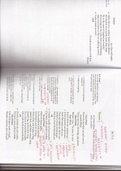
Student Exploration: Reaction Energy Vocabulary: calorimeter, chemical bond, endothermic, enthalpy, exothermic, Hess’s law Prior Knowledge Questions (Do these BEFORE using the Gizmo.) 1. Two magnets are stuck together. What might you have to do to get them to separate? 2. Suppose you held two magnets a short distance apart, then let go. What would happen? 3. Think about the magnets in terms of energy. In which case do you increase the potential energy of the magnets? In which case do you increase the kinetic energy of the magnets? Gizmo Warm-up Just like magnets, atoms of different elements are attracted together to form chemical bonds. Breaking these bonds requires energy. When a new bond forms, energy is released and temperatures rise. In the Reaction Energy Gizmo, you will explore how the energy of chemical bonding relates to temperature changes that occur during chemical reactions. To begin, check that Reaction 1 and Forward are selected. In this reaction, hydrogen (H2) and oxygen (O2) react to form water (H2O). The reaction takes place inside a device called a calorimeter. Inside the calorimeter, a small chamber holds the reactants. The rest of the calorimeter is filled with water. Exert force on both in and pull in opposite direction of the bond. They would be pulled towards each other. You increase the potential energy when holding the two magnets close to each other but not touching. You increase the kinetic energy when you let go and let them connect. As the temperature rises the hydrogen and oxygen atoms bond into water molecules.2019 1. Click Play ( ). What happens? 2. How does the temperature change?The starting temperature is 21°C and rises to 27.4°C, an increase of 6.4°C, holding at that temp once all the hydrogen and oxygen atoms are bonded.2019 Activity A: Energy of chemical bonds Get the Gizmo ready:  Check that Reaction 1 and Forward are selected.  Select the INVESTIGATION tab. Introduction: The heat energy stored in a chemical system is called the enthalpy (H) of the system. When atoms are joined by a chemical bond, energy must be added to pull them apart. This increases the enthalpy of the system. When a chemical bond forms, energy is released as shared electrons move into lower-energy orbitals. This causes the enthalpy to decrease. Question: How can you predict how much energy is released in a chemical reaction? 1. Predict: In the warm-up activity, you observed how the reaction inside the chamber affected the temperature of the surrounding water. Based on what happens to the surrounding water, do you think heat energy (enthalpy) is absorbed in the reaction or released? Explain. 2. Observe: In the Gizmo, the energy required to break a chemical bond is modeled by placing a molecule into a set of mechanical claws. Place one of the hydrogen (H2) molecules between the claws, and press Break bond. A. What happens? B. Look under the Energy absorbed column of the table. How much energy was required to break this bond? Note: The energy is given here in units of kilojoules per mole (kJ/mol). This is the energy, in kilojoules, required to break all of the H–H bonds in one mole of H2 gas. C. Remove the hydrogen atoms from the claws and then break apart the other H–H molecule. What is the total energy absorbed so far? 3. Measure: Notice that the oxygen atoms are connected by a double covalent bond. This is because the oxygen atoms share two pairs of electrons. Place the oxygen molecule in the claws and press Break bond. A. How much energy is required to break the first O–O bond? B. Press Break bond. How much energy is needed to break both bonds? C. What is the total energy required to break up two moles of H2 molecules and one mole of O2 molecules? Because the water heated up, the heat energy is released. If it had been absorbed then the water would have gotten colder. The claws applied force in opposite direct of about 400+ kJ/mol to break the bond. 436 kJ/mol 872 kJ/mol 349 kJ/mol 495 kJ/mol 1,367 kJ/mol2019 (Activity A continued on next page)2019 Activity A (continued from previous page) 4. Create: Remove the two oxygen atoms from the claws. Now the claws disappear and you see a template for creating a water molecule. Drag an oxygen and a hydrogen atom into the template. (If necessary, use the Key on the right-hand side as a reference.) A. Click Create bond. What happens? B. The “jiggling” animation you see represents the release of kinetic energy that occurs when a bond is formed. How much energy was released? C. Drag another hydrogen molecule into the template and click Create bond to make a water molecule. What is the total energy released so far? D. Drag the first water molecule away from the template, then use the Gizmo to create a second water molecule. What is the total energy released now? 5. Calculate: Compare the energy absorbed in breaking up the molecules to the energy released when new bonds are formed. A. In this reaction, was more energy absorbed or released? B. How does this relate to the change in temperature observed for this reaction? C. The change in enthalpy (∆H) of the system is equal to the total energy absorbed minus the total energy released. What is the ∆H value for this reaction? Compa

Show more Read less
Institution
Course


Whoops! We can’t load your doc right now. Try again or contact support.

Written for

Institution
Secondary school
Course
School year
5

Document information

Uploaded on
June 25, 2021
Number of pages
14
Written in
2020/2021
Type
Exam (elaborations)
Contains
Questions & answers

Subjects

Content preview

Name: Date:


Student Exploration: Reaction Energy

Vocabulary: calorimeter, chemical bond, endothermic, enthalpy, exothermic, Hess’s law


Prior Knowledge Questions (Do these BEFORE using the Gizmo.)

1. Two magnets are stuck together. What might you have to do to get them to separate?

Exert force on both in and pull in opposite direction of the
bond.

2. Suppose you held two magnets a short distance apart, then let go. What would happen?

They would be pulled towards each other.


3. Think about the magnets in terms of energy. In which case do you increase the potential
energy of the magnets? In which case do you increase the kinetic energy of the magnets?

You increase the potential energy when holding the two
magnets close to each other but not touching. You increase
the kinetic energy when you let go and let them connect.


Gizmo Warm-up
Just like magnets, atoms of different elements are
attracted together to form chemical bonds. Breaking
these bonds requires energy. When a new bond forms,
energy is released and temperatures rise. In the Reaction
Energy Gizmo, you will explore how the energy of chemical
bonding relates to temperature changes that occur during
chemical reactions.

To begin, check that Reaction 1 and Forward are selected. In this reaction, hydrogen (H2) and
oxygen (O2) react to form water (H2O). The reaction takes place inside a device called a
calorimeter. Inside the calorimeter, a small chamber holds the reactants. The rest of the
calorimeter is filled with water.

As the temperature rises the hydrogen
and oxygen atoms bond into water molecules.
2019

, 1. Click Play ( ). What happens?


starting temperature is 21°C and
2. How does the temperature change?The
rises to 27.4°C, an increase of 6.4°C, holding at that temp
once all the hydrogen and oxygen atoms are bonded.


2019

Get to know the seller

Seller avatar
Reputation scores are based on the amount of documents a seller has sold for a fee and the reviews they have received for those documents. There are three levels: Bronze, Silver and Gold. The better the reputation, the more your can rely on the quality of the sellers work.
Examhack Stanford University
Follow You need to be logged in order to follow users or courses
Sold
268
Member since
4 year
Number of followers
237
Documents
698
Last sold
1 month ago
EASY A GRADE!!

Here, you will find simple, articulate well-researched education material for you. .... ALL WORK HAS PASSED WITHOUT NEEDING REVISIONS AND BY THE RUBRIC.

3.7

57 reviews

5
28
4
10
3
5
2
4
1
10

Recently viewed by you

Why students choose Stuvia

Created by fellow students, verified by reviews

Quality you can trust: written by students who passed their tests and reviewed by others who've used these notes.

Didn't get what you expected? Choose another document

No worries! You can instantly pick a different document that better fits what you're looking for.

Pay as you like, start learning right away

No subscription, no commitments. Pay the way you're used to via credit card and download your PDF document instantly.

Student with book image

“Bought, downloaded, and aced it. It really can be that simple.”

Alisha Student

Frequently asked questions