The multi-store Model of Memory
Key Words
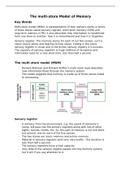
Multi-store model (MSM)- A representation of how memory works in terms
of three stores called sensory register, short-term memory (STM) and
long-term memory (LTM), it also describes how information is transferred
from one store to another, how it is remembered and how it is forgotten.
Sensory register- The memory stores for each of our five senses, such a
vision (iconic store) and hearing (echoic store). Coding in the iconic
sensory register is visual and in the echoic sensory registry it is acoustic.
The capacity of sensory registers is huge (millions of receptors) and
information lasts for a very short time, less than half a second.
The multi store model (MSM)
- Richard Atkinson and Richard Shiffrin’s multi store most describes
how information flows through the memory system.
- The model suggests that memory is made up of three stores linked
to processing.
Sensory register
- A stimulus from the environment, e.g. the sound of someone’s
name, will pass into the sensory registers along with lots of other
sights, sounds, smells, etc. So, this part of memory is not one store
but several, one for each of the five senses.
- The two stores are iconic memory and echoic memory.
- Material in sensory registers lasts only very briefly – the duration is
less than half a second.
- The sensory registers have a high capacity.
- Very little of the sensory register passes into the memory system,
but it will if you pay attention to it.
Key Words
Multi-store model (MSM)- A representation of how memory works in terms
of three stores called sensory register, short-term memory (STM) and
long-term memory (LTM), it also describes how information is transferred
from one store to another, how it is remembered and how it is forgotten.
Sensory register- The memory stores for each of our five senses, such a
vision (iconic store) and hearing (echoic store). Coding in the iconic
sensory register is visual and in the echoic sensory registry it is acoustic.
The capacity of sensory registers is huge (millions of receptors) and
information lasts for a very short time, less than half a second.
The multi store model (MSM)
- Richard Atkinson and Richard Shiffrin’s multi store most describes
how information flows through the memory system.
- The model suggests that memory is made up of three stores linked
to processing.
Sensory register
- A stimulus from the environment, e.g. the sound of someone’s
name, will pass into the sensory registers along with lots of other
sights, sounds, smells, etc. So, this part of memory is not one store
but several, one for each of the five senses.
- The two stores are iconic memory and echoic memory.
- Material in sensory registers lasts only very briefly – the duration is
less than half a second.
- The sensory registers have a high capacity.
- Very little of the sensory register passes into the memory system,
but it will if you pay attention to it.