Unit 3 miss johannes
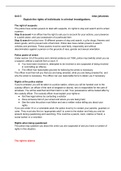
Explain the rights of individuals in criminal investigations.
The right of suspects
The police have certain powers to deal with suspects, inc rights to stop and search and to arrest
a person.
Stop & account = an officer has the right to ask you to account for your actions, your presence
in a public place, and your possession of a particular item.
Stop & search = police have 19 different powers of stop and search, e.g for drugs, firearms and
stolen goods, and to prevent acts of terrorism. Police also have certain powers to search
vehicles and premises. These powers must be used fairly, responsibly and without
descrimination against a person on the grounds of race, gender and sexual orientation.
Police power of arrest
Under section 24 of the police and criminal evidence act 1984, police may lawfully arrest you as
a suspect, without a warrant from a court, if:
● You have been involved in, attempted to be involved or are suspected of being involved
in committing an offence.
● The officer has reasonable grounds for believing the arrest is necessary.
The officer must then tell you that you are being arrested, what you are being arrested for, and
why the arrest is necessary. The officer can use reasonable force to detain you if necessary.
Rights at the police station
If you're arrested, you will be taken to a police station, where you will be handed over to the
custody officer ( an officer of the rank of sergeant or above), who is responsible for the care of
arrestees. You will be searched and then held in a cell. Your possessions will be looked after by
the custody officer. The custody officer must explain your rights to:
● Get free legal advice by contacting a solicitor
● Have someone told of your arrest and where you are being held
● See the rules the police must follow and see a written notice telling you about your
rights.
If you are under 18 or a vulnerable adult, the police must try to contact your parents, guardian or
carer. They must also find an ‘appropriate adult’ to come to the station and help you and be
present during questioning and searching. This could be a parent, carer, relative or friend, a
social worker or a volunteer.
Rights when being questioned
The police may question you about the crime you are suspected of and you have a number of
rights in this situation.
The right to silence
, You don't have to answer the polices questions, but there could be consequences if you don't
the police must explain this to you by reading you the police caution:
‘You do not have to say anything. But it may harm your defence if you do not mention when
questioned something which you later rely on in court. Anything you do may be given in
evidence.’
If your case goes to trial and in your defence you use something that you had failed to tell the
police in your interview, your earlier silence about the matter can be used as part of the case
against you. However, remaining silent and refusing to answer the police's questions is not
proof of guilt in itself- the prosecution must still produce other evidence against you to convict
you.
Recording- all interviews must be tape recorded. Many police forces also video interviews.
The right to legal advice
You have the right to free legal advice if you are questioned by the police, including the right to
have a solicitor present during your interview to represent and advise you. You must be told
about your right to legal advice before you are questioned.
Once you have asked for legal advice, the police cannot normally question you until you have it.
However, in serious cases, the police can make you wait for legal advice for up to 36 hours(48
for terrorist offences).
Fingerprints, photographs & samples
The police have the right to take photographs of you, as well as fingerprints and a DNA sample
e.g from a mouth swab, and they can swab the skin surface of your hands and arms. They
don't need your permission to do this and they can use reasonable force if necessary.
The police need both your permission and the authority of a senior police officer to take blood/
urine samples ( except when taken in connection with drink/drug driving).
Rights to information
Info from fingerprints and samples is stored in a police database. You can ask the police to
remove your info from their database but they will only do this if an offence no longer exists or if
anything in the police process e.g how long you were arrested was unlawful.
How long the police can hold you
Police can hold you in custody for up to 24 hours. After that they have to either charge you with
a crime or release you. For indictable offences (serious crimes) you can be held for 36 hours.
After that police can detain you for a further 96 hours (4 days) with the approval of a magistrate.
However if you are arrested under the terrorism act, you can be held without charge for up to 14
days.
Explain the rights of individuals in criminal investigations.
The right of suspects
The police have certain powers to deal with suspects, inc rights to stop and search and to arrest
a person.
Stop & account = an officer has the right to ask you to account for your actions, your presence
in a public place, and your possession of a particular item.
Stop & search = police have 19 different powers of stop and search, e.g for drugs, firearms and
stolen goods, and to prevent acts of terrorism. Police also have certain powers to search
vehicles and premises. These powers must be used fairly, responsibly and without
descrimination against a person on the grounds of race, gender and sexual orientation.
Police power of arrest
Under section 24 of the police and criminal evidence act 1984, police may lawfully arrest you as
a suspect, without a warrant from a court, if:
● You have been involved in, attempted to be involved or are suspected of being involved
in committing an offence.
● The officer has reasonable grounds for believing the arrest is necessary.
The officer must then tell you that you are being arrested, what you are being arrested for, and
why the arrest is necessary. The officer can use reasonable force to detain you if necessary.
Rights at the police station
If you're arrested, you will be taken to a police station, where you will be handed over to the
custody officer ( an officer of the rank of sergeant or above), who is responsible for the care of
arrestees. You will be searched and then held in a cell. Your possessions will be looked after by
the custody officer. The custody officer must explain your rights to:
● Get free legal advice by contacting a solicitor
● Have someone told of your arrest and where you are being held
● See the rules the police must follow and see a written notice telling you about your
rights.
If you are under 18 or a vulnerable adult, the police must try to contact your parents, guardian or
carer. They must also find an ‘appropriate adult’ to come to the station and help you and be
present during questioning and searching. This could be a parent, carer, relative or friend, a
social worker or a volunteer.
Rights when being questioned
The police may question you about the crime you are suspected of and you have a number of
rights in this situation.
The right to silence
, You don't have to answer the polices questions, but there could be consequences if you don't
the police must explain this to you by reading you the police caution:
‘You do not have to say anything. But it may harm your defence if you do not mention when
questioned something which you later rely on in court. Anything you do may be given in
evidence.’
If your case goes to trial and in your defence you use something that you had failed to tell the
police in your interview, your earlier silence about the matter can be used as part of the case
against you. However, remaining silent and refusing to answer the police's questions is not
proof of guilt in itself- the prosecution must still produce other evidence against you to convict
you.
Recording- all interviews must be tape recorded. Many police forces also video interviews.
The right to legal advice
You have the right to free legal advice if you are questioned by the police, including the right to
have a solicitor present during your interview to represent and advise you. You must be told
about your right to legal advice before you are questioned.
Once you have asked for legal advice, the police cannot normally question you until you have it.
However, in serious cases, the police can make you wait for legal advice for up to 36 hours(48
for terrorist offences).
Fingerprints, photographs & samples
The police have the right to take photographs of you, as well as fingerprints and a DNA sample
e.g from a mouth swab, and they can swab the skin surface of your hands and arms. They
don't need your permission to do this and they can use reasonable force if necessary.
The police need both your permission and the authority of a senior police officer to take blood/
urine samples ( except when taken in connection with drink/drug driving).
Rights to information
Info from fingerprints and samples is stored in a police database. You can ask the police to
remove your info from their database but they will only do this if an offence no longer exists or if
anything in the police process e.g how long you were arrested was unlawful.
How long the police can hold you
Police can hold you in custody for up to 24 hours. After that they have to either charge you with
a crime or release you. For indictable offences (serious crimes) you can be held for 36 hours.
After that police can detain you for a further 96 hours (4 days) with the approval of a magistrate.
However if you are arrested under the terrorism act, you can be held without charge for up to 14
days.