Monetary macroeconomics;
Final exam; 14-23.
Chapter 14; financial markets and expectations.
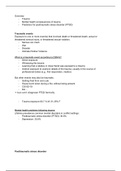
Expected present discounted value = the value today of this expected sequence of payments.
computing present discounted values;
Today’s payment: $zt
The payment next year; $zt+1
Present discounted value; $Vt
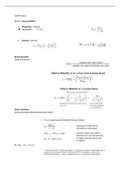
Present discounted value:
The expected present discounted value: (when future payments and interest rates are uncertain:
➔ $z or future $ze increase: $V increases.
➔ i or future ie increase: $V decreases.
Constant interest rates;
➔ present value is a weighted sum of current and expected future payments.
➔ The weight on a payment this year is 1. The weight on the payment n years from now is
(1/1+i))n
,The present value formula in equation (14.2) simplifies to:
Constant interest rates and payments forever:
$𝑧
$𝑉𝑡 =
𝑖
$𝑉𝑡
= 𝑉𝑡
𝑃𝑡
14.2 Bond prices and bond yields
Arbitrage: The process of simultaneous buying and selling of an asset from different platforms,
exchanges or location to cash in on the price differences.
Maturity; The maturity of a bond is the length of time over which the bond promises to make
payments to the holder of the bond. A bond that promises to make one payment of $1,000 in six
months has a maturity of six months; a bond that promises to pay $100 per year for the next 20 years
and a final payment of $1,000 at the end of those 20 years has a maturity of 20 years.
Bonds of different maturities each have a price and an associated interest rate called the yield to
maturity, or simply the yield.
, ➔ Given that the one-year bond promises to pay $100 next year, it follows that its prices, call it
$P1t, must equal to the present value of a payment of $100 next year.
If the two bonds offer the same expected one-year return:
Returns from holding one-year and two-year bonds for one year:
Constant yield:
, Reintroducing risk:
14.3 stock markets and movements in stock prices
returns from holding one-year bonds or stocks for one year:
➔ Q = the price of the stock
➔ De = the expected dividend.
Ex-dividend price; the stock price after the dividend has been paid this year.
The risk premium of a stock is called the equity premium. Equilibrium then requires that the
expected rate of return from holding stocks for one year be the same as the rate of return on one-
year bonds plus the equity premium:
➔ Where x denotes the equity premium. Rewrite this equation as:
Arbitrage implies that the price of the stock today ($Qt) must be equal to the present value of the
expected dividend plus the present value of the expected stock price next year:
For t+1:
Final exam; 14-23.
Chapter 14; financial markets and expectations.
Expected present discounted value = the value today of this expected sequence of payments.
computing present discounted values;
Today’s payment: $zt
The payment next year; $zt+1
Present discounted value; $Vt
Present discounted value:
The expected present discounted value: (when future payments and interest rates are uncertain:
➔ $z or future $ze increase: $V increases.
➔ i or future ie increase: $V decreases.
Constant interest rates;
➔ present value is a weighted sum of current and expected future payments.
➔ The weight on a payment this year is 1. The weight on the payment n years from now is
(1/1+i))n
,The present value formula in equation (14.2) simplifies to:
Constant interest rates and payments forever:
$𝑧
$𝑉𝑡 =
𝑖
$𝑉𝑡
= 𝑉𝑡
𝑃𝑡
14.2 Bond prices and bond yields
Arbitrage: The process of simultaneous buying and selling of an asset from different platforms,
exchanges or location to cash in on the price differences.
Maturity; The maturity of a bond is the length of time over which the bond promises to make
payments to the holder of the bond. A bond that promises to make one payment of $1,000 in six
months has a maturity of six months; a bond that promises to pay $100 per year for the next 20 years
and a final payment of $1,000 at the end of those 20 years has a maturity of 20 years.
Bonds of different maturities each have a price and an associated interest rate called the yield to
maturity, or simply the yield.
, ➔ Given that the one-year bond promises to pay $100 next year, it follows that its prices, call it
$P1t, must equal to the present value of a payment of $100 next year.
If the two bonds offer the same expected one-year return:
Returns from holding one-year and two-year bonds for one year:
Constant yield:
, Reintroducing risk:
14.3 stock markets and movements in stock prices
returns from holding one-year bonds or stocks for one year:
➔ Q = the price of the stock
➔ De = the expected dividend.
Ex-dividend price; the stock price after the dividend has been paid this year.
The risk premium of a stock is called the equity premium. Equilibrium then requires that the
expected rate of return from holding stocks for one year be the same as the rate of return on one-
year bonds plus the equity premium:
➔ Where x denotes the equity premium. Rewrite this equation as:
Arbitrage implies that the price of the stock today ($Qt) must be equal to the present value of the
expected dividend plus the present value of the expected stock price next year:
For t+1: