Concepts, themes and theories
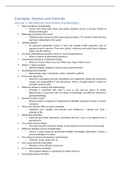
Lecture 1, Introduction and history of philosophy:
Origin and drivers of philosophy
o Comes from Greek philo (love) and Sophia (wisdom). Driver is Socrates (Father of
Western philosophy)
Philosophy (meaning of the word)
o Thinking human being that think about deep questions. The world in which they live
and their relationships to the world.
Sophists/sophism
o An argument apparently correct in form, but actually invalid especially: such an
argument used to deceive. They were atheist, relativists and cynical about religious
beliefs and all traditions.
Two basic philosophical questions (‘what is?’ and ‘presuppositions’)
o What or essence of phenomena questions.
Fundamental questions of philosophy (Kant)
o What can I know? What must I do? What may I hope? What is man?
Mythos → logos transition
o Rational thinking, looking for natural causes instead of God.
Six philosophical disciplines
o Epistemology, logic, metaphysics, ethics, aesthetics, political.
Presocratics (doctrines)
o Asked for unchanging (eternal) foundations and regularities behind the permanent
change and changeability of the phenomena. What is thought behind? Looked for
principles behind reality.
Difference between ontology and epistemology
o Ontology is concerned with what is true or real and the nature of reality.
Epistemology is concerned with the nature of knowledge and different methods of
gaining knowledge.
Atomism (ancient Greek)
o Physical world is composed of fundamental indivisible component known as atoms.
Leucippus.
Three souls doctrine (Plato as well as Aristotle)
o Vegetative soul, sensitive and animate soul, intellectual / rational soul. Soul =
principle of life.
Entelecheia (Aristotle)
o Inside the goal inside themselves. Everything that has a soul, is an organism that is
goal directed.
Two worlds doctrine (Plato)
o First world is perfect (world of being), second imperfect world (world of becoming)
Difference between science and philosophy
o Science is about empirical (proefondervindelijk) knowledge; philosophy is about a
priori knowledge (if it exists).
Four elements doctrine (Empedocles and Aristotle)
o “Stoichei”. Earth, water, fire, air.
Four causes doctrine (Aristoteles)
o Material, formal, efficient, final cause.
Form-matter doctrine (Aristotle)
o Every physical object is a compound of matter and form.
Soul (psyche/anima: Aristotle)
, o Principle of life = organizing and visualizing principle in each living organism. Three
souls doctrine.
Basic philosophical concepts and their modern counterparts: cosmos, logos, energeia,
dynamis, ananke, hyle, morphe, arche, aitia, ousia
o Cosmos: the world is intelligible
o Logos: rational thinking
o Energia: reality and energy
o Dynamis: possibility, potentially
o Ananke: necessity
o Hyle: matter (where it is made of)
o Morphe: form of that
o Arche: ground, principle
o Aitia: cause (of someone’s behavior)
Difference between physis and techne
o Physis: nature that has its principle of movement and rest within itself (like an
amoeba), it contains a soul.
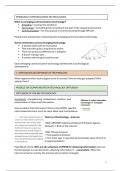
Lecture 2, Introduction to philosophy of science:
Demarcation problem
o Non-science (astrology, tarot, etc.) and pseudo-science (sociobiology)
Falsification
o Way of demarcating science from non-science. It must be tested to be considered
science and conceivably proven false.
Formal theory structure
o Logical and extralogical vocabulary (O and T-terms) and law statements (true and
unlimited in scope)
Laws of nature
o A stated regularity in the relations or order of phenomena in the world that holds,
under a stipulated set of conditions, either universally or in a stated proportion of
instances.
Theory dynamics
o Theories specify or define abstract or idealized systems.
Non-formal patterns
o The rigid structures of the forma approaches leave it ill-suited for dealing with
gradual and piecemeal theory change and also for highlighting the non-formal
patterns that scientists us to construct evaluate and revise their theories.
Scientific models
o A representation or simulation, an abstraction, an analogue, an experimental
organism or an experimental preparation.
Mechanisms
o No essential difference between life and non-life.
Explanations
o The more abstract the explanation is, the more phenomena it can be.
Difference between a theory, a model and an explanation
o An explanation of a model is a mechanism. A model can’t be made if the mechanism
is not known.
Relationship between explanations and values
o Values refer to what man prefers or would want to be with a degree of attachment
that may involve all the loyalty or devotion or sacrifice of which he is capable.
Epistemic values
Lecture 1, Introduction and history of philosophy:
Origin and drivers of philosophy
o Comes from Greek philo (love) and Sophia (wisdom). Driver is Socrates (Father of
Western philosophy)
Philosophy (meaning of the word)
o Thinking human being that think about deep questions. The world in which they live
and their relationships to the world.
Sophists/sophism
o An argument apparently correct in form, but actually invalid especially: such an
argument used to deceive. They were atheist, relativists and cynical about religious
beliefs and all traditions.
Two basic philosophical questions (‘what is?’ and ‘presuppositions’)
o What or essence of phenomena questions.
Fundamental questions of philosophy (Kant)
o What can I know? What must I do? What may I hope? What is man?
Mythos → logos transition
o Rational thinking, looking for natural causes instead of God.
Six philosophical disciplines
o Epistemology, logic, metaphysics, ethics, aesthetics, political.
Presocratics (doctrines)
o Asked for unchanging (eternal) foundations and regularities behind the permanent
change and changeability of the phenomena. What is thought behind? Looked for
principles behind reality.
Difference between ontology and epistemology
o Ontology is concerned with what is true or real and the nature of reality.
Epistemology is concerned with the nature of knowledge and different methods of
gaining knowledge.
Atomism (ancient Greek)
o Physical world is composed of fundamental indivisible component known as atoms.
Leucippus.
Three souls doctrine (Plato as well as Aristotle)
o Vegetative soul, sensitive and animate soul, intellectual / rational soul. Soul =
principle of life.
Entelecheia (Aristotle)
o Inside the goal inside themselves. Everything that has a soul, is an organism that is
goal directed.
Two worlds doctrine (Plato)
o First world is perfect (world of being), second imperfect world (world of becoming)
Difference between science and philosophy
o Science is about empirical (proefondervindelijk) knowledge; philosophy is about a
priori knowledge (if it exists).
Four elements doctrine (Empedocles and Aristotle)
o “Stoichei”. Earth, water, fire, air.
Four causes doctrine (Aristoteles)
o Material, formal, efficient, final cause.
Form-matter doctrine (Aristotle)
o Every physical object is a compound of matter and form.
Soul (psyche/anima: Aristotle)
, o Principle of life = organizing and visualizing principle in each living organism. Three
souls doctrine.
Basic philosophical concepts and their modern counterparts: cosmos, logos, energeia,
dynamis, ananke, hyle, morphe, arche, aitia, ousia
o Cosmos: the world is intelligible
o Logos: rational thinking
o Energia: reality and energy
o Dynamis: possibility, potentially
o Ananke: necessity
o Hyle: matter (where it is made of)
o Morphe: form of that
o Arche: ground, principle
o Aitia: cause (of someone’s behavior)
Difference between physis and techne
o Physis: nature that has its principle of movement and rest within itself (like an
amoeba), it contains a soul.
Lecture 2, Introduction to philosophy of science:
Demarcation problem
o Non-science (astrology, tarot, etc.) and pseudo-science (sociobiology)
Falsification
o Way of demarcating science from non-science. It must be tested to be considered
science and conceivably proven false.
Formal theory structure
o Logical and extralogical vocabulary (O and T-terms) and law statements (true and
unlimited in scope)
Laws of nature
o A stated regularity in the relations or order of phenomena in the world that holds,
under a stipulated set of conditions, either universally or in a stated proportion of
instances.
Theory dynamics
o Theories specify or define abstract or idealized systems.
Non-formal patterns
o The rigid structures of the forma approaches leave it ill-suited for dealing with
gradual and piecemeal theory change and also for highlighting the non-formal
patterns that scientists us to construct evaluate and revise their theories.
Scientific models
o A representation or simulation, an abstraction, an analogue, an experimental
organism or an experimental preparation.
Mechanisms
o No essential difference between life and non-life.
Explanations
o The more abstract the explanation is, the more phenomena it can be.
Difference between a theory, a model and an explanation
o An explanation of a model is a mechanism. A model can’t be made if the mechanism
is not known.
Relationship between explanations and values
o Values refer to what man prefers or would want to be with a degree of attachment
that may involve all the loyalty or devotion or sacrifice of which he is capable.
Epistemic values