Pierre Palms BBA 1 Philosophy
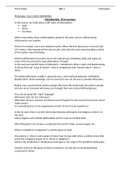
Philosophy, Part 2, INGE VERHOEVEN.
Introduction, First Lecture.
In this course, we’ll talk about 3 diff. types of philosophies:
India
China
The West
What’s interesting, those 3 philosophies started in the same century without being
influenced by one another.
China, for example, was a very isolated country. When the first missionary’s arrived in the
16th century, they translated their text to Latin. Only then the west started getting a notion
of the eastern way of thinking.
Western philosophers focused a lot on the rational way of thinking. Ratio and Logics are
some of the key words the main philosophers thought.
In the west you had diff. types of philosophy : Metaphysics, Ethics, Logics and Epistemology.
In China, they had “ways of heaven” close to metaphysics and “human nature” close to
ethics.
The Indian philosophy, buddha’s approach was a more spiritual approach. Meditation.
Buddha didn’t deny knowledge, but he assumed it was not the key to salvation/liberation.
Kipling, was convinced that eastern people will never fully understand the western people
and vice versa. Everyone will always see through their own cultural defined glasses.
Thus, do we speak the “right” language?
What does God, Sin, the self-mean?
What does Nirvana, Samsara and Karma mean? People from the west do they know what it
really means?
Is it something that can be explained by words? Or has it to be experience?
In the far east, there is no strict distinction between philosophy and religion as there is in
the west.
Many religions were initially philosophies and it is easy to combine both.
Why Philosophy? Can it help us understand the world? Make us more happy? Etc.
What is considered as happiness? a certain peace of mind.
One enemy is : Stress is not a peace of mind, how to cope with stress, scientists prove that
stress has a negative impact on us. Stress vs Happiness?
What is this mindfulness? Mindfulness itself goes to the origin of the Buddhism philosophy.
Another enemy to this peace of mind is loneliness, it is the fact of not being/feeling
connected to others.
, Pierre Palms BBA 1 Philosophy
A man who feels a huge connection to all other men is Dalai Lama, he’s received a lot of
awards, Nobel prices and so on. He has authored more than 110 books. He looks very
peaceful and happy. The most famous Buddhist monk.
The same for Confucius and Socrates. They both had a huge influence, what do they have in
common? Did they have they same approach? We’ll talk about that in the following courses.
This course we’ll be based on “Karl Jaspers: Socrates Buddha Confucius Jesus.”
Confucianism, Second Lecture.
Mother or Girlfriend? Who would you save from a burning building?
A difficult question to answer for some. This question is asked by Chinese National
Traditional Examination, asked to future lawyers. Those who passed could exercise the job.
The Minister of Justice posted the answer “Mother”. It would be considered as crime of
non-action to choose romantic love in place of filial duty.
What is Filial Piety?
Is a Confucian virtue. It’s the loving of one’s family, friend, neighbor, mankind.
Confucius believed that people lived their lives within the parameters established by
heaven, but men are responsible for their actions, especially for their treatment of others.
Men is in the 1st place a social being, men must educate and cultivate themselves, so that
they be able to serve the state as moral leaders.
Confucianism was propagated by Confucius in the 5th/6th century before Christ.
It had an impact on Japan, Korea, Vietnam. It transformed during the years but it’s ideas are
still the main values and the social codes of those countries.
Confucius lived during the Zhou Dynasty.
During that dynasty, feudal states were created within the empire to maintain order. Well
structured. It lasted for 200 years. It is known as the Golden Period.
After 200 years, that period collapsed and in the 8th century before Christ, China was divided
into small states competing for power. This period is called the Warring State Period.
This period is also known as the 100 schools of thought, due to the fact that there was a
political and social turmoil. People started to ask themselves questions and philosophical
schools were created.
These schools had an impact on Chinese Civilization and political life : Confucianism,
Mohism, Daoism, Legalism and the school of Yin and Yang.
Confucius was born in 551 B.C., he influenced Leibniz, Voltaire and Montesquieu. Confucius’
life was written down, that’s why we know so much about him. We found info about him in
the Chinese Historical Records.
Philosophy, Part 2, INGE VERHOEVEN.
Introduction, First Lecture.
In this course, we’ll talk about 3 diff. types of philosophies:
India
China
The West
What’s interesting, those 3 philosophies started in the same century without being
influenced by one another.
China, for example, was a very isolated country. When the first missionary’s arrived in the
16th century, they translated their text to Latin. Only then the west started getting a notion
of the eastern way of thinking.
Western philosophers focused a lot on the rational way of thinking. Ratio and Logics are
some of the key words the main philosophers thought.
In the west you had diff. types of philosophy : Metaphysics, Ethics, Logics and Epistemology.
In China, they had “ways of heaven” close to metaphysics and “human nature” close to
ethics.
The Indian philosophy, buddha’s approach was a more spiritual approach. Meditation.
Buddha didn’t deny knowledge, but he assumed it was not the key to salvation/liberation.
Kipling, was convinced that eastern people will never fully understand the western people
and vice versa. Everyone will always see through their own cultural defined glasses.
Thus, do we speak the “right” language?
What does God, Sin, the self-mean?
What does Nirvana, Samsara and Karma mean? People from the west do they know what it
really means?
Is it something that can be explained by words? Or has it to be experience?
In the far east, there is no strict distinction between philosophy and religion as there is in
the west.
Many religions were initially philosophies and it is easy to combine both.
Why Philosophy? Can it help us understand the world? Make us more happy? Etc.
What is considered as happiness? a certain peace of mind.
One enemy is : Stress is not a peace of mind, how to cope with stress, scientists prove that
stress has a negative impact on us. Stress vs Happiness?
What is this mindfulness? Mindfulness itself goes to the origin of the Buddhism philosophy.
Another enemy to this peace of mind is loneliness, it is the fact of not being/feeling
connected to others.
, Pierre Palms BBA 1 Philosophy
A man who feels a huge connection to all other men is Dalai Lama, he’s received a lot of
awards, Nobel prices and so on. He has authored more than 110 books. He looks very
peaceful and happy. The most famous Buddhist monk.
The same for Confucius and Socrates. They both had a huge influence, what do they have in
common? Did they have they same approach? We’ll talk about that in the following courses.
This course we’ll be based on “Karl Jaspers: Socrates Buddha Confucius Jesus.”
Confucianism, Second Lecture.
Mother or Girlfriend? Who would you save from a burning building?
A difficult question to answer for some. This question is asked by Chinese National
Traditional Examination, asked to future lawyers. Those who passed could exercise the job.
The Minister of Justice posted the answer “Mother”. It would be considered as crime of
non-action to choose romantic love in place of filial duty.
What is Filial Piety?
Is a Confucian virtue. It’s the loving of one’s family, friend, neighbor, mankind.
Confucius believed that people lived their lives within the parameters established by
heaven, but men are responsible for their actions, especially for their treatment of others.
Men is in the 1st place a social being, men must educate and cultivate themselves, so that
they be able to serve the state as moral leaders.
Confucianism was propagated by Confucius in the 5th/6th century before Christ.
It had an impact on Japan, Korea, Vietnam. It transformed during the years but it’s ideas are
still the main values and the social codes of those countries.
Confucius lived during the Zhou Dynasty.
During that dynasty, feudal states were created within the empire to maintain order. Well
structured. It lasted for 200 years. It is known as the Golden Period.
After 200 years, that period collapsed and in the 8th century before Christ, China was divided
into small states competing for power. This period is called the Warring State Period.
This period is also known as the 100 schools of thought, due to the fact that there was a
political and social turmoil. People started to ask themselves questions and philosophical
schools were created.
These schools had an impact on Chinese Civilization and political life : Confucianism,
Mohism, Daoism, Legalism and the school of Yin and Yang.
Confucius was born in 551 B.C., he influenced Leibniz, Voltaire and Montesquieu. Confucius’
life was written down, that’s why we know so much about him. We found info about him in
the Chinese Historical Records.