Block 1.8. Educational Psychology
Problem 6. PBL
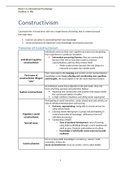
Constructivism
Constructivism: A broad term, with not a single theory of learning, that is centered around
two main ideas
1. Learners are active in constructing their own knowledge
2. Social interactions are important in this knowledge construction processes
Timeline of Constructivism
Individuals construct their own cognitive structures by interpreting
their experiences in particular situations.
Information processing theories: they are constructivist
Individual/Cognitive because they rely on how they construct internal
constructivism representations and how they retrieve them
o Weak constructivism because the only thing is to
represent accurately the outside world
More interested in the meaning and not the correct representations.
First wave of Knowledge comes from reflecting and coordinating own cognitions
constructivism (Piaget) and thoughts, the social aspect is not the most important feature.
“solo”
An individual cannot know objective truth and reality; they only
know what they perceive and what they believe.
Radical constructivism Replacing one construction with another that explain better
the current perception of reality.
In high relativism situations everything seems equal/good
Participating in social interaction, using cultural tools and activity can
help in individual development and learning.
Outcome: appropriating= being able to reason and act by
using cultural tools.
Learning means belonging to a group and participating in
Vygotsky’s social social construction of knowledge. (difference from first?
constructivism individual processing)
- Combination of both:
Second wave o Zone of proximal development: area of learning
using help (scaffolding) through a more experienced
adult or peer. Products and producers of culture
o Knowledge is individually constructed and socially
mediated.
Focus on how public knowledge is created e.g. science, math,
economics, history etc.
Constructionism Social constructionism: focus on society, norms values beliefs
1
, Block 1.8. Educational Psychology
Problem 6. PBL
Construction of knowledge
Knowledge is acquired by Info processing
constructing a representation of
External direction
the outside world. Accurate
reflection of how things are
Knowledge is constructed by Piaget
transforming, organizing and
Internal direction
reorganizing previous knowledge.
Exploration discovery not mirror
Knowledge is constructed based on Vygotsky
social interaction and experiences.
Reflects the outside world like it is
Both external and
influenced by the culture, language,
internal beliefs and interaction with others.
Guidance, prior knowledge, beliefs
and thinking influence that.
Situated or General knowledge
Question: Is learning internal, generalizable and transferable to other situations?
Situated learning: Learning in the real world is not like studying at school. It is an
apprenticeship where novices with a support of an expert or guide model take more
responsibility until they function independently. (More linked to Vygotskian view)
Enculturation: adopting the norms, behaviors, beliefs, attitudes, skills and language
of a particular community. Knowledge is a creation of community over time.
Community practice: an idea useful in community practice but not outside that.
Elements of constructivist student-centered teaching
Constructivists disagree on whether learning should be individual, social, situated or general.
But they agree on students should make sense of the experiments, make mental models
better and have same learning goals, knowledge in use not in storage.
Five conditions of learning
Complex tasks, with many parts, not just
difficult.
Not simplified but ill-structured
problems
Complex environments and authentic
Many interacting elements and possible
tasks
solutions
Maybe they need scaffolding as they
work
Consistent with situated learning
Social negotiation, interaction collaboration is
valued. Students must talk and listen to each
Social negotiation, shared other’s interpretations.
responsibility Intersubjective attitude: built meaning,
find common ground, exchanging
interpretations.
2
Problem 6. PBL
Constructivism
Constructivism: A broad term, with not a single theory of learning, that is centered around
two main ideas
1. Learners are active in constructing their own knowledge
2. Social interactions are important in this knowledge construction processes
Timeline of Constructivism
Individuals construct their own cognitive structures by interpreting
their experiences in particular situations.
Information processing theories: they are constructivist
Individual/Cognitive because they rely on how they construct internal
constructivism representations and how they retrieve them
o Weak constructivism because the only thing is to
represent accurately the outside world
More interested in the meaning and not the correct representations.
First wave of Knowledge comes from reflecting and coordinating own cognitions
constructivism (Piaget) and thoughts, the social aspect is not the most important feature.
“solo”
An individual cannot know objective truth and reality; they only
know what they perceive and what they believe.
Radical constructivism Replacing one construction with another that explain better
the current perception of reality.
In high relativism situations everything seems equal/good
Participating in social interaction, using cultural tools and activity can
help in individual development and learning.
Outcome: appropriating= being able to reason and act by
using cultural tools.
Learning means belonging to a group and participating in
Vygotsky’s social social construction of knowledge. (difference from first?
constructivism individual processing)
- Combination of both:
Second wave o Zone of proximal development: area of learning
using help (scaffolding) through a more experienced
adult or peer. Products and producers of culture
o Knowledge is individually constructed and socially
mediated.
Focus on how public knowledge is created e.g. science, math,
economics, history etc.
Constructionism Social constructionism: focus on society, norms values beliefs
1
, Block 1.8. Educational Psychology
Problem 6. PBL
Construction of knowledge
Knowledge is acquired by Info processing
constructing a representation of
External direction
the outside world. Accurate
reflection of how things are
Knowledge is constructed by Piaget
transforming, organizing and
Internal direction
reorganizing previous knowledge.
Exploration discovery not mirror
Knowledge is constructed based on Vygotsky
social interaction and experiences.
Reflects the outside world like it is
Both external and
influenced by the culture, language,
internal beliefs and interaction with others.
Guidance, prior knowledge, beliefs
and thinking influence that.
Situated or General knowledge
Question: Is learning internal, generalizable and transferable to other situations?
Situated learning: Learning in the real world is not like studying at school. It is an
apprenticeship where novices with a support of an expert or guide model take more
responsibility until they function independently. (More linked to Vygotskian view)
Enculturation: adopting the norms, behaviors, beliefs, attitudes, skills and language
of a particular community. Knowledge is a creation of community over time.
Community practice: an idea useful in community practice but not outside that.
Elements of constructivist student-centered teaching
Constructivists disagree on whether learning should be individual, social, situated or general.
But they agree on students should make sense of the experiments, make mental models
better and have same learning goals, knowledge in use not in storage.
Five conditions of learning
Complex tasks, with many parts, not just
difficult.
Not simplified but ill-structured
problems
Complex environments and authentic
Many interacting elements and possible
tasks
solutions
Maybe they need scaffolding as they
work
Consistent with situated learning
Social negotiation, interaction collaboration is
valued. Students must talk and listen to each
Social negotiation, shared other’s interpretations.
responsibility Intersubjective attitude: built meaning,
find common ground, exchanging
interpretations.
2