Block 1.8 Educational Psychology
Problem 8. Transfer
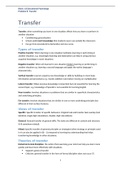
Transfer
Transfer: when something you learn in one situation affects how you learn or perform in
another situation
Conditioning-generalization
School yields inert knowledge that students never use outside the classroom
Can go from procedural to declarative and vice versa.
Types of transfer
Positive transfer: When learning in one situation facilitates learning or performing in
another situation, e.g. meaningful learning and elaboration can help in using previous
acquired knowledge in novel situations
Negative transfer: When sth learned in one situation hinders learning or performing in
another situation e.g. learning a second language and apply the native language’s
characteristics.
Vertical transfer: Learner acquires new knowledge or skills by building on more basic
information and procedures e.g. master addition rules before moving on multiplication
Lateral transfer: When previous knowledge is important but not essential for learning the
second topic, e.g. knowledge of Spanish is not essential for learning English
Near transfer: Involves situations or problems that are similar in superficial characteristics
and underlying principles.
Far transfer: Involves situations that are similar in one or more underlying principles but
different in their surface features.
Views of transfer
Specific: Specific transfer of specific behaviors. Original task and transfer task overlap (A-B
identical, single digit calculations, double- digit calculations)
General: General transfer of general skills. The tasks are different in content and structure
(A-B somehow related).
Mixed: Specific transfer of general principles or strategies (when strategy or principle used
in A can also be applied in B) – Correspond to learning by understanding that helps
transferring knowledge in other situations.
Theories of transfer
Historical-Formal discipline: the notion that exercising your mind can help you learn more
quickly and deal more effectively with situations.
Supports general transfer
Criticism: general transfer in the form of formal discipline does not occur (?)
1
Problem 8. Transfer
Transfer
Transfer: when something you learn in one situation affects how you learn or perform in
another situation
Conditioning-generalization
School yields inert knowledge that students never use outside the classroom
Can go from procedural to declarative and vice versa.
Types of transfer
Positive transfer: When learning in one situation facilitates learning or performing in
another situation, e.g. meaningful learning and elaboration can help in using previous
acquired knowledge in novel situations
Negative transfer: When sth learned in one situation hinders learning or performing in
another situation e.g. learning a second language and apply the native language’s
characteristics.
Vertical transfer: Learner acquires new knowledge or skills by building on more basic
information and procedures e.g. master addition rules before moving on multiplication
Lateral transfer: When previous knowledge is important but not essential for learning the
second topic, e.g. knowledge of Spanish is not essential for learning English
Near transfer: Involves situations or problems that are similar in superficial characteristics
and underlying principles.
Far transfer: Involves situations that are similar in one or more underlying principles but
different in their surface features.
Views of transfer
Specific: Specific transfer of specific behaviors. Original task and transfer task overlap (A-B
identical, single digit calculations, double- digit calculations)
General: General transfer of general skills. The tasks are different in content and structure
(A-B somehow related).
Mixed: Specific transfer of general principles or strategies (when strategy or principle used
in A can also be applied in B) – Correspond to learning by understanding that helps
transferring knowledge in other situations.
Theories of transfer
Historical-Formal discipline: the notion that exercising your mind can help you learn more
quickly and deal more effectively with situations.
Supports general transfer
Criticism: general transfer in the form of formal discipline does not occur (?)
1