Q1.
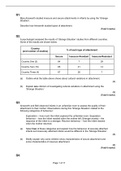
Mary Ainsworth studied insecure and secure attachments in infants by using the ‘Strange
Situation’.
Describe how Ainsworth studied types of attachment.
(Total 5 marks)
Q2.
A psychologist analysed the results of ‘Strange Situation’ studies from different countries.
Some of the results are shown below.
Country
% of each type of attachment
(and number of studies)
Secure Insecure-Avoidant Insecure-Resistant
Country One (2) 64 7 29
Country Two (18) 65 21 14
Country Three (4) 67 26 7
(a) Outline what the table above shows about cultural variations in attachment.
(3)
(b) Explain one criticism of investigating cultural variations in attachment using the
‘Strange Situation.’
(3)
(Total 6 marks)
Q3.
Ainsworth and Bell observed infants in an unfamiliar room to assess the quality of their
attachment to their mother. Observations during this ‘Strange Situation’ related to the
following categories of behaviour:
Exploration – how much the infant explored the unfamiliar room; Separation
behaviour – how the infant reacted when the mother left; Stranger anxiety – the
response of the infant to a stranger; Reunion behaviour – how the infant reacted
when the mother returned.
(a) Select two of these categories and explain how the behaviour of securely attached
infants and insecurely attached infants would be different in the ‘Strange Situation’.
(4)
(b) Briefly explain why some children show characteristics of secure attachment and
some characteristics of insecure attachment.
(2)
(Total 6 marks)
Q4.
Page 1 of 11
, One situation in which disruption of attachment can occur is when a mother of a young
child is admitted into hospital. A researcher decided to study the behaviour of a two year
old boy who experienced this disruption of attachment.
She decided to use naturalistic observation of the boy both before his mother was
admitted into hospital and after she returned home. Each period of observation lasted for
one hour.
(a) Suggest two suitable behavioural categories the researcher could use to record the
boy’s behaviour.
(2)
(b) How might the researcher record the boy’s behaviour during the one-hour
observation?
(2)
(c) Explain why the psychologist might want to carry out a pilot study before the main
observation.
(2)
(Total 6 marks)
Q5.
How does the behaviour of securely attached infants differ from that of insecurely
attached infants?
(Total 4 marks)
Q6.
Research has suggested that institutionalisation can have negative effects on children. In
the 1990s, many children were found living in poor quality orphanages in Romania. Luca
had lived in one of these orphanages from birth. When he was four years old, he was
adopted and he left the orphanage to live in Canada. His development was then studied
for a number of years.
(a) Outline possible negative effects of institutionalisation on Luca.
(4)
(b) The scenario above is an example of a case study. Outline one strength and one
limitation of this research method.
(4)
(Total 8 marks)
Q7.
By observing interactions between the infants and their mothers in a Strange Situation,
Mary Ainsworth was able to identify different types of attachment.
Describe possible demand characteristics in this research.
(Total 3 marks)
Q8.
Tick two of the boxes below to indicate which of the following statements relate to
Bowlby’s evolutionary theory of attachment.
Page 2 of 11
Mary Ainsworth studied insecure and secure attachments in infants by using the ‘Strange
Situation’.
Describe how Ainsworth studied types of attachment.
(Total 5 marks)
Q2.
A psychologist analysed the results of ‘Strange Situation’ studies from different countries.
Some of the results are shown below.
Country
% of each type of attachment
(and number of studies)
Secure Insecure-Avoidant Insecure-Resistant
Country One (2) 64 7 29
Country Two (18) 65 21 14
Country Three (4) 67 26 7
(a) Outline what the table above shows about cultural variations in attachment.
(3)
(b) Explain one criticism of investigating cultural variations in attachment using the
‘Strange Situation.’
(3)
(Total 6 marks)
Q3.
Ainsworth and Bell observed infants in an unfamiliar room to assess the quality of their
attachment to their mother. Observations during this ‘Strange Situation’ related to the
following categories of behaviour:
Exploration – how much the infant explored the unfamiliar room; Separation
behaviour – how the infant reacted when the mother left; Stranger anxiety – the
response of the infant to a stranger; Reunion behaviour – how the infant reacted
when the mother returned.
(a) Select two of these categories and explain how the behaviour of securely attached
infants and insecurely attached infants would be different in the ‘Strange Situation’.
(4)
(b) Briefly explain why some children show characteristics of secure attachment and
some characteristics of insecure attachment.
(2)
(Total 6 marks)
Q4.
Page 1 of 11
, One situation in which disruption of attachment can occur is when a mother of a young
child is admitted into hospital. A researcher decided to study the behaviour of a two year
old boy who experienced this disruption of attachment.
She decided to use naturalistic observation of the boy both before his mother was
admitted into hospital and after she returned home. Each period of observation lasted for
one hour.
(a) Suggest two suitable behavioural categories the researcher could use to record the
boy’s behaviour.
(2)
(b) How might the researcher record the boy’s behaviour during the one-hour
observation?
(2)
(c) Explain why the psychologist might want to carry out a pilot study before the main
observation.
(2)
(Total 6 marks)
Q5.
How does the behaviour of securely attached infants differ from that of insecurely
attached infants?
(Total 4 marks)
Q6.
Research has suggested that institutionalisation can have negative effects on children. In
the 1990s, many children were found living in poor quality orphanages in Romania. Luca
had lived in one of these orphanages from birth. When he was four years old, he was
adopted and he left the orphanage to live in Canada. His development was then studied
for a number of years.
(a) Outline possible negative effects of institutionalisation on Luca.
(4)
(b) The scenario above is an example of a case study. Outline one strength and one
limitation of this research method.
(4)
(Total 8 marks)
Q7.
By observing interactions between the infants and their mothers in a Strange Situation,
Mary Ainsworth was able to identify different types of attachment.
Describe possible demand characteristics in this research.
(Total 3 marks)
Q8.
Tick two of the boxes below to indicate which of the following statements relate to
Bowlby’s evolutionary theory of attachment.
Page 2 of 11