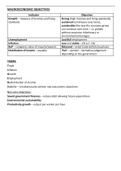
MACROECONOMIC OBJECTIVES
Indicator Objective
Growth – measure of incomes and living Strong (high incomes and living standards),
standards sustained (continuous over time),
sustainable (the way the economy grows
can continue over time – i.e. growth
without excessive inflationary or
environmental damage)
Unemployment Low/full employment
Inflation Low and stable – 2% (+/- 1%)
BoP – compares value of imports/exports Balanced – avoid trade deficits/surpluses
Distribution of income – equality ‘Fair’ – opinion - normative judgement
depending on the government
TIGERS:
Trade
Inflation
Growth
Employment
Redistribution of income
Stability – simultaneously achieve macroeconomic objectives
Non-core objectives:
Sound government finances – reduce debt allowing future expenditure
Environmental sustainability
Productivity growth – output per worker per hour
,CIRCULAR FLOW OF INCOME
Circular flow of income = movement of spending and income in an economy
Households provide factors of production to firms: land, labour, capital, enterprise
Firms combine factors of production and produce goods & services
Firms provide households factor incomes – each factor of production rewards households
e.g. land – rent; labour – wages/salaries; capital – interest; enterprise – profit
Households spend incomes on goods & services
Limitations:
Ignores government and international sectors of an economy
Assumes all factor incomes are spent on goods & services – ignores leakages: savings (I),
taxation (S), import spending (M)
Assumes only expenditure in an economy is by households – ignores injections: investment
(I) – when firms spend on capital goods, government spending (G), export spending (X)
Circular flow of income reveals whether an economy is growing:
Injections > leakages - economic growth increases
Injections < leakages - economic growth decreases
Injections = leakages – macroeconomic equilibrium
You can calculate GDP (measures economic growth) using the circular flow of income:
GDP = total output/income/expenditure of an economy in a year
Output method – add total annual value of goods & services
Income method - add total annual factor incomes (wages, salaries, profit, rent)
Expenditure method – add total annual expenditure (C+I+G+X-M)
, AGGREGATE DEMAND – total demand for goods & services in an economy
Increase in AD = increase in actual growth
Measure of spending in an economy: AD = C + I + G + X – M
Increase in AD causes increase in actual growth
& reduction in unemployment from Y1 to Y2
and an increase in the price level from P1 to P2
Movement along the AD curve: caused by changes in the price level
Downward sloping: inverse relationship between the price level and AD/Real GDP
1.) Wealth effect (C): when price level falls purchasing power of income increases –
increased consumption – increases AD
2.) Trade effect (X-M): when price level falls exports become more competitive, and
imports become less competitive – increased demand for exports (X) and demand for
imports decreases (M) – increases AD
3.) Interest effect (C, I, X-M): when price level falls interest rates can be kept lower in an
economy as central banks will adopt monetary policy to meet an inflation target – lower
interest rates stimulate higher consumption and investment, and depreciates the
exchange rate – increases AD
Indicator Objective
Growth – measure of incomes and living Strong (high incomes and living standards),
standards sustained (continuous over time),
sustainable (the way the economy grows
can continue over time – i.e. growth
without excessive inflationary or
environmental damage)
Unemployment Low/full employment
Inflation Low and stable – 2% (+/- 1%)
BoP – compares value of imports/exports Balanced – avoid trade deficits/surpluses
Distribution of income – equality ‘Fair’ – opinion - normative judgement
depending on the government
TIGERS:
Trade
Inflation
Growth
Employment
Redistribution of income
Stability – simultaneously achieve macroeconomic objectives
Non-core objectives:
Sound government finances – reduce debt allowing future expenditure
Environmental sustainability
Productivity growth – output per worker per hour
,CIRCULAR FLOW OF INCOME
Circular flow of income = movement of spending and income in an economy
Households provide factors of production to firms: land, labour, capital, enterprise
Firms combine factors of production and produce goods & services
Firms provide households factor incomes – each factor of production rewards households
e.g. land – rent; labour – wages/salaries; capital – interest; enterprise – profit
Households spend incomes on goods & services
Limitations:
Ignores government and international sectors of an economy
Assumes all factor incomes are spent on goods & services – ignores leakages: savings (I),
taxation (S), import spending (M)
Assumes only expenditure in an economy is by households – ignores injections: investment
(I) – when firms spend on capital goods, government spending (G), export spending (X)
Circular flow of income reveals whether an economy is growing:
Injections > leakages - economic growth increases
Injections < leakages - economic growth decreases
Injections = leakages – macroeconomic equilibrium
You can calculate GDP (measures economic growth) using the circular flow of income:
GDP = total output/income/expenditure of an economy in a year
Output method – add total annual value of goods & services
Income method - add total annual factor incomes (wages, salaries, profit, rent)
Expenditure method – add total annual expenditure (C+I+G+X-M)
, AGGREGATE DEMAND – total demand for goods & services in an economy
Increase in AD = increase in actual growth
Measure of spending in an economy: AD = C + I + G + X – M
Increase in AD causes increase in actual growth
& reduction in unemployment from Y1 to Y2
and an increase in the price level from P1 to P2
Movement along the AD curve: caused by changes in the price level
Downward sloping: inverse relationship between the price level and AD/Real GDP
1.) Wealth effect (C): when price level falls purchasing power of income increases –
increased consumption – increases AD
2.) Trade effect (X-M): when price level falls exports become more competitive, and
imports become less competitive – increased demand for exports (X) and demand for
imports decreases (M) – increases AD
3.) Interest effect (C, I, X-M): when price level falls interest rates can be kept lower in an
economy as central banks will adopt monetary policy to meet an inflation target – lower
interest rates stimulate higher consumption and investment, and depreciates the
exchange rate – increases AD