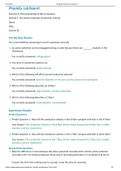
26-5-2021 PhysioEx Exercise 2 Activity 3
PhysioEx Lab Report
Exercise 2: Skeletal Muscle Physiology
Activity 3: The Effect of Stimulus Frequency on Skeletal Muscle Contraction
Name:
Date:
Session ID:
Pre-lab Quiz Results
You scored 100% by answering 4 out of 4 questions correctly.
1 During a single twitch of a skeletal muscle
You correctly answered: maximal force is never achieved.
2 When a skeletal muscle is repetitively stimulated, twitches can overlap each other and result in a
stronger muscle contraction than a stand-alone twitch. This phenomenon is known as
You correctly answered: wave summation.
3 Wave summation is achieved by
You correctly answered: increasing the stimulus frequency (the rate of stimulus delivery to the
muscle).
4 Wave summation increases the force produced in the muscle. Another way to increase the force
produced by a muscle is to
You correctly answered: increase the number of activated motor units.
Experiment Results
Predict Questions
1 Predict Question 1: As the stimulus frequency increases, what will happen to the muscle force
generated with each successive stimulus? Will there be a limit to this response?
Your answer: As the stimulus frequency increases, the muscle force generated by each successive
stimulus will increase. There will be a limit to this increase.
2 Predict Question 2: In order to produce sustained muscle contractions with an active force value of
5.2, do you think you will need to increase the stimulus voltage?
Your answer: Yes.
Stop & Think Questions
1 Was there any change in the force generated by the muscle during the second stimulated twitch?
You correctly answered: Yes, the second twitch generated more muscle force.
https://media.pearsoncmg.com/bc/bc_0media_ap/physioex/10/ex2/act3/ 1/6
, 26-5-2021 PhysioEx Exercise 2 Activity 3
2 Is the total muscle force generated by the higher frequency stimulation greater than the force
generated in previous stimulations?
You correctly answered: Yes, it is greater than the previous stimulations.
3 Does the force generated by the muscle change with each additional stimulus?
You correctly answered: As the stimulus frequency increased, the muscle tension generated by each
successive stimulus also increased, and a limiting maximum value was observed.
Experiment Data
Voltage (v) Length (mm) Stimulus Active Force Passive Force Total Force
8.5 75 Single 1.83 0.0 1.83
8.5 75 Multiple 2.87 0.0 2.87
8.5 75 Multiple 2.93 0.0 2.93
8.5 75 Multiple 4.87 0.0 4.87
10 75 Multiple 4.79 0.0 4.79
8.5 75 Multiple 5.77 0.0 5.77
Voltage = 8.5 V
Multiple Stimulus
Active Force = 2.87
https://media.pearsoncmg.com/bc/bc_0media_ap/physioex/10/ex2/act3/ 2/6
PhysioEx Lab Report
Exercise 2: Skeletal Muscle Physiology
Activity 3: The Effect of Stimulus Frequency on Skeletal Muscle Contraction
Name:
Date:
Session ID:
Pre-lab Quiz Results
You scored 100% by answering 4 out of 4 questions correctly.
1 During a single twitch of a skeletal muscle
You correctly answered: maximal force is never achieved.
2 When a skeletal muscle is repetitively stimulated, twitches can overlap each other and result in a
stronger muscle contraction than a stand-alone twitch. This phenomenon is known as
You correctly answered: wave summation.
3 Wave summation is achieved by
You correctly answered: increasing the stimulus frequency (the rate of stimulus delivery to the
muscle).
4 Wave summation increases the force produced in the muscle. Another way to increase the force
produced by a muscle is to
You correctly answered: increase the number of activated motor units.
Experiment Results
Predict Questions
1 Predict Question 1: As the stimulus frequency increases, what will happen to the muscle force
generated with each successive stimulus? Will there be a limit to this response?
Your answer: As the stimulus frequency increases, the muscle force generated by each successive
stimulus will increase. There will be a limit to this increase.
2 Predict Question 2: In order to produce sustained muscle contractions with an active force value of
5.2, do you think you will need to increase the stimulus voltage?
Your answer: Yes.
Stop & Think Questions
1 Was there any change in the force generated by the muscle during the second stimulated twitch?
You correctly answered: Yes, the second twitch generated more muscle force.
https://media.pearsoncmg.com/bc/bc_0media_ap/physioex/10/ex2/act3/ 1/6
, 26-5-2021 PhysioEx Exercise 2 Activity 3
2 Is the total muscle force generated by the higher frequency stimulation greater than the force
generated in previous stimulations?
You correctly answered: Yes, it is greater than the previous stimulations.
3 Does the force generated by the muscle change with each additional stimulus?
You correctly answered: As the stimulus frequency increased, the muscle tension generated by each
successive stimulus also increased, and a limiting maximum value was observed.
Experiment Data
Voltage (v) Length (mm) Stimulus Active Force Passive Force Total Force
8.5 75 Single 1.83 0.0 1.83
8.5 75 Multiple 2.87 0.0 2.87
8.5 75 Multiple 2.93 0.0 2.93
8.5 75 Multiple 4.87 0.0 4.87
10 75 Multiple 4.79 0.0 4.79
8.5 75 Multiple 5.77 0.0 5.77
Voltage = 8.5 V
Multiple Stimulus
Active Force = 2.87
https://media.pearsoncmg.com/bc/bc_0media_ap/physioex/10/ex2/act3/ 2/6